
Why Reading Zeta as a Generic Martech Play Is the Wrong Frame
Surface-level analysis of Zeta Global produces a familiar-looking picture: a mid-cap martech company riding the AI narrative, GAAP net losses on the income statement, elevated stock-based compensation, and the lingering shadow of a short-seller report. This reading is both incomplete and misleading.
A more careful look tells a different story. From 2021 to 2025, Zeta grew revenue at a 29.9% compound annual rate, expanding from $458 million to $1.305 billion. Over that same period, free cash flow margin expanded from 7.6% to 14.2%, the company delivered eighteen consecutive quarters of guidance beats and upward revisions, and net revenue retention hit a record 120% in 2025. The capex-to-revenue ratio fell to just 1.1%, and GAAP net income turned positive for the first time in Q4 2025.
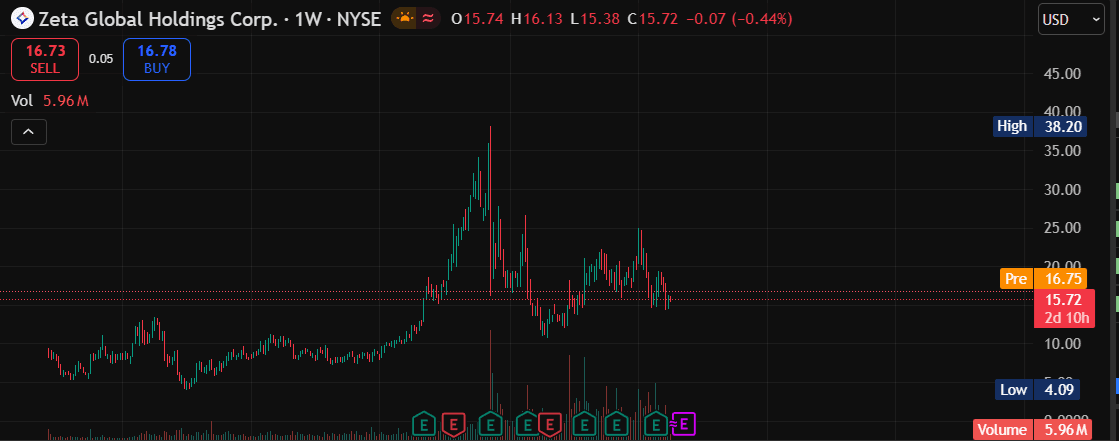
And yet the stock trades around $15.72, while six of eight covering analysts maintain buy ratings and the consensus price target sits at $29.25. That gap — between what the operating metrics say and what the market is willing to pay — is the central question of this essay: Can Zeta Global, with its data moat and AI execution layer, become a structural winner in AI-driven marketing, or is this a more fragile martech story that the market is rationally discounting?
What Zeta Actually Is
Understanding why Zeta is consistently misread requires understanding the company's two-layer architecture — because neither layer alone explains the business, and most analyses stop at one or the other.
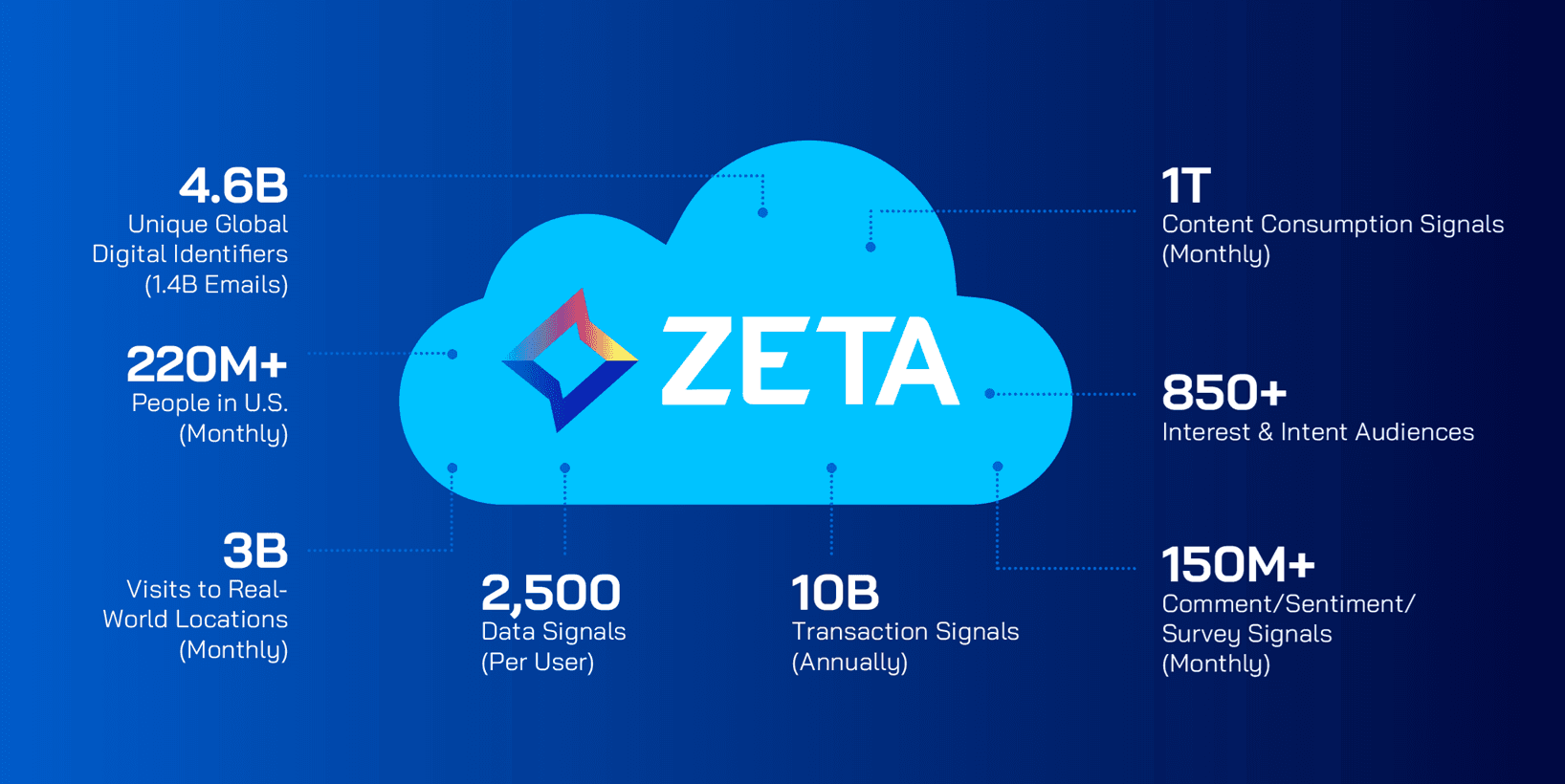
The Data Layer. Zeta's foundation is a proprietary identity graph covering more than 245 million U.S. consumer profiles. Each profile carries over 2,500 individual attributes, and the system processes more than 1 trillion data signals per month. Critically, this data infrastructure is predominantly first-party and permissioned — meaning it does not depend on third-party cookies for identity resolution. In an environment where Google has been phasing out third-party cookies and regulatory pressure has forced structural changes across the advertising ecosystem, this cookieless identity architecture is not just a marketing differentiator — it is a structural competitive advantage that compounds as the broader industry weakens.
The Platform Layer. Built on top of this data, the Zeta Marketing Platform (ZMP) delivers identity resolution, AI-driven audience segmentation, omnichannel activation (email, social, connected TV, programmatic display, SMS), and closed-loop measurement — all within a single architecture. This is the critical distinction from incumbents: Adobe and Salesforce assembled their marketing suites through dozens of separate acquisitions, each with its own data model and integration layer. Zeta built this stack from scratch, on a unified foundation. The integration quality difference matters enormously in practice, particularly when enterprise clients need data to flow seamlessly between audience intelligence and campaign activation.
The revenue model is hybrid, and this distinction carries real analytical weight. Direct platform revenue represents high-margin income from enterprise clients using ZMP directly. By Q2 2025, this segment represented 75% of total revenue and was growing at 51% year-over-year. Integrated/agency revenue captures lower-margin media buying and agency channel services. Management's explicit strategic priority is to grow the direct mix, because that shift simultaneously improves gross margins and increases customer stickiness. The Marigold acquisition added a third dimension: subscription revenue. When Zeta closed the $325 million Marigold deal in November 2024, more than 90% of Marigold's business was subscription-based, meaningfully shifting Zeta's recurring revenue profile. Marigold's portfolio includes Cheetah Digital, Sailthru, Selligent, Liveclicker, and Grow — all with Fortune 500 client relationships.
On the customer base: Zeta is entirely enterprise-focused. "Scaled Customers" (spending $100K+ annually) reached 602 by end of 2025. "Super-Scaled Customers" (spending $1M+ annually) grew 24% year-over-year to 184. Scaled ARPU reached $1.87 million in 2024, up 19% year-over-year. These are not SMB metrics retrofitted with enterprise language — these reflect a genuine enterprise sales motion with deep account penetration.
Where AI Is Actually Creating Value
The "AI company" label has been so thoroughly diluted by 2026 that applying it without qualification is almost meaningless. What makes Zeta's AI layer worth taking seriously is the structural foundation beneath it, not the label itself.
Zeta's AI infrastructure operates across four core functions. Predictive scoring processes more than 1 trillion monthly signals to forecast consumer purchase intent and behavioral trajectories. Identity resolution uses deterministic identity matching to link individuals across channels and devices without relying on third-party cookies — the core capability that makes Zeta's data advantage actionable in a cookieless environment. Closed-loop measurement feeds every campaign interaction back into the models, creating a continuous optimization loop that most competitors either partially implement or skip entirely. Omnichannel activation translates all of this intelligence into real-time, cross-channel decisions at enterprise scale.
Athena, launched for general availability in March 2026, layers a conversational AI agent interface on top of all of this. Its two primary applications are Insights (instant trend access through conversational analytics) and Advisor (goal-driven automated optimization). The practical result: campaign setup time has fallen from days to minutes, and campaign execution cycles have compressed from weeks to hours. A Forrester study found that organizations using the Zeta platform achieved 50% reduction in campaign setup time. Reported ROAS for current customers reaches 6x, with management targeting 10x as Marigold integration matures.
The "AI = new UI" critique — that AI is merely a fresh interface on existing capabilities — is partly valid and partly misleading when applied to Zeta. Athena genuinely is, in part, a more accessible interface to platform capabilities that already existed. But that framing misses the deeper structural point: the differentiation does not originate in the LLM layer. It originates in the data. 245 million first-party profiles with 2,500+ attributes per individual feed the models with context that generic AI marketing tools simply cannot replicate. Without that data, Athena would be an unremarkable chatbot with marketing features. With it, the AI layer produces outputs that are structurally different in quality. The conclusion: the primary differentiator is not the LLM interface, not even the OpenAI partnership — it is the combination of data depth, execution integration, and closed-loop platform architecture.
OpenAI Partnership — Accelerant, Not Moat
The OpenAI partnership, announced at CES 2026 in January, moved ZETA shares approximately 20% higher in the days following the announcement. As the market digested the details, that enthusiasm was moderated by context — and both the initial enthusiasm and subsequent cooling deserve honest analysis.
The substance of the partnership: OpenAI models were integrated into Athena's conversational intelligence layer. Zeta gained prioritized access to OpenAI's latest model developments, and the two companies synchronized their product roadmaps. This is a genuine product accelerant. Athena's development cycle was meaningfully compressed; the quality of the conversational layer improved. These are real benefits.
But the critical question is whether this constitutes exclusive differentiation — and the answer is clearly no. OpenAI is working with many companies across the technology landscape, including reportedly exploring advertising partnerships with The Trade Desk (TTD). When that TTD-OpenAI news surfaced in March 2026, it briefly pressured ZETA shares because it undermined the perception that Zeta held something uniquely exclusive through OpenAI. That perception was always overstated.
The more durable analytical point is this: OpenAI models deployed against Zeta's 245-million-profile identity graph produce materially different outputs than the same models deployed against generic or sparse data environments. The intelligence of the AI agent is a function of what it is fed. A competing enterprise that signs an OpenAI partnership tomorrow does not thereby acquire Zeta's data asset — and the data asset is what makes the AI layer competitively meaningful. Zeta would have continued growing without the OpenAI partnership — it compounded at 23–38% annually before the partnership existed — but Athena's time-to-market would have been slower and the competitive narrative less sharp. The partnership is an accelerant, not a moat. That distinction matters significantly for valuation.
Financial Quality — Does the Business Support the Story?
The financial history of Zeta from 2021 to 2025 is one of the more compelling operating improvement stories in mid-cap enterprise software — and also one of the more persistently misread ones, largely because GAAP net income lagged the underlying business quality for years.
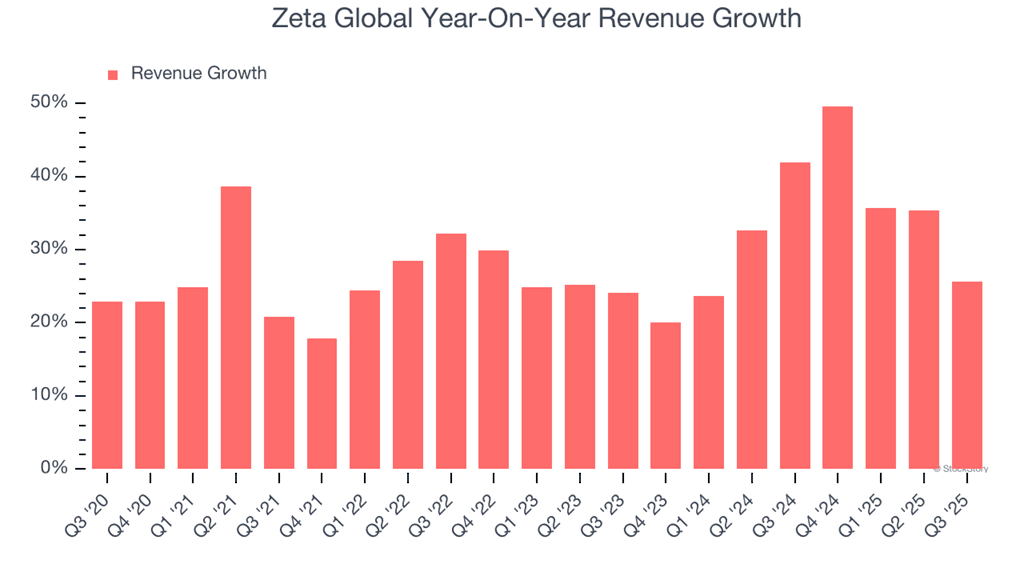
Revenue grew consistently throughout the period: $458M in 2021, $591M in 2022 (+28.9%), $729M in 2023 (+23.3%), $1.006B in 2024 (+38.0%), $1.305B in 2025 (+29.7%). The 29.9% five-year CAGR is not anomalous or single-period driven — it reflects a compounding enterprise customer base with expanding ARPU and high retention.
Gross margin held stable across the period: 61.9% in 2021, 63.5% in 2022, 62.3% in 2023, 60.3% in 2024, 60.6% in 2025. The slight dip from 2022 peaks reflects Marigold and LiveIntent contributions at lower initial margins; as direct platform mix rises, structural gross margin improvement toward 62–65% should follow.
The more compelling transformation is in operating leverage. Operating margin moved from -54.2% in 2021 to -43.8% in 2022, -23.0% in 2023, -6.8% in 2024, and +0.4% in 2025. Net margin followed the same trajectory: -54.4% in 2021, -25.7% in 2023, -6.9% in 2024, -2.4% in 2025. The direction is unambiguous; the inflection point has been crossed.
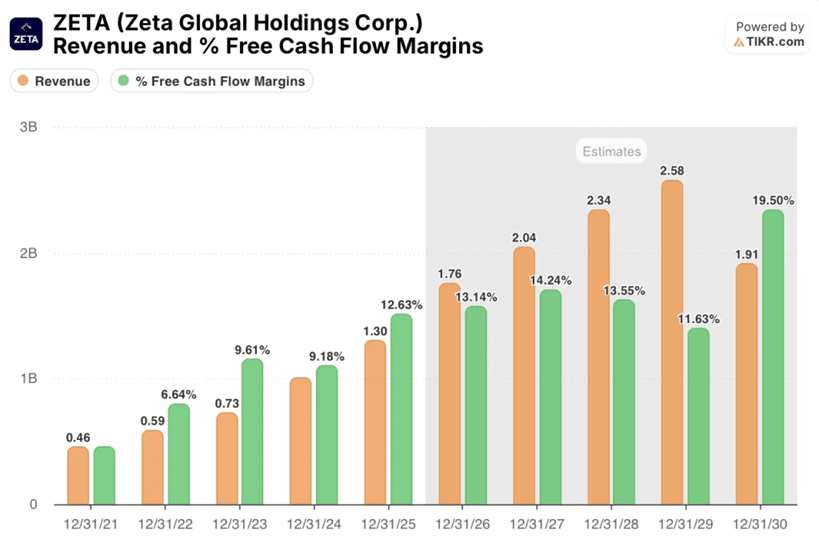
The FCF picture is where the real business quality lives, and it is worth dwelling on. FCF grew from $34.8M (7.6% margin) in 2021, to $56.3M (9.5%) in 2022, $70.0M (9.6%) in 2023, $108.1M (10.8%) in 2024, and $185.1M (14.2%) in 2025. That is 5.3x FCF growth over four years, with margin nearly doubling. FCF grew 78% in 2025 alone. The capex-to-revenue ratio fell from 3.8% in 2022 to just 1.1% in 2025, confirming that the model is genuinely asset-light and that scale generates rather than consumes cash.
The GAAP net income question is the one that trips up most investors who approach Zeta without understanding the mechanics. The 2024 GAAP net loss was approximately $70 million. But the primary driver was stock-based compensation of approximately $195 million — a non-cash accounting charge that creates no cash outflow. Strip out SBC and the underlying cash generation is clear in the FCF figures. Management executed $121 million in share buybacks in 2025 and delivered GAAP net income positive for the first time in Q4 2025 at +$6.5 million. The trajectory toward sustained GAAP profitability is real, not cosmetic.
Looking forward: FY2026 consensus estimates call for approximately $1.756 billion in revenue, ~$391 million in Adjusted EBITDA at a 22.2% margin, and ~$231 million in FCF. The "Zeta 2028" plan targets $2.1B+ in revenue, $525M+ in Adjusted EBITDA, and $350M+ in FCF. The achievability of those targets rests heavily on Marigold integration execution and the durability of organic growth as acquisition effects fade — both of which are legitimate open questions.
Is the business getting better? Clearly yes. Is the stock still distrusted for rational reasons? Also yes. The SBC normalization remains incomplete; the short-seller shadow persists; and the 2026 organic growth test — as Marigold and LiveIntent anniversary effects wash out — is the first real isolated read on platform-native momentum. Management guides for 20–21% organic growth in 2026. If that holds, the acquisition-driven growth narrative gets replaced by a platform momentum narrative. If it misses, the trust discount widens.
Competitive Landscape — Where Zeta Can Win
Positioning Zeta correctly within the martech and adtech ecosystem requires more than a feature comparison matrix. The economic architecture of each competitor determines where they are strong, where they are structurally limited, and where Zeta has a genuine angle.
Salesforce (CRM, ~$171B market cap) is the uncontested CRM market leader, and its Agentforce AI platform represents a serious enterprise AI push launched in 2025. But Salesforce's marketing stack — branded Marketing Cloud — is a collection of separately acquired companies: ExactTarget, Radian6, Buddy Media, Krux. The integration is surface-level rather than architectural. Critically, Salesforce does not possess the first-party identity graph infrastructure that Zeta has built. In a cookieless world, that data architecture gap is widening, not closing. Enterprise marketers who use Salesforce CRM but find Marketing Cloud underwhelming on data activation are Zeta's natural target. The competitive pressure on CRM from Zeta is real and likely to intensify over a 2–3 year horizon.
Adobe (ADBE, ~$98B) holds powerful positions in creative tools and digital experience management through Experience Cloud. But Adobe's AI challenges are structural: Firefly is creative-focused and does not address the customer acquisition and data activation gap. The company faces AI fear across its entire subscription model — the worry that AI commoditizes the value Adobe charges for. In the data layer, Adobe cannot match Zeta's identity resolution depth or first-party signal richness. For enterprise clients running both Adobe Experience Cloud and a separate data activation layer, Zeta is increasingly positioned as either a complement or a replacement for the latter function.
HubSpot (HUBS, ~$12B) dominates SMB with its ease-of-use and all-in-one approach. The enterprise migration is underway but incomplete. The data depth, identity resolution precision, and closed-loop measurement infrastructure that large enterprises require are absent from HubSpot's current product. The competitive overlap with Zeta is currently limited — real collision only occurs if HubSpot's upmarket push accelerates meaningfully, which remains a 3+ year scenario.
LiveRamp (RAMP, ~$1.7B) is the closest structural peer to Zeta in the identity space. Its cookieless identity resolution capabilities make it a structural beneficiary of the same trends powering Zeta. But LiveRamp's Achilles heel is the activation gap: it resolves identity but lacks the platform to activate that identity across omnichannel campaigns at scale. Zeta closes this loop. The LiveRamp-Zeta relationship is simultaneously competitive (for identity-centric enterprise budget) and complementary (as some clients use both in different parts of the stack).
The Trade Desk (TTD, ~$9.9B) is the clear leader in programmatic DSP. Its open internet focus and demand-side execution are excellent. But TTD structurally lacks owned first-party data — it depends on data signals from publishers and data providers, a model that weakens in a cookieless environment relative to Zeta's owned identity graph. The OpenAI advertising discussions reportedly underway at TTD signal that the company is aware of this gap and attempting to close it. TTD and Zeta compete primarily at the enterprise programmatic allocation level — who owns the intelligence layer that informs bidding decisions.
Braze (BRZE, ~$2.5B) excels in mobile engagement and customer messaging. Its focus is narrow but genuinely deep. The competitive overlap with Zeta is limited: Braze addresses the engagement layer, Zeta addresses the data and acquisition layer. In most enterprise architectures they currently occupy different stack positions, making this more of a complementary relationship than direct competition. AI commoditization of Braze's core engagement features is the more pressing threat to that company than Zeta.
The synthesis: large players (Adobe, Salesforce) are trying to integrate but are slowed by legacy architecture. Specialists (LiveRamp, Braze) do one thing well but cannot close the end-to-end loop. Zeta sits in the middle with a genuinely integrated platform, building on data infrastructure that is structurally difficult to replicate — and doing it at a scale ($1.3B revenue, 60%+ gross margin, expanding FCF) that makes it a serious enterprise vendor rather than a niche challenger.
Growth Engine Quality — Real and Durable?
The best stress-test for a growth narrative is decomposing where the growth actually comes from. In Zeta's case, three distinct engines are running simultaneously, with different sustainability profiles.
New customer acquisition shows real strength. Q4 2025 RFP (request for proposal) volume doubled year-over-year. CAC payback period in Q4 2024 was just 1.4 months — an unusually efficient sales motion for an enterprise software company. Direct sales force combined with agency partnerships is driving new logo wins across financial services, retail, automotive, and healthcare verticals with consistent velocity.
Expansion revenue from existing customers may be the most durable long-term driver. NRR at 120% means Zeta's existing customer base generates 20% net growth annually before adding a single new logo. Super-Scaled Customer count growing 24% year-over-year and Scaled ARPU reaching $1.87M (+19%) confirm that upsell and cross-sell motions are working. The Marigold acquisition broadened the expansion pipeline significantly: legacy Marigold clients — Cheetah Digital, Sailthru, Selligent customers — represent natural ZMP upsell candidates, with the conversion cycle just beginning.
Platform adoption acceleration via Athena is the 2026 and beyond variable. With Athena reaching general availability in March 2026, all ZMP customers gained access to the AI agent layer. Management's stated goal is to drive ROAS from the current 6x to 10x as Marigold integration matures and Athena adoption spreads. If Athena's adoption materially increases platform stickiness and per-seat utilization, NRR could push higher still. That potential has not yet shown up in the financial results — it is a forward-looking catalyst, not a trailing validation.
The critical distinction that analysts watching Zeta must make: 2025 organic growth (excluding Marigold, LiveIntent, and political ad cycle effects) ran at approximately 28%. This suggests the majority of Zeta's growth is genuine platform demand rather than acquisition arithmetic. As anniversary effects wash out through 2026, organic growth will be tested in isolation. The guidance of 20–21% organic growth for 2026 represents management's confidence that platform momentum, not transaction volume, is the real engine. Meeting that target transforms the narrative from acquisition-driven to platform-native — and that distinction carries significant valuation implications.
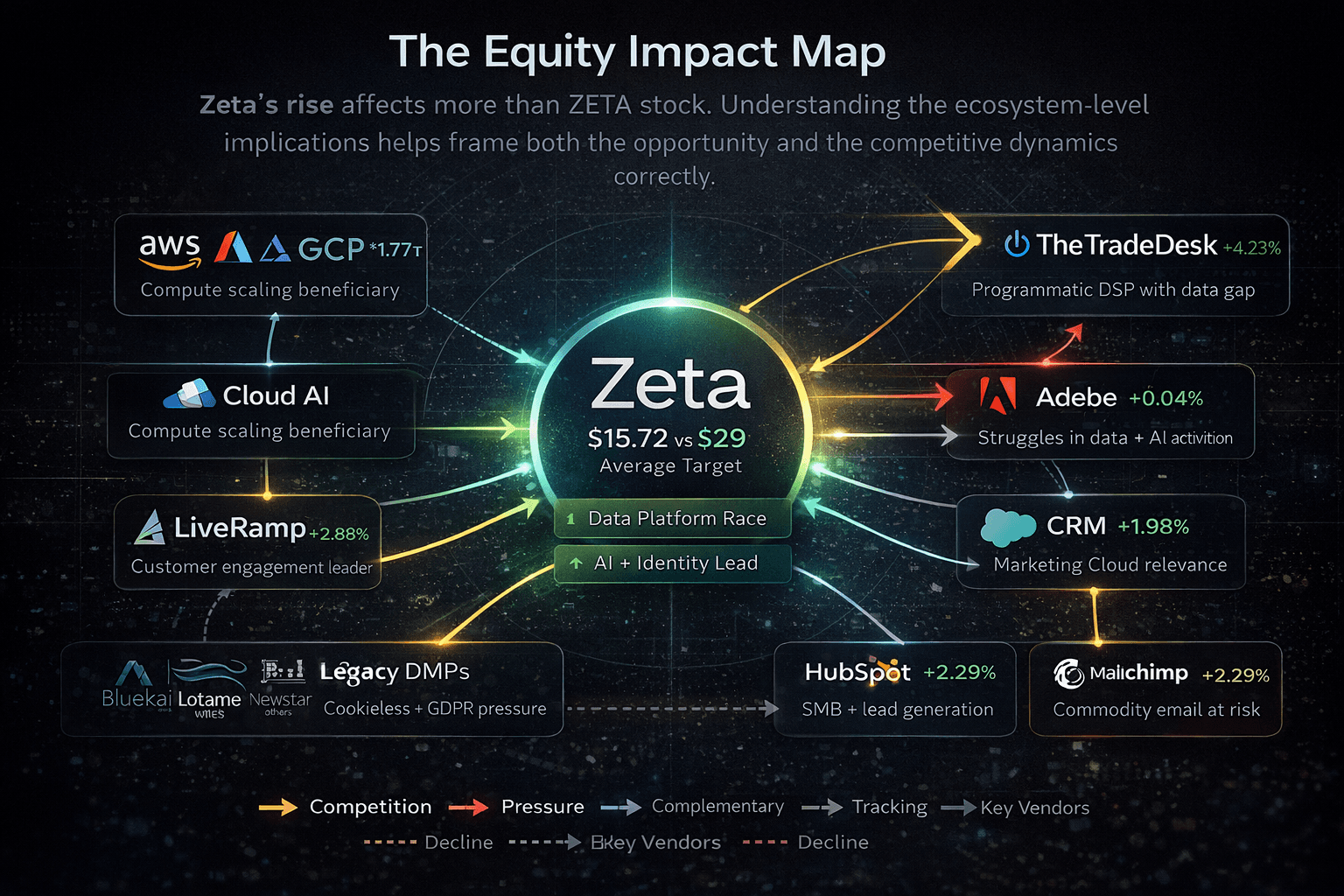
Equity Impact Map
Zeta's rise affects more than ZETA stock. Understanding the ecosystem-level implications helps frame both the opportunity and the competitive dynamics correctly.
ZETA is the most direct beneficiary of its own thesis, but the stock at $15.72 — versus an average analyst target near $29 — reflects persistent trust discount rather than a disagreement about operating metrics. Closing that gap requires: GAAP profitability sustaining through 2026, Marigold integration tracking to plan, and Athena adoption visibly impacting NRR and ARPU. Timeline: 12–24 months for meaningful rerating if execution holds.
The Trade Desk (TTD) faces a mixed picture. Programmatic DSP strength is real, but the first-party data gap is structural. The OpenAI advertising discussions signal TTD recognizes the problem — they are a response to competitive pressure from platforms like Zeta that own identity data. The Zeta-TTD competitive overlap is real at the enterprise budget allocation level; as cookieless headwinds deepen, TTD's relative position in identity-informed targeting weakens unless it closes the data gap.
LiveRamp (RAMP) benefits from the same structural tailwinds as Zeta in the cookieless identity space. Identity resolution expertise is increasingly valuable. The activation gap remains the constraint on RAMP's growth ceiling. The Zeta-LiveRamp dynamic is genuinely mixed: competitive for enterprise identity budget, but potentially complementary in enterprise stacks where both functions are procured separately.
Braze (BRZE) operates in a different stack position and is not primarily threatened by Zeta today. The risk to BRZE is more from AI commoditization of core engagement features than from direct Zeta competition. Marigold's integration into ZMP gradually expands Zeta's email and loyalty capabilities, which creates marginal overlap — but BRZE's mobile engagement core is not yet in Zeta's primary path.
Cloud AI infrastructure players (AWS, Azure, GCP) are clear beneficiaries of Zeta's trajectory. Athena's GA and the OpenAI integration increase inference compute consumption. Every AI marketing platform scaling up is a tailwind for cloud providers. This is not a Zeta-specific story but a structural trend across the ecosystem.
Salesforce (CRM) faces real medium-term pressure from Zeta in the enterprise marketing allocation. If Agentforce AI does not close the data infrastructure gap fast enough, Zeta's data-native position in marketing activation will continue to chip away at Marketing Cloud's relevance. The competitive pressure is not existential for Salesforce's overall platform, but marketing is a meaningful revenue line and Zeta is an increasingly credible challenger within it.
Adobe (ADBE) faces a compounded problem: AI fear around its core subscription model combined with competitive pressure from data-native platforms like Zeta in the experience activation layer. Adobe may be positioned as a complementary layer (creative and content) to Zeta (data and activation) for some enterprises — but the long-term budget competition is real.
HubSpot (HUBS) is largely neutral relative to Zeta at present, with meaningful overlap only if HubSpot's enterprise push accelerates faster than expected. The 3+ year timeline on meaningful competitive collision makes this a background monitor rather than a near-term investment implication.
Legacy DMPs and third-party data brokers are structural losers in this environment. The cookieless transition combined with GDPR/CCPA maturation makes third-party data aggregation business models progressively less viable. This is both a Zeta tailwind and a structural headwind for an entire category of companies.
Legacy ESPs (Constant Contact, Mailchimp, and equivalents) face existential questions as AI-integrated platforms like Zeta demonstrate the value differential between predictive segmentation + closed-loop optimization and simple batch email delivery. The value gap will only widen.
Risks That Deserve Honest Treatment
A balanced analysis of Zeta requires confronting the counterarguments seriously, not as boilerplate risk disclosure but as genuine threats to the thesis.
AI Commoditization. The most sophisticated version of this risk is not that AI replaces marketing teams — it is that large foundation model providers (OpenAI, Anthropic, Google DeepMind) move directly into enterprise marketing applications, rendering Zeta's AI agent layer redundant before it fully monetizes. The Trade Desk's OpenAI discussions are an early signal that this ecosystem consolidation is already underway. The countervailing argument is strong: when AI models commoditize, value migrates from the model to the data. Zeta's 245-million-profile first-party identity graph is not replicable quickly. But if hyperscalers (Google, Microsoft, Amazon) deepen their own first-party data moats significantly over the next three to five years, the structural gap Zeta exploits today narrows. This risk is real and probably underpriced in current valuations.
The Culper Research Shadow. In November 2024, short-seller Culper Research published a report containing two serious categories of allegations: "two-way contract" arrangements (suggesting Zeta simultaneously served as vendor and customer in certain deals to inflate revenue metrics) and "consent farm" practices (questioning the legitimacy of Zeta's data collection consent practices). Zeta denied all allegations. Deloitte, Zeta's Big Four auditor, issued a clean opinion. No SEC investigation or regulatory enforcement action has been publicly disclosed. However, the key analytical point is this: the report has not been formally refuted through external investigation — it has only been denied by the company. That distinction explains why short interest remains around 13% of float and why institutional capital is hesitant to build large long positions. The uncertainty is not resolved; it is merely dormant. Dismissing this risk would be analytically reckless.
Privacy and Regulatory Risk. GDPR, CCPA/CPRA, and potential future U.S. federal privacy legislation all carry implications for Zeta's identity graph — the company's most valuable asset. Zeta claims GDPR compliance and emphasizes its first-party, permissioned data architecture. The structural risk is this: a regulatory body targeting a company of Zeta's scale and data depth would not need to find a legal violation to create damage — even a formal inquiry, investigation, or consent order requiring changes to data collection methodology could materially affect the graph's quality and scale. The probability of such a scenario is not high in any given year, but it is non-negligible over a three-to-five year horizon.
Marigold Integration Risk. A $325 million acquisition is large relative to Zeta's balance sheet and operational bandwidth. Integrating different technology stacks, sales cultures, and customer bases carries real execution risk. If Marigold clients churn faster than anticipated, or if the ZMP conversion cycle for legacy Marigold customers is slower than management models, the synergy arithmetic breaks down and the 2028 plan loses its foundation.
Margin Expansion Uncertainty. Gross margin has been stable at ~60% despite management's stated objective of expanding it as direct platform mix increases. If integrated revenue does not decline as projected — or if new direct customers come with higher initial support costs than modeled — margin expansion could stall. SBC normalization is also incomplete: until stock-based compensation steps down meaningfully as a percentage of revenue, GAAP profitability will remain episodic rather than structural. Management's buyback program ($121M in 2025) helps but does not fully offset dilution.
Competing Narratives
Stress-testing the investment thesis against its own counterarguments is where the analysis reaches its most intellectually honest level.
Is Zeta's AI real or an interface upgrade? Both are partially correct answers, and the distinction matters. The underlying AI capabilities — predictive scoring, identity resolution, LTV forecasting, behavioral segmentation — were built into the platform over years and produce verified ROI. A Forrester study confirmed 50% campaign setup time reduction; reported 6x ROAS represents real customer outcomes, not marketing claims. Athena makes these capabilities more accessible, faster to deploy, and increasingly autonomous. The OpenAI integration improved the quality of the conversational layer. But the strategic differentiator is not the LLM interface and it is not the OpenAI brand — it is the identity graph that feeds the models with context no competitor can easily replicate. Remove the data and Athena is a product manager's demo. Retain the data and Athena is a genuine platform differentiation story.
Would growth have continued without the OpenAI partnership? Yes. The 23–38% annual growth rates from 2022 to 2024 were achieved entirely without this partnership. OpenAI compressed Athena's time-to-market and sharpened the competitive narrative in enterprise sales cycles. The measurable impact on customer lifetime value and NRR will become visible over the next four to six quarters. But framing OpenAI as the foundation of the growth story rather than an accelerant to an existing one is analytically backward.
Data, AI, or execution — what is the primary edge? The priority ordering is clear: data first, execution second, AI third. The identity graph is the structural moat because it is the hardest thing to replicate and the last thing to be commoditized. Execution — product integration, customer success infrastructure, agency partnerships, direct sales efficiency — converts the data into revenue. AI amplifies the leverage of both. In a world where AI capabilities continue commoditizing, the companies that sustain advantage will be those whose data cannot be replicated. Zeta's 245 million first-party profiles, built over more than a decade, fall into that category — assuming regulatory and competitive data collection dynamics remain broadly favorable.
What is the biggest risk in three years? The most dangerous scenario is not a single risk — it is a combination. If AI commoditization reduces the premium enterprises pay for Zeta's platform intelligence at the same time that economic pressure compresses enterprise marketing budgets, NRR would decline from 120% toward 100–105%, the growth narrative would deflate, and a stock priced for continued 20%+ growth would face serious multiple compression. The secondary scenario: a Salesforce or Microsoft deepens its own first-party data infrastructure through strategic acquisitions or partnerships, entering Zeta's exact positioning with vastly superior distribution and customer relationships. Neither scenario is the base case — but each is within the probability distribution of outcomes over a three-to-five year horizon.
Final Synthesis — What the Market Is Pricing, What It Is Missing
The analytical exercise ultimately converges on this question: At $15.72 per share, what is the market assigning to ZETA?
Eighteen consecutive quarters of guidance beats and upward revisions. FCF margin nearly doubled over five years; capex burden approaching zero. Operating margin turned positive for the first time; GAAP profitability crossed the threshold in Q4 2025. NRR at a record 120%, Super-Scaled customer growth at 24%, ARPU expanding. 75% of analysts rating the stock a buy with an average target implying ~86% upside from current levels. The market knows these facts and is not paying for them. The trust discount from the Culper short report, the AI commoditization fear narrative, and SBC-distorted GAAP earnings are overriding the operating improvement signal. This is a credibility problem, not a business quality problem.
Recent developments have not disrupted the thesis — they have reinforced it. Athena reaching GA, Q4 2025 GAAP net income turning positive, the OpenAI partnership materializing, and Marigold integration progressing all signal continued directional improvement. The counterweights — persistent short interest, The Trade Desk's OpenAI discussions, incomplete SBC normalization — are also real. The market is running a trust discount that exceeds what the financial evidence justifies, but the trust discount exists for reasons that are not irrational.
The asymmetric opportunity is real under specific conditions. Marigold integration tracking to plan; GAAP profitability sustaining through 2026; Athena adoption producing measurable NRR and ARPU uplift in the next two quarterly reports; no regulatory action or short-seller follow-up that reopens the data practices question. If these conditions hold, the gap between $15 and $29 closes. If any one of the structural risks materializes in a serious way — particularly a regulatory action against the identity graph or a miss on organic growth as acquisition effects anniversary — the downside scenario is severe given the premium growth multiple embedded in even the current depressed valuation.
Zeta Global has built a business that checks the boxes for structural AI marketing leadership: a first-party data moat, genuinely expanding free cash flow, strong enterprise retention metrics, and a rapidly maturing AI execution platform. It also carries a trust discount, an unresolved short-seller shadow, and the execution burden of proving 2026 organic growth in isolation. The business is improving — that much is clear. Whether the market chooses to believe it at the pace the fundamentals suggest is a question that only the next two to three quarters can answer.


