
Markets tend to read drone warfare through what is visible. FPV drones, loitering munitions, attritable UAVs and viral battlefield footage naturally pull investor attention toward drone manufacturers. But once you look a layer deeper, the core investment question becomes more complex than “who builds the drone?” It becomes: who builds that drone, and more importantly, who actually sees it, classifies it and brings it down?
The fact that the anti-drone market is expected to grow from around 3.01 billion dollars in 2024 to roughly 15.06 billion dollars by 2031, implying a compound annual growth rate of about 25.86%, turns this into not just a technological but a clearly economic question. If drone warfare is structurally expanding, the investment lens cannot stop at airframes and propellers.
Reading this theme purely as “more attack drones will be built” is incomplete. The battlefield is rapidly becoming drone-saturated; cheap, distributed, networked, semi-autonomous and increasingly AI-driven platforms are spreading across theaters. Yet for investors, the more critical reality may be this: value often does not accrue to the visible drone airframe, but to the radar, RF sensing, EO/IR, thermal imaging, lidar, AI sensor fusion, command-and-control and electronic warfare stack that actually detects and counters the threat. On the modern battlefield, the hardest problem is no longer just building drones; it is reliably detecting, classifying and neutralizing small, low-flying, slow, cheap and numerous targets in real time.
The Ukraine‑Russia war has transformed this from an abstract thesis into an industrial reality. Open-source assessments suggesting that Ukraine is now producing on the order of 4 million drones a year – vastly outpacing U.S. production – make it impossible to read modern doctrine solely through the lens of missiles and manned platforms. In that context, the invisible layers of the defense economy – detection and classification infrastructure – may be where the most durable and least appreciated value pools for investors actually sit.
How do drone and anti-drone systems really work?
On the drone side, the value chain is broader than it looks from the outside. The most visible layer is the airframe: the physical structure, composite materials, aerodynamics and integrability of the platform. Immediately below that sits propulsion: electric motors, ESCs, propellers, actuators and servos that define flight characteristics. Energy is provided by batteries, where large cell producers such as LG Energy, Panasonic and CATL, directly or indirectly, are important links in the supply chain. This segment looks competitive on a commercial basis but is geopolitically fragile. Skydio’s battery supply crunch after Chinese sanctions is a clear reminder that batteries and electronic components are not just generic inputs but critical elements in a war economy.
The flight intelligence layer is built around the flight controller, GPS/GNSS modules, the inertial measurement unit (IMU), cameras, thermal sensors, datalink and onboard compute. In GPS/GNSS and anti-jam modules, players like Collins Aerospace, L3Harris and Safran stand out; in inertial navigation, Honeywell and Safran are key high‑reliability suppliers. This layer becomes particularly critical in GNSS‑denied environments, because when GPS is jammed or spoofed, survival depends on IMUs, visual navigation and autonomous flight software. Above that sit AI perception, object recognition, route optimization and swarm coordination – the software nerve center of autonomous operations. At the top sits the payload: ISR sensors, loitering munition warheads, reconnaissance packages or kinetic munitions, depending on the mission profile.
On the anti-drone side, the chain is even more complex. The process starts with detection: radar, RF sensing, electro‑optical/infrared cameras, thermal imaging and increasingly lidar are used to find small targets. This is followed by identification and tracking: the system must not only see something in the sky, it must decide whether it is a bird, a friendly drone, a commercial UAV or an attack platform. Then comes classification, where sensor fusion software combines multi‑sensor data and pushes down false positives. Next, the command‑and‑control layer takes over: operator interfaces, threat prioritization, engagement decisions and system‑to‑system coordination are executed here. Only then does neutralization occur: jamming, spoofing, kinetic interceptors, net interceptors, directed energy, high‑power microwaves or missile‑based solutions, depending on the chosen concept of operations.
The important insight here is that the most talked‑about element in the market is often the “kill moment” – neutralization. Yet the real technological and economic bottleneck frequently lies upstream. If the system does not see the target early enough, or misclassifies what it sees, the best jammer, the most expensive laser or the most sophisticated interceptor all have limited value. For investors, therefore, simply asking “which company shoots drones down better?” is not enough. The more relevant question is: “which company builds scalable, reliable, low‑false‑positive awareness of the threat?”
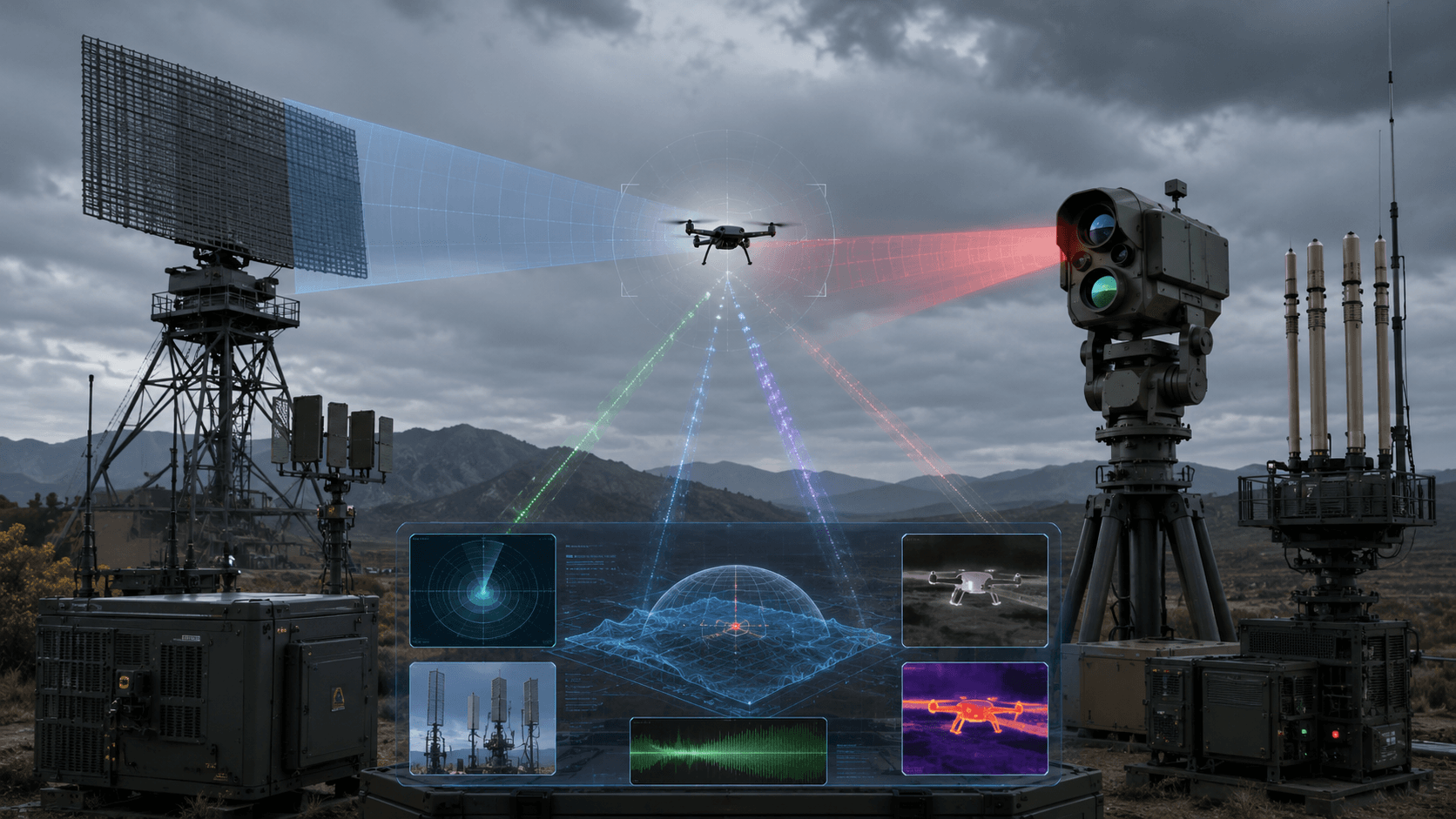
Why is the true bottleneck detection and classification?
On a modern battlefield, detecting small, low‑altitude, slow and often low radar‑cross‑section targets is extremely hard. Legacy air defense radars are optimized for fighter jets, missiles or larger air vehicles, not FPVs and small quadcopters. This is why counter‑drone architectures are being forced to augment radar with RF sensing, EO/IR, thermal imaging and often lidar. HENSOLDT’s outperformance in radar and optronics, Teledyne FLIR’s emphasis on thermal imaging modules for C‑UAS, and Ouster’s approval for defense drone applications all confirm that multi‑sensor architectures are becoming institutionalized in the market.
The problem is not only seeing; it is seeing correctly. One of the most expensive issues in counter‑drone operations is false positives. In an airport, along a border or around an energy facility, treating every bird, every plastic bag and every friendly commercial drone as a threat is not operationally sustainable. This is where the classification engine – AI sensor fusion – becomes the real economic moat. DroneShield’s heavy R&D emphasis on AI‑enabled RF detect/defeat and sensor fusion, Axon’s aggressive build‑out of airspace security after acquiring Dedrone, and L3Harris’ work on AI‑enabled drone detection all matter precisely for this reason.
Another structural bottleneck is command‑and‑control. In swarm attacks, as the number of threats rises, human decision cycles slow down. In a scenario with hundreds of small targets arriving simultaneously, it is unrealistic to expect a single operator to watch feeds, classify threats and select the right countermeasure in time. In the anti‑drone race, therefore, the competition is not just about stronger jammers or faster interceptors, but about more autonomous C2 and smarter threat prioritization software. Fact: today’s real bottleneck is not building more drones but reliably detecting and classifying them. Inference: as a result, the invisible software and sensor layer may represent a more powerful economic rent than the visible platform layer.
In which critical component layers does value actually accumulate?
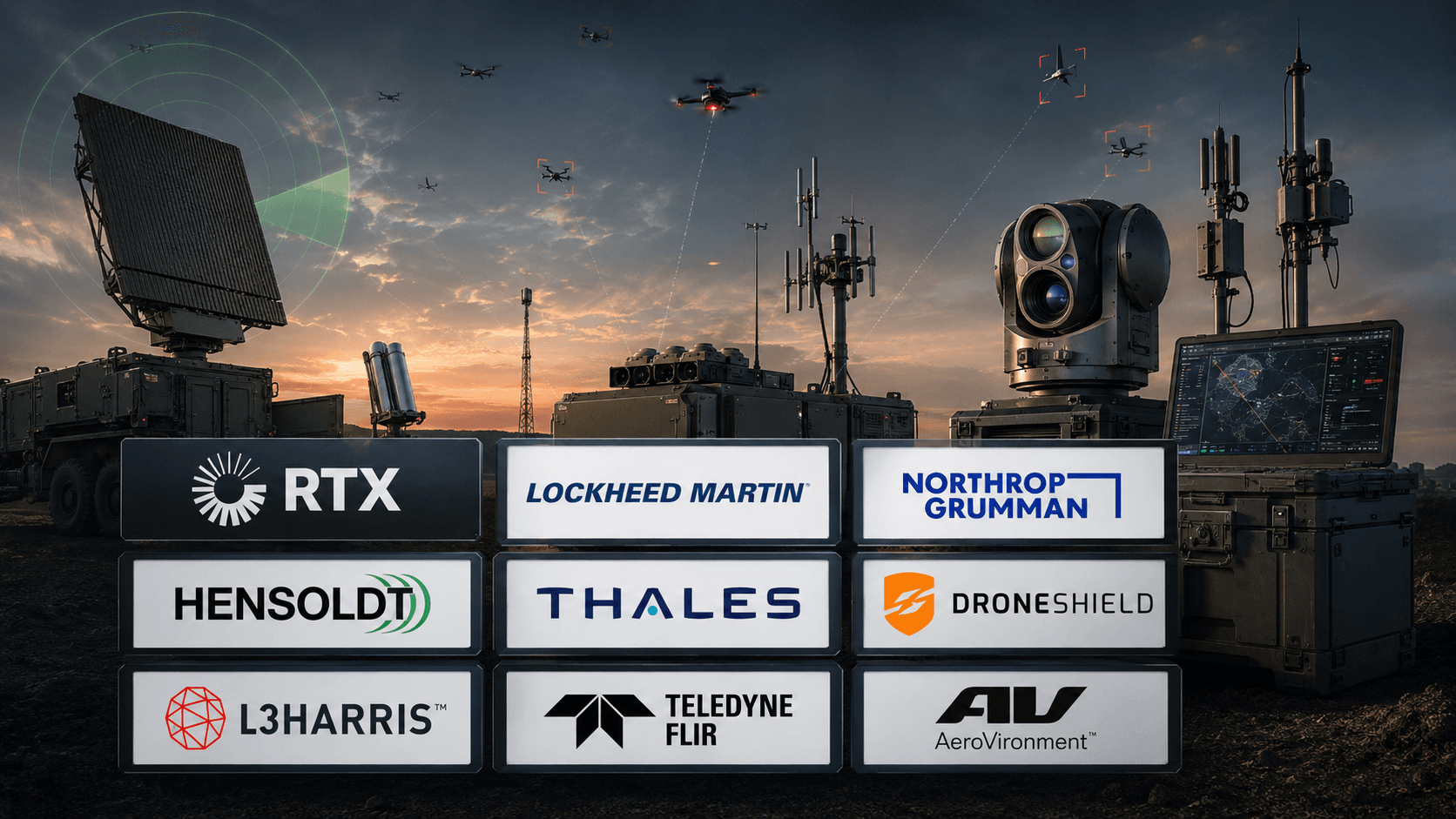
Radar is the first layer, because without a coherent air picture there is no defense. RTX, Lockheed Martin, Northrop Grumman, HENSOLDT and Thales are key players. Radar is not just about producing hardware; it requires high‑frequency design, sophisticated signal processing, military qualification, integration and proven field reliability. HENSOLDT’s 2025 performance – order intake of 4.71 billion euros, revenue of 2.455 billion euros and a book‑to‑bill ratio of 1.9x – is hard evidence that demand for radar and optronics is shifting from episodic to structural.
RF sensing is the second critical layer because many drones still emit exploitable communication signatures. DroneShield is the most notable pure‑play here, focusing on RF detect/defeat, AI sensor fusion and portable C‑UAS solutions. Its 2025 metrics – 431% growth, an A$2.55 billion sales pipeline and over A$50 million in annual R&D – show that the story is not just marketing but backed by measurable commercial momentum. At the same time, this data also reveals the flip side: RF detect/defeat is attractive enough to invite heavy competition from big defense names. L3Harris, HENSOLDT and Thales are expanding their own portfolios in this space.
The EO/IR and thermal imaging layer bridges detection and classification. Teledyne FLIR is one of the most interesting, and often underappreciated, assets in this context. It explicitly positions its thermal imaging solutions for counter‑UAS, ISR, precision strike and uncrewed systems, and presents itself as the world’s largest manufacturer of ITAR‑free thermal IR sensors and modules. For investors, the implication is clear: if anti‑drone networks scale out, then not only system integrators but also merchant suppliers that sell modules into many platforms can emerge as durable winners.
Lidar is still a controversial layer. Many investors view it primarily through the automotive autonomy narrative and treat defense as a secondary application. But Ouster’s digital lidar sensors gaining Defense Department approval for unmanned aerial systems, and its strategic partnership with ARGUS for net‑based counter‑drone interceptors, suggest lidar could become more important than expected in short‑range 3D spatial awareness, terminal guidance and fine‑grained discrimination in cluttered environments. Lidar is unlikely to become the central pillar of anti‑drone defense on its own; it is more realistically an additive 3D sensing layer on top of radar and EO/IR that can grow in importance over time.
AI sensor fusion is arguably the most strategic layer. Radar, RF, thermal and lidar all generate data; the economic moat is in software that can turn this data into low‑latency, low‑false‑positive decisions. DroneShield’s position in this space, Dedrone’s airspace security engine and L3Harris’ AI‑enabled detection work all matter for exactly this reason. There is a strong investment logic here: hardware sales are project‑based and cyclical; by contrast, decision support, threat libraries, classification engines and sensor‑orchestration software can generate higher‑margin, updatable and sticky revenue streams over time.
Electronic warfare, secure communications and anti‑jam modules form another invisible yet essential layer. Jamming and spoofing remain core tools, but they may no longer be sufficient on their own. As drones become more autonomous and adopt navigation methods that reduce GNSS dependence, pure RF jamming could lose relative effectiveness. This increases the importance of secure communications, anti‑jam GNSS, IMUs and alternative navigation systems. Collins Aerospace, Safran, Honeywell and L3Harris are directly or indirectly important here. The key investment point: even if jamming does not “win”, the anti‑jam provider can still win; even if one particular neutralization concept loses favor, robust navigation and communications infrastructure remain indispensable.
Kinetic interceptors, net interceptors, directed energy and high‑power microwaves are the final layer. RTX’s Coyote family and the U.S. Army’s LIDS program are among the most important reference points. The non‑kinetic Coyote variant, with faster launches, higher speeds and greater range at higher altitudes, is specifically tailored for UAS threats and swarm defense. Yet economically, this layer has not yet matured into a “winner‑takes‑most” structure. Which neutralization architecture will dominate remains unclear: kinetic, net‑based, laser, microwave, or some hybrid. This uncertainty suggests investors should be more cautious in pricing the terminal engagement layer than the detection and classification stack.
No true monopolies – so why do high‑barrier oligopolies form?
From the outside, the defense supply chain looks crowded. Once you step inside, you often find that for each critical sub‑segment there are only a small number of trusted suppliers. Radar has RTX, Lockheed Martin, Northrop Grumman, HENSOLDT, Thales and a handful of others. RF detect/defeat involves DroneShield, L3Harris, HENSOLDT and a few niche players. Thermal imaging is dominated by Teledyne FLIR and, to a lesser extent, L3Harris. In AI sensor fusion, the list seems longer, but the number of players with real combat data, customer trust and fielded integrations is far more limited. Still, calling any of these “monopolies” would usually be an overstatement. Products are technically substitutable, governments actively avoid single‑source dependencies, and procurement structures are designed to create second sources where possible.
Yet high‑barrier oligopolies do emerge, and for three main reasons. First is qualification. Selling into defense, particularly in radar, EW, secure communications, anti‑jam and inertial navigation, requires years of testing, certification and security vetting. Second is ITAR and similar export and security regimes; market structure is governed not only by technical merit but by where systems can legally be sold and which integration chains they can join. Third is combat data. A counter‑drone system that looks great in the lab might still fail under real‑world conditions full of birds, clutter, urban noise, friendly traffic and dense target streams. The data that comes from operating at scale in those environments is not easily copied by a new entrant.
This is why radar, thermal imaging, electronic warfare, IMU/anti‑jam and secure comms tend to display meaningful pricing power, even if not unlimited. Customers are not just buying a product; they are buying risk reduction, reliability, integration ease and supply continuity. HENSOLDT’s order growth, Teledyne FLIR’s emphasis on “volume production at scale” and the multi‑layered portfolios of the big primes are all manifestations of this trust economy. Inference: in defense technology, the moat often does not come from patents alone, but from qualification history, program participation and operational reliability.
A similar oligopoly tendency can be seen in loitering munitions. AeroVironment, RTX and a few Israeli firms stand out. But on the platform side, competition is fiercer: attack drones are subject to faster design cycles, lower entry barriers and a strong incentive for states to build local capabilities. Investors should therefore not expect the same quality of moat on the drone manufacturing side as in the anti‑drone sensing stack.
Pure-play names: direct exposure or just narrative?
DroneShield is the most important name under this heading. Its appeal is obvious: pure thematic exposure, a clear story and strong metrics. The 431% growth in 2025, A$2.55 billion pipeline, more than A$50 million in annual R&D and the move into profitability make DroneShield one of the cleanest pure‑play counter‑drone stocks in the market. Its combination of RF sensing, defeat and AI sensor fusion also matters: it is not merely selling jammers, but a layered detection and decision engine. That strengthens the investment thesis; being a system brain is better than being a single tool.
A good investor note, however, does not just polish the story, it draws boundaries. DroneShield’s risk is valuation and expectations. In pure‑play names, markets often price in future defense budgets early. If procurement cycles turn out slower than hoped, if primes push aggressively with integrated solutions, or if technology preferences shift away from RF detect/defeat to other layers, multiples can compress quickly. DroneShield is powerful exposure, but it is not risk‑free exposure.
The Axon/Dedrone story offers a different quality of play. Axon’s acquisition of Dedrone showed that the counter‑drone market is not confined to traditional defense channels but extends into public safety, law enforcement and critical infrastructure security. More importantly, Dedrone’s roughly 300% revenue growth post‑acquisition and bookings that exceeded the purchase price show that this was not just a trophy M&A deal. The fact that Axon’s Platform Solutions segment grew about 95% year‑over‑year, with Dedrone as a key driver, signals that airspace security is integrating naturally into Axon’s core mission.
Axon thus offers a hybrid. It is not a pure‑play counter‑drone name; the core business remains Tasers, body cams and a digital public safety ecosystem. That said, precisely for this reason, its anti‑drone exposure looks less like a standalone speculative story and more like a cross‑sell software/solution layer on top of an existing customer base. For many investors, that can be a more attractive, lower‑volatility way to own the theme than a small pure‑play.
Ondas, by contrast, looks like the weak link in the basket. Its autonomous systems arm is interesting on paper, but the company is still loss‑making, trades at stretched multiples relative to peers, and has pushed back its adjusted EBITDA profitability targets. Names like this can rally hard when the theme is hot, but without evidence of high‑quality revenue and cash conversion, it is too early to call them durable winners. Inference: in defense tech, the line between pure‑play and pure hype is often drawn by the quality of revenue and the speed at which procurement actually converts.
Ouster is not a pure defense name but offers a non‑trivial connection. Its Department of Defense approvals and its strategic deal with ARGUS for counter‑drone interception show that lidar’s defense angle is becoming more tangible. Even so, its core business remains the broader lidar market. The stock should not be priced as a pure‑play C‑UAS name; the right framing is that defense applications provide an option‑like upside rather than the entire thesis.
The big defense primes: powerful but not pure
RTX is one of the strongest large‑cap ways to play the theme. Its Coyote family and the LIDS framework position it directly in the neutralization layer. The 2025 financials – around 88.6 billion dollars in revenue, guidance for 92–93 billion in 2026 and roughly 7.9 billion dollars in free cash flow – offer investors both technological exposure and balance sheet quality. The catch: counter‑UAS is only a small part of RTX’s total value. Even if the theme plays out strongly, the marginal impact on the stock is limited compared to pure‑plays.
Lockheed Martin and Northrop Grumman are even more indirect. Lockheed Martin is strong in radar, missile defense and command systems; Northrop is strong in sensors, space and autonomy. But for both, counter‑drone is one theme among many within a vast portfolio. That is not a negative; it simply means these stocks offer more stable, lower‑beta defense exposure rather than concentrated anti‑drone upside.
L3Harris has a somewhat special position among the primes. It is deeply embedded in electronic warfare, secure comms, battlefield networking and EO/IR – all of which tie naturally into the anti‑drone stack. Its VAMPIRE system, multi‑domain variants and AI‑enabled detection posture give it meaningful exposure on both detection and neutralization. It is still far from a pure‑play, but the overlap between its core competencies and C‑UAS needs is unusually tight for a company of its size.
Thales and HENSOLDT deserve separate attention on the European side. Thales, with its integrated EagleSHIELD counter‑drone solution and drone‑mounted EW initiatives, stands at the intersection of secure communications, radar and EW for European defense. HENSOLDT has translated its radar and optronics strength directly into numbers: record order intake, a 1.9x book‑to‑bill ratio and a backlog above 7 billion euros confirm that its growth is driven by real programs, not just sentiment. HENSOLDT is not a pure C‑UAS name, but it is extremely well positioned in the sensor layer without which no anti‑drone system can work.
The common thread across these primes is clear: they are strong, trusted, have high customer access and enjoy qualification advantages. But they are not pure. That is why, in the early phase of a theme, pure‑plays tend to capture the headlines and highest beta, while primes capture the more durable cash flows and program depth. The investor’s question should not be “which is better?”, but “at this point in the cycle, which risk‑return profile is preferable?”
The drone side: who sits on the offensive platform?
Kratos and AeroVironment represent the offensive side of the battlefield. Kratos is a leader in low‑cost attritable UAVs and tactical drones. Its roughly 22.6% revenue growth in Q1 2026 and double‑digit organic growth in its unmanned systems segment show that it is benefiting from the doctrinal shift toward cheaper, more expendable platforms. The logic is straightforward: instead of a few exquisite, irreplaceable assets, the future points toward many affordable, attritable ones.
AeroVironment has a clearer narrative around loitering munitions. Its Switchblade family has become the company’s growth engine and is expanding with new variants. The Ukraine war has turned loitering munitions from a niche product into a staple of modern combat.
The crucial distinction is this: the offensive drone side is important, but its economic moat quality may be lower. Platform diversity is high, new entrants can appear relatively quickly, states can more easily pursue domestic production and design cycles are faster. The market for attack platforms can grow rapidly, but profits may fragment across many players. The anti‑drone sensing stack may appear slower moving, but because of qualification, data and integration barriers, it can generate deeper and more durable economic moats.
Hidden winners: where might the real long-term winners be hiding?
The most common mistake in this theme is focusing only on branded system integrators. In defense, some of the best businesses sit where the logo is small but the attach rate is high. Teledyne FLIR is a prime example. Given its depth in thermal imaging, EO/IR and IR modules for C‑UAS and ISR, it can arguably become one of the backbone vendors of the anti‑drone economy. Its role as a merchant supplier means it is not tied to a single prime but can quietly feed value into many programs.
HENSOLDT fits a similar pattern. It may not always be the headline stock in U.S. media, but its position in European defense electronics, radar and optronics is strong and backed by record orders. If anti‑drone defenses become a permanent budget line in Europe, sensor‑centric names like HENSOLDT could capture value more consistently than some of the system names featured in headlines.
Ouster is a more speculative but still notable hidden‑winner candidate. Because lidar is not yet core to the defense narrative for most investors, its defense connection may be underpriced; if that connection grows, re‑rating potential exists. The same logic extends to RF components, IMUs, anti‑jam and secure comms suppliers. Honeywell, Safran, Collins Aerospace and several private companies are not marketed as “anti‑drone plays”, yet provide indispensable infrastructure without which no C‑UAS or drone system can function. Inference: platform names give investors stories; component suppliers often deliver the more durable economic rents.
Regional demand: where does the theme turn into actual budgets?
The U.S. is, unsurprisingly, the largest lab for this theme. The sheer size of the defense budget, the need to protect critical infrastructure, bases, borders and public events make demand for anti‑drone systems multidimensional. The Axon/Dedrone story is particularly important, because it emphasizes that the market is not just the Pentagon. Airports, stadiums, city centers and law‑enforcement agencies can all become customers for airspace security.
In NATO and Europe, Ukraine accelerated everything. Germany, Poland, the U.K. and others can no longer treat cheap, massed drones as an edge case. They must bridge gaps not only in traditional air defense but in low‑cost drone defense as well. HENSOLDT’s order acceleration and Thales’ integrated C‑UAS/EW moves are the corporate manifestations of this reality. In Europe, export control and supply‑chain sovereignty concerns add another layer, favoring local sensor and comms suppliers.
The Ukraine‑Russia war sits at the center of any regional map. Ukraine’s move toward roughly 4 million drones a year makes it clear that war is now shaped by a high‑volume drone economy. That drives demand not only for offensive platforms but also for the anti‑drone systems that must be iterated under live conditions. The war is effectively training both drone producers and C‑UAS vendors at the same time.
In the Middle East, demand is driven by critical facility protection, border security, energy infrastructure and proxy conflicts. Here jamming, kinetic interceptors and layered air defense all matter. In the Asia‑Pacific, the combination of China, maritime disputes and dispersed geography pushes demand for both tactical drones and counter‑UAS. Australia adds regional security architecture and DroneShield’s local status to that mix.
Finally, the critical infrastructure and commercial market should be treated as its own investment segment. Airports, power plants, nuclear sites, ports, stadiums and large event venues are all potential customers. Contracts here are smaller than in defense but procurement can be faster and recurring revenue potential higher. Again, Axon/Dedrone is a good case study.
Financial quality: high growth, stability or mid‑tier quality?
A useful way to structure the investable universe is to think in three buckets.
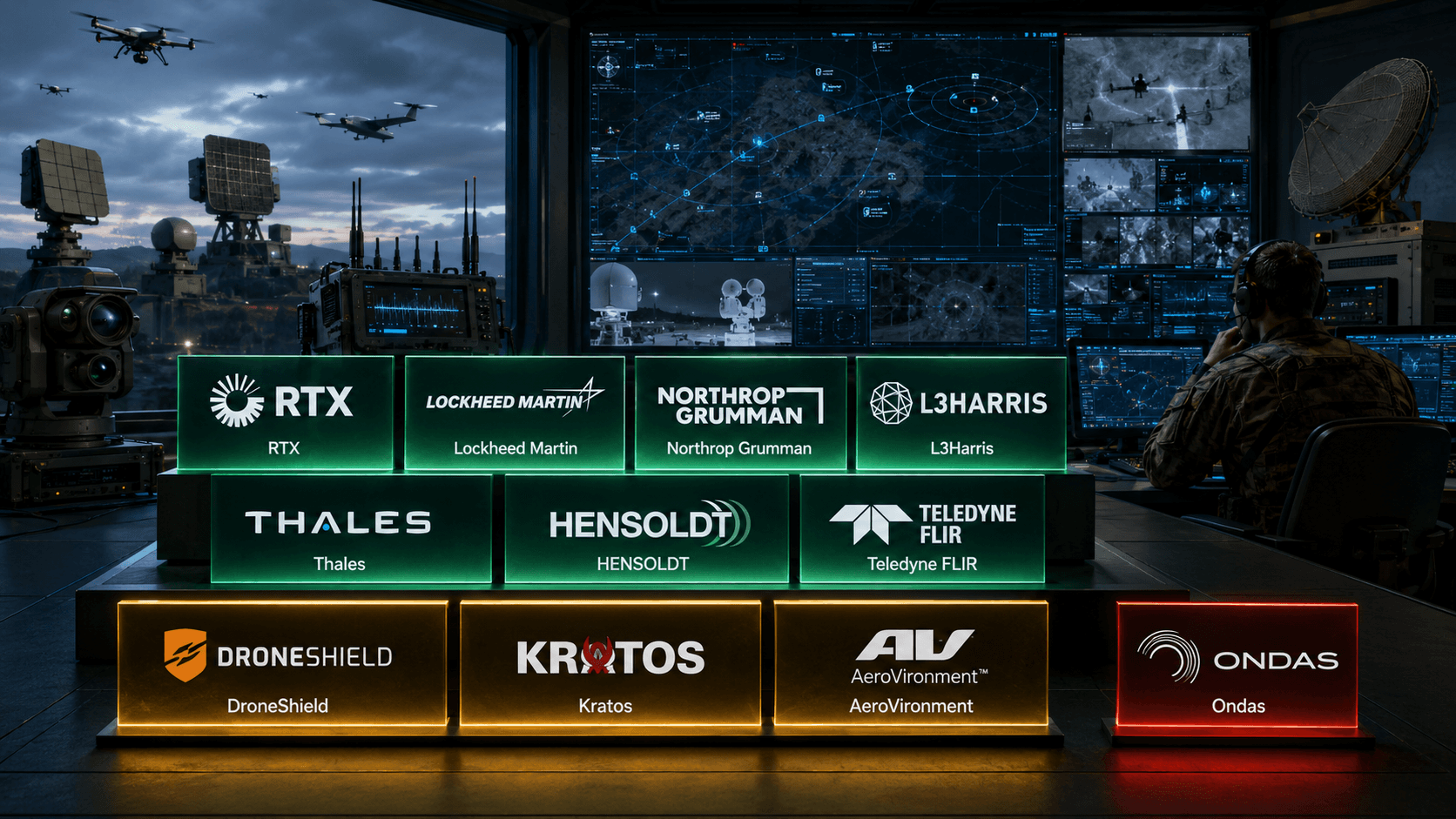
The first bucket is high‑growth but higher‑risk pure‑plays. DroneShield is the cleanest example; growth is explosive, the theme is pure, the pipeline is large and profitability is emerging, but valuation and execution risk are high. Ondas is a weaker profile in this bucket; losses, pushed‑out profitability and stretched multiples skew the risk/return profile unfavorably.
The second bucket is large, stable but diluted players. RTX is the strongest example here: it offers real C‑UAS exposure via Coyote and LIDS, but the stock is driven by a far broader set of programs. Lockheed Martin, Northrop Grumman, L3Harris and Thales all fall into this category – strong balance sheets, deep backlogs, broad government access, but only a modest portion of their value is tied directly to counter‑drone.
The third bucket consists of mid‑tier sensor/component leaders. HENSOLDT is the clearest listed representative: order growth, focus on radar and optronics, and its positioning in European defense electronics make it very interesting. Teledyne FLIR, although part of a larger group, belongs in the same conceptual bucket: its dominance in thermal imaging and IR modules gives it a quiet but powerful seat in the system stack.
Kratos and AeroVironment sit in a parallel category as offensive platform suppliers. They enjoy growth and doctrinal tailwinds in attritable UAVs and loitering munitions, but face higher competition and less standardization on the platform side, which can translate into more volatile leadership and multiples over time.
Why the bull and bear cases both deserve respect
The core of the bull case is simple and powerful. The drone swarm threat is real and accelerating. Ukraine has provided the lab for this process; states and militaries are increasingly treating cheap, dense, AI‑assisted air threats as the new normal. This could drive anti‑drone line items in defense budgets higher, accelerate deployments around critical infrastructure and pull radar, RF, thermal imaging, EW and sensor fusion layers into multi‑year procurement cycles. In this scenario, pure‑play C‑UAS names deliver strong top‑line growth, while sensor/component suppliers benefit from higher quality and more sustainable margin structures. Axon/Dedrone’s early momentum, DroneShield’s explosive growth and HENSOLDT’s backlog strength all support this bull thesis.
The bear case is equally serious. Many stocks have already moved sharply; the theme is not undiscovered. Smaller players carry very real profitability and cash‑flow risks. Government procurement can be slow, even when threats are obvious. The technological winner is far from clear: jamming, kinetic, directed energy and hybrid architectures are all in play. Large primes can squeeze smaller players using integrated packages, pricing power and entrenched customer relationships. Geopolitical risk around Chinese batteries and electronics can disrupt supply chains; Skydio’s experience shows this is not just a theoretical concern. Finally, post‑war normalization of demand or shifting political priorities could pull growth expectations back toward reality.
Good investment theses are never purely exuberant or purely cynical. The key is to distinguish which layers are most subject to hype and which are closest to structural moats.
Narrative analysis: a real megatrend – but are investors looking in the right place?
The thesis that drone warfare is a new defense megatrend has gained serious traction. This is not just about more drones being used; it is about drones reshaping the economics of war. Low‑cost, distributed, quickly producible platforms erode the dominance of a small set of expensive, exquisite systems. On that dimension, the narrative is correct. But it does not automatically follow that the best investments are the drone manufacturers.
Looking at where the moat lies – detection versus neutralization – current evidence tilts toward detection and classification. The neutralization layer is still in the middle of a technology race whose winner is unclear. Kinetic solutions can be effective but expensive; jamming is useful but may be constrained as autonomy rises; directed energy is promising but far from universal deployment. In contrast, situational awareness is required regardless of which neutralization option “wins”. Radar, RF sensing, thermal imaging, EO/IR and sensor fusion therefore carry more durable economic value.
There is no single correct answer to whether pure‑plays, primes or sensor vendors are the “best” investment layer. Pure‑plays offer the highest thematic purity and most potential for rerating; DroneShield is the textbook example. Primes offer the strongest balance sheets and program depth; RTX is the reference case. Sensor/component vendors often provide the most silent but durable economic positioning; Teledyne FLIR and HENSOLDT are particularly compelling here. Inference: if markets are over‑focusing on the visually dramatic parts of the war – platforms and interceptors – the real alpha may lie in the less visible detection infrastructure.
Final synthesis: what is correctly priced, what isn’t, and where does asymmetric value live?
Markets today are correctly pricing the fact that drone warfare is real. FPVs, loitering munitions, attritable UAVs and anti‑drone systems are no longer fringe topics. It is also rational that pure‑play exposure commands a premium; thematic purity attracts capital. DroneShield’s reception and the Axon/Dedrone momentum illustrate this dynamic.
But markets may be over‑ or under‑pricing different parts of the stack. Over‑pricing is visible in some small caps where the story has outrun fundamentals; Ondas is a flashing warning example. Under‑pricing is more likely in the sensor, thermal imaging, radar, anti‑jam, secure comms and AI sensor fusion layers – tightly scoped but indispensable components. Investor attention is still largely on platforms and kill mechanisms; yet the higher‑quality slice of the war economy often sits in “must‑have” components that are present in every credible system.
The most honest answer to where asymmetric value sits is threefold. The highest beta and thematic purity are in pure‑play counter‑drone names; DroneShield and, in a more balanced way, Axon/Dedrone stand out here. The lowest‑risk, balance‑sheet‑anchored exposure lies with the big primes – RTX, L3Harris, Thales, Lockheed Martin and Northrop Grumman – which are safe but diluted plays on the theme. The most interesting long‑term economic moats, however, likely accumulate in the sensor and component layers: Teledyne FLIR with its thermal dominance, HENSOLDT with its radar/optronics momentum, Ouster with its optional defense lidar angle, and infrastructure names like Honeywell, Safran and Collins Aerospace underpinning navigation and communications.
Drone warfare is real. But the best investment is not always the drone you see in the sky. The future of air defense is not just a missile economy; it is an economy of data, sensing, classification and electronic warfare. In this new cycle, the strongest economic value is likely to accumulate, not in the visible platform, but in the sensor and software layers that make that platform visible – and actionable – to the defenders.

