
Public markets are still trained to see “space” as rockets, launch videos and Elon Musk. That instinct is understandable; SpaceX’s confidential IPO filing, the 1.5–1.75 trillion dollar valuation range being floated, and expectations of 30–75 billion dollars in primary and secondary funding would make it one of the largest equity events in modern market history. But for investors, the real question does not end with “how do I get into this IPO?” – it starts there. If space is genuinely becoming a multi‑year, structural infrastructure layer, will economic value concentrate in launch, or will it accumulate upstream in RF chains, radiation‑hardened chips, geospatial analytics, ground station equipment and specialty materials?
That distinction matters because a SpaceX IPO narrative and a good space investment are not the same thing – and often they are the opposite. When a company of SpaceX’s quality approaches the public market, the first thing that gets priced is rarely the underlying cash‑flow pool; it is the story. The initial moves in Rocket Lab, AST SpaceMobile, Planet Labs and other listed names – sharp rallies driven by “space basket” buying and sympathy trades – suggest that for now the market is buying the word “space” more than the actual economics of each business.
Meanwhile, the space economy itself is no longer a single‑segment story. It is becoming a stack: satellite internet, Earth observation, defense/ISR, ground stations, RF/antenna infrastructure, rad‑hard semiconductors, geospatial analytics, satellite components, propulsion, sensors, space cybersecurity – plus longer‑dated frontiers like in‑space manufacturing, space‑based solar power and orbital compute concepts. The right mental model for a SpaceX IPO is not “a rocket company is going public” but “the primary private integrator of a new space‑defense‑data‑AI infrastructure layer is about to get a public benchmark.”
The core tension that runs through this entire theme is simple: does the SpaceX IPO wave reflect a durable infrastructure transition, or a prematurely romanticised narrative? And if the theme is real, does value pool primarily in high‑profile launch names – or in the less visible suppliers of data, RF, chips, materials and analytics that sit behind the rockets?

What is the space economy, really?
For investors, the space economy should be defined less by “things that go to orbit” and more by “cash flows enabled by assets in orbit.” In practice, that means the upstream of launch and hardware, plus a much larger downstream layer of communications, navigation, imaging, analytics, security and software. OECD and WEF work on the space economy converge on that point: the bulk of value today, and most of the growth going forward, sits in downstream applications – services that monetise connectivity and data, not in the vehicles that get metal into orbit.
On current estimates, the global space economy is on the order of 630 billion dollars and is projected to grow to roughly 1.8 trillion by 2035. That implies high‑single‑digit compound growth, but more importantly, it implies a mix shift: from government‑driven exploration and broadcast towards commercial communications, Earth observation and defense applications at scale.
Launch services are still foundational. Without a reliable way to put mass into orbit, there is no downstream economy. But reusable rockets transform launch from a bespoke product into an infrastructure utility. What SpaceX has done with Falcon 9 and Falcon Heavy is not just “more launches.” It has driven the cost per kilogram down to a point where business models that were previously marginal or impossible become investable. If Starship scales as advertised, this effect becomes nonlinear; heavy‑lift capacity at low marginal cost turns entire mission classes – large constellations, lunar logistics, bulky defense payloads, in‑space manufacturing experiments – from science projects into plausible businesses.
The second main pillar is satellite internet. Starlink is the most visible example, but AST SpaceMobile, Iridium, Globalstar, Viasat, SES, Eutelsat/OneWeb and Telesat are all playing on the same board with different architectures and customer sets. Starlink’s structural edge is the vertical integration between launch and broadband: it controls the rockets, the spacecraft and the network. That yields capital efficiency, deployment speed and network optimisation advantages most rivals do not enjoy. Iridium offers a more mature, mission‑critical flavour of connectivity; Globalstar focuses on narrower but strategic niches; Viasat, SES and Eutelsat/OneWeb sit at the intersection of legacy GEO/MEO infrastructure and new‑generation constellations.
Earth observation and geospatial intelligence may be the most misunderstood part of the space economy. Planet Labs, BlackSky, Maxar, MDA and Satellogic are not simply “selling pictures.” They are selling decision infrastructure – for agriculture, energy, insurance, supply chains, border security and more. Raw pixels are low‑margin. But once you add AI‑based change detection, target recognition, pattern‑of‑life analytics and event triggers, you move from “imagery provider” to “analytics platform.” That shift – from data to insight – is where the margin expansion lives.
Defense space is no longer an adjacent vertical; it is central to the space economy. Lockheed Martin, Northrop Grumman, RTX, L3Harris, BAE Systems, Leonardo, Thales, Airbus and Boeing sit across missile warning constellations, secure military communications, ISR payloads and deep‑space exploration. To a public‑equity investor, these companies usually do not screen as “space pure‑play” but as diversified primes with long‑cycle defense budgets and complex program portfolios. That comes with a trade‑off: the space exposure is more stable and contract‑backed, but also diluted in group‑level revenues, which reduces thematic purity.
Space situational awareness (SSA) – tracking objects, modelling collision risk, managing orbital debris – is becoming an unavoidable layer as LEO constellations proliferate. Lunar and deep space infrastructure, driven by NASA’s Artemis program and related commercial landers and logistics, is a longer‑dated domain, but it underpins the idea that “space economy” will not stop at LEO.
In‑space manufacturing, space‑based solar power and space‑based AI data centres are frontier concepts. They feature prominently in slide decks, but they are not today’s cash‑flow pool. Still, as options on the very long‑term shape of the infrastructure, they help to anchor why investors treat space as more than a niche.
On the ground, ground stations are the invisible pipelines. They connect satellites to the terrestrial internet and control systems. You cannot monetise an orbital asset without the RF, antennas, modems, routing and data‑centre interfaces that sit in the ground segment. Satellite components, propulsion, sensors and space cybersecurity form the rest of the “boring but critical” stack: solar arrays, batteries, star trackers, reaction wheels, IMUs, thermal management, RF front‑ends, phased‑array antennas, rad‑hard power management, secure command‑and‑control.
The fact is simple: the space economy is no longer “just launch.” The more important inference is that if this theme is real, the most durable economic moats are likely to sit not in the rocket fuselage itself but in the layers that deliver data, connectivity, security and mission‑critical components.
Why the SpaceX IPO matters so much
SpaceX’s confidential IPO filing is not being treated as just another offering. It is the moment where a decade of private capital formation around the space theme hits public markets at full force. A 1.5–1.75 trillion dollar valuation range, paired with 30–75 billion dollars in primary and secondary issuance, would place the deal among the largest in history. If those numbers hold, SpaceX does not just list as a sector leader; it becomes the reference multiple for the entire space complex.
Two pillars support that valuation narrative: Starlink and Starship. Starlink converts a cyclical, contract‑driven launch business into a recurring‑revenue‑like network platform. The addressable market spans rural broadband, enterprise connectivity, maritime and aviation links, and secure defense communications. Starship is a very different option. If it ultimately delivers high‑mass payloads at dramatically lower cost, many currently marginal missions cross into economic viability: denser constellations, heavier ISR payloads, lunar logistics, and, further out, in‑space manufacturing and orbital infrastructure concepts.
Investors are prone to two symmetrical mistakes here. The first is to treat the valuation as a simple multiple of current revenues – underestimating how much of the price is about the expected future shape of the launch cost curve and global network economics. The second is the opposite: to extrapolate that future so aggressively into the present that the valuation leaves little room for execution risk. A high valuation is, by definition, a high expectation. And that expectation can bleed into everything labelled “space,” inflating premiums for businesses that do not share SpaceX’s fundamentals.
So the impact of the SpaceX IPO will be two‑sided. Structurally, it can enforce a real valuation reset: for the first time, investors will have a public benchmark for a scaled, profitable launch‑plus‑broadband platform. But tactically, there is a real risk that weaker listed names get treated as “mini SpaceX” by association. Markets usually do the second faster than the first.
The first impact on listed names
Early price action has been instructive. Rocket Lab, AST SpaceMobile, Planet Labs and others saw sharp moves on SpaceX IPO headlines. That looks a lot like a “space basket” trade: if you cannot buy SpaceX yet, you buy whatever is closest by ticker and narrative.
The key distinction is between a structural valuation reset and a sentiment spike. A reset is about durable reassessment of cash‑flow power and sector multiples. A sentiment spike is about investors bidding up anything that “sounds like” the headline.
Rocket Lab is the cleanest example. It is a real launch and spacecraft platform, in the same general problem space as SpaceX. That makes the IPO a more fundamental catalyst: if public markets are ready to put a software‑platform‑like multiple on launch plus space systems, Rocket Lab may benefit as the only listed analogue. But the scale gap is enormous and the balance sheet very different. Much of any premium will be “closest public comp,” not “true peer.”
AST SpaceMobile’s move is more narrative‑driven. The company plays in satellite broadband, with an architecture that is technically ambitious and commercially unproven at scale. The SpaceX/Starlink story spills over into ASTS because they share the words “space” and “broadband,” not because they share the same economics.
Planet and BlackSky are more nuanced. Planet’s moves reflect general space appetite, but BlackSky’s price action also has a fundamental anchor in AI‑driven geospatial and defense analytics contracts. Iridium and Globalstar rally as part of a broader “satellite communications” basket, even though their business quality and maturity differ. UFO – the Procure Space ETF – acts as a thermometer for this behaviour: when the narrative pulls in ETF flows, everything inside the wrapper is pulled along, regardless of individual merit.
The investor takeaway is straightforward: in the first phase after the IPO, “everything with a satellite” can go up. That does not invalidate the theme – it just means the best‑performing tickers in that window are not necessarily the best businesses. They tend to be the most volatile, least liquid and most story‑driven names. They also tend to be the ones that fall hardest when the story cools.

AI and space: where is the reality, where is the narrative?
The intersection of AI and space is both more real than the hype suggests – and narrower. The most concrete revenue‑bearing applications today are in Earth observation data processing, defense ISR and target detection, geospatial intelligence, satellite network optimisation and autonomy.
AI turns space from a “sensor layer” into a decision engine. A raw satellite image is just a picture. Once you layer in change detection, object classification, pattern‑of‑life models and anomaly detection, it becomes an input into real‑time decision‑making for militaries, insurers, farmers, logistics operators and governments. That is where willingness to pay rises and where unit economics improve.
In defense ISR, this is explicit. BlackSky’s work with organizations like the JAIC and NGA is about delivering actionable intelligence – not pixels. Maxar, no longer public but still a cornerstone, fuses very high‑resolution imagery with analytics for state and commercial clients. MDA adds radar and robotics into that mix. Planet’s analytics arm pushes similar ideas into more commercial domains.
Satellite network optimisation is the second key domain. LEO and MEO constellations have complex routing, handover, interference and capacity allocation problems. As constellations densify and customer mixes diversify, AI‑driven resource optimisation becomes necessary rather than optional. Autonomous satellite operations and edge AI on satellites are logical extensions: perform pre‑processing in orbit, avoid downlinking low‑value data, adjust mission priorities dynamically, and move from reactive maintenance to predictive.
AI plus robotics plus in‑space servicing is more speculative but strategically important. On‑orbit servicing, life extension, refuelling and debris removal are technically hard and capex‑heavy. But if the economic threshold is crossed, each could support an entire services industry. In that world, AI is the control layer for autonomous or semi‑autonomous robots operating in an unforgiving environment.
Then there is the most hyped and least proven part: space‑based AI data centres. The pitch is elegant – abundant solar power, potentially lower cooling constraints, and proximity to data sources. The practical barriers are formidable: latency, serviceability, radiation, maintenance, capital costs and launch risk. The same applies to space‑based solar power. These are frontier ideas, not current profit pools.
So the right segmentation is: today’s monetised AI‑space domains are geospatial intelligence and defense analytics; medium‑term options are constellation management, in‑orbit processing and autonomy; very long‑term frontier narratives are orbital data centres and space‑based solar.
Who benefits from AI in the near term?
The short answer: not the launch companies. AI can improve launch operations – planning, trajectory optimisation, predictive maintenance, supply chain efficiency – but that is incremental margin, not a new revenue line.
The clearest near‑term monetisation is in geospatial intelligence. BlackSky stands out as a listed pure‑play in AI‑augmented defense analytics: small, volatile, but with real demand signals from government clients. Maxar, though private, remains an anchor in this category. MDA’s radar and robotics give it leverage to the same trends from a more hardware‑centric angle. Planet’s analytics business offers a horizontal, commercialised version of the same idea.
The key point for investors: AI today is monetising space in intelligence and analytics – not yet in orbital computing or exotic infrastructure. The companies turning satellites into cash‑flowing AI products are geospatial players and defense analytics firms, not launch providers.
The global company map: who is playing which game?
On launch, SpaceX is the benchmark. If it lists, public investors will have direct access to a vertically integrated launch‑plus‑LEO‑broadband platform. Rocket Lab is the closest public analogue: an orbital launch provider with a growing spacecraft and systems business. But it is smaller, more niche and financially weaker. Firefly Aerospace is still a partial outlier with limited public access. Blue Origin remains private, which means no direct exposure for public investors.
The investment lesson: launch exposure can be direct, but if the sole product is launch, pricing power will ultimately be constrained by cost curves and government procurement dynamics. Execution and cadence risk dominates.
Satellite broadband is more crowded. Starlink is the scale and narrative leader. AST SpaceMobile is earlier‑stage and more speculative. Iridium is mature, embedded in mission‑critical and defense/enterprise use cases, and likely to produce more stable cash flow. Globalstar operates in narrower niches but can be strategically valuable. Viasat, SES, Eutelsat/OneWeb and Telesat navigate between legacy GEO/MEO platforms and new‑generation constellations. Their exposure is direct; their economic role is providing connectivity; their importance lies in national coverage and enterprise networks; their risks are capex intensity, regulation, spectrum, and Starlink’s price pressure.
Earth observation and geospatial analytics are represented by Planet, BlackSky, Maxar, MDA and Satellogic. Planet aims to be a horizontal data platform with subscription‑based revenue. BlackSky focuses on high‑revisit imagery plus AI‑driven defense analytics – a sharper niche. Maxar brings high‑resolution imagery and entrenched client relationships. MDA combines EO with radar, robotics and infrastructure. Satellogic remains smaller and riskier. These exposures are direct. Their economic role is to convert imagery into insight. The importance is the ability to widen margins via AI. The dominant risks are client concentration, slow procurement cycles and the still‑emerging profitability profile.
The defense primes – Lockheed Martin, Northrop Grumman, RTX, L3Harris, BAE Systems, Leonardo, Thales, Airbus, Boeing – are the most under‑appreciated part of the space theme for equity investors. They straddle missile warning, secure communications, ISR and exploration. Their space exposure is a mix of direct and indirect; their economic role is delivering complex, long‑cycle projects; their importance is in providing contract visibility and industrial depth; their risks are program delays, budget cycles and political oversight. They are not pure‑play space, but they are the industrial backbone without which the rest of the ecosystem cannot scale.
The supply chain is where the quiet leverage sits. Teledyne anchors sensors and imaging. HEICO and TransDigm dominate various niche aerospace components. Kongsberg touches ground and defense‑space infrastructure. Safran is critical in propulsion and engines. Moog and Curtiss‑Wright handle actuation, valves, pumps and motion control – mission‑critical subsystems. Honeywell provides IMUs, avionics and sensors. Qorvo, Analog Devices and Texas Instruments sit across RF, analog and rad‑hard devices. Coherent and Corning enable lasers, optics and specialty glass. Amphenol and TE Connectivity do connectors and harnesses. Rogers provides high‑frequency laminates. Materion supplies advanced metals and optical materials. Jabil, Flex and Benchmark offer qualified EMS capacity.
In all of these, space exposure is often a small share of total revenues – but the role is essential. The economic significance lies in high‑reliability, high‑qualification, low‑substitutability products. The main risk is that the market, looking at consolidated financials, fails to fully recognise the option value embedded in their space and defense niches.
ETF architecture: pure space bet or mixed basket?
For investors seeking diversified exposure, ETFs are attractive but subtle. UFO, the Procure Space ETF, is one of the cleanest “space‑tilted” baskets; it carries a higher weighting to satellite operators, communications and orbitally exposed names. ARKX, despite its branding, is more of a hybrid: it mixes space and defense with broader innovation names, depending on the manager’s view.
ITA, XAR, PPA and DFEN are primarily aerospace/defense ETFs. They expose investors to space indirectly through primes like Lockheed, Northrop, RTX, L3Harris, Boeing, Thales and Airbus. What you are buying there is the broader defense industrial base, not a pure space theme. DFEN adds leverage and should be treated as a tactical trading vehicle, not a structural exposure.
Post‑SpaceX, flows are likely to bifurcate. UFO and similar products may see narrative‑driven inflows as “space” becomes hot. Active products like ARKX may reconfigure portfolios around perceived SpaceX adjacencies. The risk is that ETF labels oversell purity: a “space ETF” might in practice be a mix of telecom, defense and general industrial names with only partial exposure to the space stack.
Where is oligopoly power?
Moats in the space economy are not where most first‑time investors look. Launch is capital‑intensive, technically complex and high‑risk. It has high barriers to entry, but over time, intense competition and government buying power tend to cap margins. That said, reusable heavy‑lift launch is currently a quasi‑monopoly for SpaceX and a true oligopoly overall. The number of entities that can credibly field, certify and repeatedly fly a heavy‑lift, partially reusable vehicle is small.
Satellite broadband is a de facto oligopoly because orbital slots, spectrum rights, capex and regulatory approvals form a natural barrier. Global constellations are limited more by political and financial constraints than by technological ones. Starlink has a head‑start and first‑mover scale advantages. Eutelsat/OneWeb, Telesat and others are structurally constrained in how fast they can catch up.
Geospatial imagery and especially SAR exhibit similar dynamics: plenty of start‑ups, but only a handful of operators with the resolution, revisit rate, data archives and government relationships to matter at scale. Ground stations, propulsion, rad‑hard electronics, star trackers, reaction wheels and satellite buses are classic “quiet oligopolies.” Once a rad‑hard chip or star tracker design is qualified into a mission profile, replacing it is slow and expensive. Mission assurance creates vendor lock‑in and pricing power.
Defense space contracts are outright oligopolies by design. Governments award sensitive, complex programs to a small set of primes with proven track records and security clearances. Competition is constrained by policy, not just technology.
The pattern across these domains is consistent: where failure is existential and replacement costly, the number of credible suppliers is low, and pricing power accumulates.
Critical components and the supply chain
The visible brand in space is the platform – the rocket or the satellite. The failure mode, and therefore the economic leverage, often sits deeper in the stack.
Radiation‑hardened semiconductors are a prime example. Texas Instruments and Microchip, among others, offer dedicated rad‑hard and rad‑tolerant portfolios for space environments. These are essential for power management, signal conditioning and control in orbit. Once designed in, they can sit in a program for a decade or more. That is powerful economic glue.
Solar arrays and batteries define the energy envelope. The challenge is less about raw capacity and more about long‑term reliability, cycle life and performance under thermal and radiation stress. Propulsion systems and thrusters handle station‑keeping, orbit raising and manoeuvring. Safran, L3Harris/Aerojet and specialised suppliers dominate here.
Satellite buses integrate everything: structure, power, thermal, propulsion, avionics, payload interfaces. Airbus, Thales, Lockheed and Maxar are key integrators. Thermal management, gyros/IMUs, star trackers and reaction wheels are small in revenue but large in mission‑criticality. An IMU failure or a reaction wheel issue can terminate an entire mission. Honeywell, Teledyne, Moog and others operate in these niches.
Antennas, RF front‑ends, phased‑array systems and optical communications are the interface between space and ground. Qorvo and Analog Devices provide high‑frequency RF ICs; Amphenol and TE Connectivity provide qualified connectors and harnesses; Rogers provides high‑frequency laminates; Coherent and Corning enable optical links and specialty glass. Ground station equipment – large antennas, RF chains, digital modems, back‑haul – ties it all together.
The inference is clear: in space, the largest brand is not necessarily the best business. The most durable profit pools may sit with vendors of small, mission‑critical, hard‑to‑replace components that rarely appear on conference slides.
Critical materials: the invisible supply shock risk
Behind the technology stack sits a materials stack that is both physically and geopolitically constrained. Titanium and aluminium‑lithium alloys are essential for light, strong structures. Nickel superalloys underpin high‑temperature engine and turbine components. Cobalt and lithium are foundational for high‑density batteries. Gallium and germanium sit inside RF and optoelectronic devices. Indium, hafnium and tantalum matter in specialised high‑reliability electronics and alloys. Rare earths are integral to permanent magnets in reaction wheels, motors and defense systems. Platinum‑group metals show up in certain sensors and catalytic applications. Carbon fibre composites, high‑purity silicon, sapphire and specialty glass run through everything from airframes to optics to solar cells.
The key investment insight is not about guessing spot metal prices. It is about demand stacking. If AI data centres, defense modernisation and space deployments all accelerate in the same decade, the same basket of critical materials ends up serving three separate secular themes. That amplifies the risk of shortages, export controls and price spikes.
Gallium, germanium and rare earths are particularly exposed: production is geographically concentrated and already under scrutiny. The result is a “meta‑risk” that sits above the space industry: some future bottlenecks may appear first in the materials chain, not on launch pads.
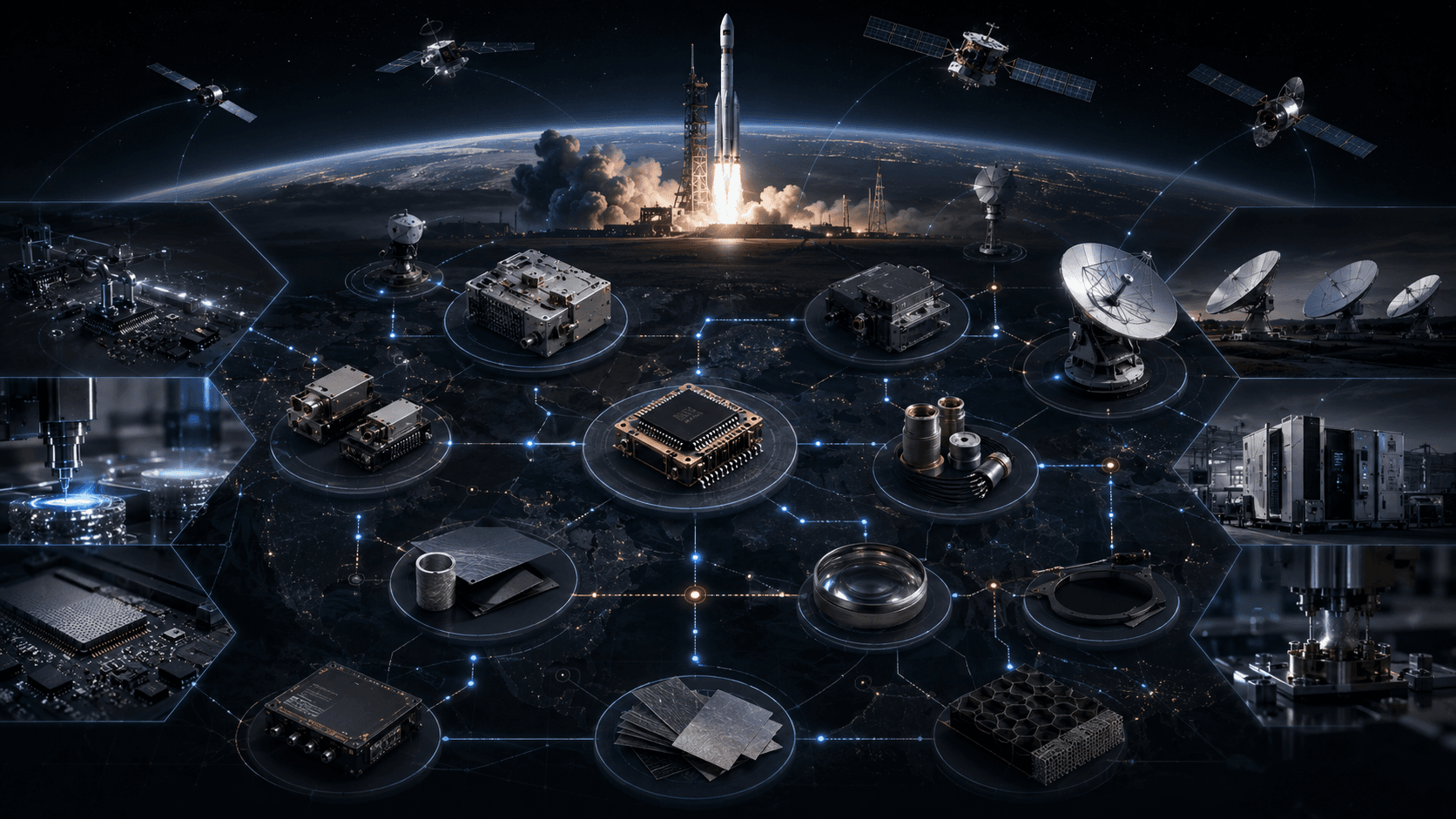
Hidden winners
Several names stand out as potential hidden winners – companies that rarely headline space narratives but sit on key bottlenecks.
Texas Instruments is one. It is usually valued as a broad analog semiconductor company, but its rad‑hard and rad‑tolerant lines give it a quiet but important role in space power and control. It looks small in the consolidated P&L, but the combination of qualification hurdles and long design‑in cycles supports pricing and margin resilience.
Microchip is similar, with an even sharper profile in some rad‑hard mixed‑signal devices. It is seen as an MCU/analog name, not a space supplier, but in flight computers and power systems its products can be critical. The risk for both is that space revenues remain a small slice of group sales for a long time, limiting thematic multiple expansion.
Amphenol and TE Connectivity look like “boring connector” companies – and that is precisely why they get overlooked. In space and defense, qualified connectors, cable assemblies and harnesses are deeply conservative choices for OEMs. Failure is catastrophic. Once qualified, these products are hard to displace. The narrative risk is dilution – space is one vertical among many – but the micro‑economics in that vertical are favourable.
Rogers and Materion sit even further in the background. Rogers’ high‑frequency laminates are critical in RF boards and antennas. Materion provides advanced metals and optical materials for space and defense. Neither will ever be thought of as “space companies” by the generalist investor. That is exactly why they could represent asymmetrical opportunities if LEO broadband, radar and optical payload demand inflects.
Moog and Curtiss‑Wright are industrial names with renewed space relevance. Their products – valves, pumps, actuators, control systems – are small pieces of very expensive systems. When failure cost is enormous, conservative procurement and high switching costs favour incumbent vendors.
BlackSky and MDA are less hidden but still under‑followed by mainstream investors. BlackSky’s small cap, high volatility and dependence on government work make it easy to ignore – yet it sits directly at the AI‑geospatial‑defense intersection. MDA’s Canadian base and complex mix of EO, radar and robotics make it less visible in U.S.‑centric narratives, but it is wired into Artemis‑era infrastructure.
Corning, finally, is pigeonholed as a glass and fibre optics name. Its role in specialty glass and optical components for space sensors and telescopes is not front‑of‑mind for many investors. As high‑end optics and deep‑space missions grow, that quiet exposure matters.
Pricing and hype risk in the equity layer
The most dangerous phase around a transformational IPO is the one where narrative overwhelms business quality. Rocket Lab’s recent moves are partially justified by its position as a real launch and spacecraft platform, but not every dollar of premium is fundamental. ASTS’s rally is more clearly narrative‑driven: the technology may be visionary, but financing and execution risks are very real.
Planet inhabits a liminal space between “imagery provider” and “data platform.” If the analytics side scales, the narrative has teeth; if not, the stock becomes a more generic space beta. BlackSky’s fundamentals are somewhat more anchored in actual defense contracts and clear customer needs, but its scale and funding profile still make it high‑risk. Iridium looks more mature and business‑like; Globalstar is closer to the speculative end. Both can rally in a space basket, but their underlying quality is not identical.
UFO as an ETF is a useful barometer for hype. When flows surge into thematic wrappers, the weakest businesses inside them go up alongside the strongest. That is what makes the early “everything goes up” phase both comfortable and dangerous. Price becomes a poor signal of quality.
Time horizons: when does which theme pay?
The 0–12 month window will be dominated by IPO dynamics, sentiment, ETF flows and headline risk. The fastest movers will likely be names that screen as “closest to SpaceX” or “purest space beta” rather than those with the best fundamentals. Capital can be made in this regime, but mostly through trading, not long‑term compounding.
In the 1–3 year horizon, fundamentals begin to assert themselves. Satellite deployments, government contract awards and AI‑geospatial adoption will drive business outcomes. This is the window where BlackSky, MDA, Planet analytics, rad‑hard suppliers, RF/connector companies and space‑heavy defense primes are most likely to see their positioning reflected in numbers and multiples.
Between 3 and 7 years out, the shape of Starship’s deployment, lunar and deep‑space infrastructure and defense‑space build‑out will define the narrative. If Starship delivers even a fraction of its promised economics, the cost structure of launch, and therefore the shape of downstream services, will change. But the program risk is large: the biggest dreams often carry the biggest delays.
Beyond 7 years, investors are dealing with frontier scenarios: orbital data centres, space‑based solar, in‑space manufacturing. It is too early to assign precise cash‑flow models. These should be treated as options rather than base‑case drivers.
The risk ledger
This is not a one‑way bet. The first structural risk is an over‑valued SpaceX IPO. A 1.5–1.75 trillion dollar market cap implies aggressive assumptions about launch economics, Starlink profitability and new business lines. If they fail to materialise on the expected timeline, the repricing will be felt sector‑wide.
The second is a sympathy‑driven bubble across smaller space names. High‑quality leadership at SpaceX does not magically turn every satellite or launch microcap into a good business. The third is low revenue / high cash‑burn profiles among many early‑stage players, which raises dilution and solvency risks if capital markets tighten.
Orbital debris and spectrum regulation are fourth‑order but increasingly tangible risks. If LEO gets too crowded or if regulators decide to slow or limit deployments, business plans can be delayed or capped. Defense budget cyclicality is another important variable: a downturn in spending would hit defense‑space and geospatial analytics names hardest. Finally, critical materials and semiconductor supply shocks – especially around gallium, germanium and rare earths – can raise costs and delay programs, even for well‑run companies.
Launch failures and program slips, of course, are evergreen risks. A single high‑profile failure can change the perceived risk of an entire theme overnight.
Narrative analysis
Is the space economy truly becoming a new infrastructure layer, or is the market dragging too much of 2040 into 2026? The honest answer is that both forces are at work. The infrastructure thesis is real: communications, Earth observation, defense ISR, geospatial analytics and critical component supply chains are all seeing tangible, budget‑backed demand. At the same time, markets are quite capable of romanticising that reality – especially when anchored to a charismatic, high‑profile IPO.
The SpaceX listing can mature the sector’s valuation framework over time by exposing the leading private operator to public scrutiny and price discovery. It can also inflate a bubble first. Big narratives often overshoot before they settle.
Is the cleanest investment in launch, broadband, geospatial analytics or the supply chain? There is no single correct answer. Launch owns the loudest story. Broadband offers a quasi‑infrastructure annuity if economics work. Geospatial analytics has the clearest near‑term AI monetisation. The component and materials supply chain has the lowest narrative content and the highest chance of being mispriced.
Is AI monetising space today, or mostly a long‑dated option? Both. In geospatial intelligence and defense analytics, AI is already a revenue driver. In constellation management and autonomy, it is a near‑term efficiency lever. In orbital data centres and space‑based solar, it is an idea. The investment discipline lies in keeping these buckets separate.
The intellectual centre of gravity is this: the space economy is not best understood as a “rocket story” but as an “infrastructure story.” And in infrastructure, the best long‑term returns often sit not in the most visible brand but in the layers that quietly resolve bottlenecks.

Final synthesis
Today, markets are getting one big thing right: space really is becoming a more central part of communications, defense and data infrastructure. Reusable launch economics, satellite broadband networks and AI‑enabled geospatial analytics prove that this is not an empty slogan.
What markets are under‑pricing is the way economic value cascades along the stack. Capital and media attention are clustering around rockets, branded constellations and thematic ETFs. Yet the most durable pricing power often resides in radiation‑hardened chips, RF/antenna/connectors, specialty glass and optics, advanced materials and mission‑critical control systems – precisely the layers most investors still treat as “boring industrials” or “generic semis.”
What markets are over‑pricing is the idea that every company with “space,” “satellite” or “AI” in its deck will enjoy SpaceX‑like economics. Many will not. Some will not survive the next funding cycle.
If one had to compress the asymmetry into a single line: launch is the biggest story, data and analytics are the clearest near‑term monetisation engines, and the quiet supply chain is the most likely source of mispriced, risk‑adjusted alpha. The space economy can be real – and probably is. But the first layer to get priced is rarely the best layer to own. In many cases, the largest long‑term gains will accrue not to the rockets themselves, but to the narrow component chains that make those rockets, satellites and data streams possible.


