
For roughly a decade, public markets priced Microsoft as the closest thing to a “perfect execution + cloud compounder” that mega-cap tech could offer. Azure’s double‑digit growth, Microsoft 365’s subscription engine and consistently high margins created a narrative that felt almost mechanical: strong recurring revenue, high visibility, robust free cash flow, disciplined buybacks and dividends, and a clear strategic arc around cloud and enterprise software.
The generative AI wave does not overturn that story, but it makes it far more complex. Capital expenditure is exploding, gross and operating margins are coming under pressure, the product stack is being re-architected in real time, and the company’s deep partnership with OpenAI sits at the intersection of competitive moat and strategic dependency. At the same time, Microsoft’s stock has fallen roughly 25–26% from its 2025 highs into early 2026—one of the weakest quarters for the stock in two decades—sending a very clear message: investors are no longer willing to just “trust the process” without re‑underwriting the entire AI economics.
Symbolically, this new phase is captured in two opposing moves. The Bill & Melinda Gates Foundation Trust has sold its remaining Microsoft shares—about 7.7 million shares worth roughly $3.2 billion—exiting a historic position built over decades. On the other side, Bill Ackman’s Pershing Square has built a new Microsoft stake of roughly 5.6 million shares, a ~$2.3 billion position financed in part by exiting Alphabet. One seller is a philanthropic vehicle winding down its portfolio over the next two decades; one buyer is an activist-style long‑only fund betting that a 21x forward P/E on one of the strongest software and cloud franchises in the world misprices the AI upside. Economically, these moves are not “Gates is bearish / Ackman is bullish” in a simplistic sense; they mostly reflect very different mandates, liquidity needs and views on valuation timing.
This essay asks a simple but loaded question: as Microsoft leans into AI, is it truly entering a new, AI‑native growth phase on top of an already powerful cloud and enterprise foundation? Or is it moving into a more ambiguous mega‑cap transition: structurally higher capex, temporarily compressed margins, real cannibalization risk and a more complex regulatory and competitive landscape? Put differently: AI is clearly Microsoft’s biggest opportunity; is it also its biggest execution and margin test?
How does Microsoft actually make money today?
To understand Microsoft’s AI transition, you first need a clear map of the business as it stands today. The company still reports in three primary segments:
- Productivity and Business Processes
- Intelligent Cloud
- More Personal Computing
Beneath these sit the actual economic engines: Azure, Microsoft 365, LinkedIn, Dynamics, Windows, GitHub, Gaming/Xbox/Activision, Security, and the Copilot product family.
Productivity and Business Processes is home to Microsoft 365 (including Office 365), Teams, Exchange, SharePoint, OneDrive, LinkedIn and Dynamics 365. Microsoft 365 bundles Word, Excel, PowerPoint, Outlook, Teams, and more into subscription packages that have become the de facto standard for enterprise productivity. Revenue here is predominantly commercial: annual and multi‑year contracts with enterprises, not one‑off consumer licenses. LinkedIn monetizes via B2B advertising, premium memberships and recruiting/talent solutions. Dynamics 365 is Microsoft’s SaaS ERP/CRM suite, squaring off against SAP and Salesforce across finance, operations, supply chain, and customer engagement.
Intelligent Cloud includes Azure, server products, and now a quickly expanding AI infrastructure layer. Azure is Microsoft’s general‑purpose cloud: infrastructure (compute, storage, networking), databases, platform services, and increasingly GPU‑heavy AI clusters for training and inference. Azure OpenAI Service and Azure AI sit in this segment, exposing GPT‑class models and other foundation models to enterprise customers with governance, security and compliance guardrails. Intelligent Cloud is the locus of both Microsoft’s growth aspirations and its capex surge.
More Personal Computing covers Windows OEM and commercial licensing, Surface hardware, Bing/search advertising, and Gaming (Xbox, services, Activision Blizzard). Windows revenue splits between OEM licenses sold to PC makers (cyclical, tied to PC shipments) and commercial volume licensing (more stable, contract‑based). Gaming combines console hardware, game sales, in‑game monetization and Game Pass subscriptions, now reinforced by Activision’s IP (e.g., Call of Duty).
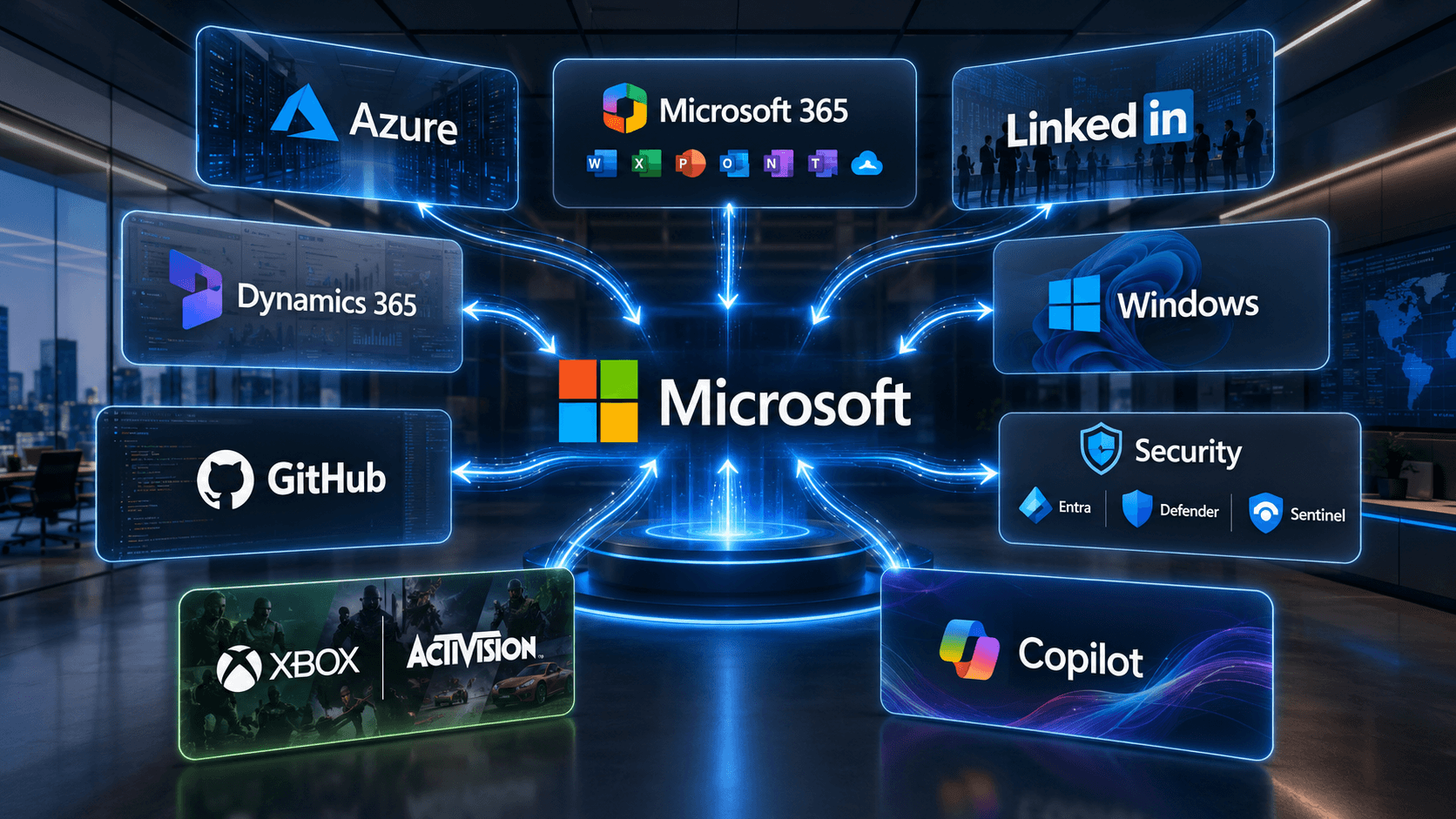
Around these segments, several horizontal product franchises matter enormously for the AI story:
- Azure: the cloud substrate and AI infrastructure backbone.
- Microsoft 365: the productivity suite that will carry much of the Copilot monetization.
- LinkedIn: a professional network and B2B ad platform that can be AI‑enhanced.
- Dynamics: the ERP/CRM platform where AI can reshape workflows.
- Windows: still critical for enterprise fleets and security baselines.
- GitHub: the developer hub through which GitHub Copilot and dev tooling AI are distributed.
- Gaming/Xbox/Activision: a consumer and content engine, less central to the core AI enterprise thesis but important for overall cash generation and optionality.
- Security (Entra, Defender, Sentinel, etc.): identity, endpoint, cloud security and SIEM/SOAR, with AI‑enhanced detection and response.
- Copilot: the cross‑suite AI assistant family that sits on top of all of this.
The Copilot family is being layered onto this existing revenue base as a new AI surface. Microsoft 365 Copilot embeds generative AI into Office applications; GitHub Copilot targets developers; Security Copilot supports security teams; Dynamics Copilot augments sales, support and finance workflows. Copilot Studio and Agent 365 provide tools to build and manage custom AI agents and domain‑specific copilots, creating an “AI layer” that cuts across the entire Microsoft stack.
The starting point, then, is clear: Microsoft is not a pure AI platform company yet. It is a cloud + enterprise software giant systematically infusing AI into every layer of that stack.
Revenue quality: why it is still strong
The striking thing about Microsoft’s current risk profile is this: AI clearly introduces real risks, but it has not yet degraded the core quality of revenue. Three structural features matter here: subscription models, enterprise contracts, and the CRPO/deferred revenue engine.
First, subscription. Microsoft 365, Dynamics 365, LinkedIn Premium and Recruiter, GitHub Enterprise, Game Pass, Security suites and now Copilot licenses are all subscription‑based. Renewals are high, particularly in the commercial business. Revenue is not primarily driven by lumpy, one‑off license sales; it flows from recurring contracts, seats and expansions.
Second, enterprise agreements. Large customers typically sign multi‑year, company‑wide contracts covering Microsoft 365, security bundles, Windows enterprise licensing and committed Azure consumption. Seat‑based pricing is common, but the real economic muscle comes from upsell: moving from E3 to E5 (and potentially E7), attaching security and compliance modules, and now adding Copilot layers on top.
This is where ARPU and upsell come in. Rather than brute‑force price hikes, Microsoft grows per‑user economics by pushing customers into higher‑tier bundles and attaching additional capabilities like Copilot. That’s precisely the logic behind discussions of an E7 SKU: more AI, more security, more compliance, higher ARPU.
Third, CRPO and deferred revenue. Microsoft’s remaining performance obligation (RPO) and commercial RPO are substantial—hundreds of billions of dollars in already‑contracted but not yet recognized revenue. Deferred revenue adds another buffer. This gives Microsoft unusual forward visibility into its top line, especially in cloud and enterprise software.
Put together, these dynamics yield a simple conclusion: Microsoft definitely has AI‑related risk, but its revenue quality—recurring nature, margin profile and cash‑conversion—remains intact. The market’s concern is not “does this business still generate high‑quality revenue?” but “how much of that revenue will be consumed by AI capex and inference cost, and for how long?”
The AI push: what is Microsoft actually building?
Microsoft’s AI strategy is often summarized as “we added AI features to Office and GitHub.” That framing is far too shallow. The company is trying to re‑architect the entire stack—cloud, data, applications and identity—around AI.
The first pillar is the OpenAI partnership. Microsoft has invested billions into OpenAI and secured a deep commercial relationship that makes Azure the primary cloud for OpenAI workloads, while also giving Microsoft economic participation via a significant equity stake and revenue sharing. GPT‑class models and other OpenAI models power Copilot products and Azure OpenAI Service, giving Microsoft early access to leading generative AI capabilities.
The second pillar is Azure OpenAI Service and Azure AI. Azure OpenAI exposes GPT‑4/4.5‑level models via APIs to enterprise customers with Azure‑grade governance and security. Corporates can keep data in their own Azure environments and build chatbots, content generation pipelines, summarization tools, coding assistants and domain‑specific agents. On top of this, Azure AI Studio and the broader Azure AI platform host not just OpenAI models but also Microsoft’s own models and multiple third‑party models. This is where the model‑agnostic strategy becomes visible: Azure as a multi‑model AI platform rather than an OpenAI‑only conduit.
The third pillar is Microsoft 365 Copilot. Copilot is embedded across Word, Excel, PowerPoint, Outlook and Teams, automating emails, meeting summaries, document drafting, data analysis and presentation creation. It is sold as an add‑on license on top of Microsoft 365 and, increasingly, is expected to be bundled into higher‑tier SKUs. In effect, Microsoft is trying to turn Microsoft 365 from “software suite” into “AI‑augmented workflow environment.”
The fourth pillar is GitHub Copilot. Here, the target is developers. GitHub Copilot provides AI‑assisted code completion, refactoring and documentation. Given GitHub’s centrality in the developer ecosystem, this is not just a feature; it’s a way to lock developers into Microsoft’s toolchain and generate incremental subscription revenue.
The fifth pillar is Copilot Studio and AI agents. Copilot Studio lets customers build their own domain‑specific copilots and agents, connect them to internal data sources and define how they operate under corporate policy. Microsoft Agent 365 acts as an identity and policy control plane for these agents inside the Microsoft 365 environment. This is a key architectural move: re‑defining “user” to include AI agents with identities, permissions and audit trails.
The sixth pillar is the model‑agnostic Azure AI strategy. Alongside OpenAI, Microsoft offers its own models and third‑party/open‑source models on Azure AI. This not only broadens the customer value prop (choose the right model for your use case) but also mitigates over‑dependence on any single model provider.
Net‑net: Microsoft is not just bolting AI onto existing products. It is rebuilding the platform so that AI is woven into infrastructure (Azure), data, application logic (Copilot), identity and governance (Agent 365). The question is no longer “does Microsoft have AI?” but “can it translate this architecture into durable economics?”
Is Copilot truly a new revenue layer?
From an investor’s perspective, the single most important near‑to‑medium term question may be this: does Copilot actually create a new, incremental revenue layer, or is it just re‑packaged existing value?
Today, Copilot is largely sold via seat‑based licenses. Enterprises buy Copilot for subsets of users; it’s layered on top of Microsoft 365 subscriptions at a premium per‑user price. Early signals show very selective roll‑outs, often starting with knowledge workers or specific teams. There are already examples of companies scaling back from initial seat counts once they evaluate actual utilization and ROI.
At the same time, there is a growing discussion of an E7 premium bundle that would package Copilot with advanced security, compliance and data capabilities in a higher‑priced SKU. The logic mirrors past cycles: higher functionality at a higher tier, driving ARPU via mix shift. If E7 materializes, Copilot would be both an add‑on license and a catalyst for tier‑migration.
The structural tension is that AI economics are usage‑driven while Microsoft’s commercial contracts are historically seat‑driven. The costs—training and especially inference—scale with API calls, tokens and compute usage. But Copilot today is priced per user, not per token. That means Microsoft must manage utilization, model efficiency and infrastructure costs tightly to avoid Copilot eroding margins.
For Copilot to be a genuine new revenue layer, three things have to be true:
- Adoption must be broad enough that Copilot revenue is material at the consolidated level.
- Perceived ROI must be clear enough that customers are willing to keep paying and expand seat counts, rather than trimming or limiting to pilots.
- Unit economics must be favorable: incremental Copilot revenue per user exceeds incremental infrastructure and inference costs by a comfortable margin.
Right now, adoption is still early but growing. The potential is massive, but the data is not yet conclusive. That is why Copilot sits at the center of the investment debate: if it succeeds, it can push Microsoft 365 ARPU to a structurally higher plateau and validate the AI capex; if it disappoints, some of the AI spend will look like cost without a matching revenue engine.
The AI threat: will Microsoft weaken its own products?
AI is not just a growth lever for Microsoft; it is also a potential threat vector—especially to Microsoft’s own product and pricing architecture.
One risk is that AI agents reduce direct Office usage. If the dominant workflow becomes “tell an agent what you want” rather than manually crafting documents and emails inside Office apps, the user’s perceived value shifts from the application surface (Word, Outlook) to the agent layer. In that world, the licensing logic of “everyone gets a full Office seat” is less obviously necessary—at least in theory.
Whether that risk materializes depends heavily on how Microsoft positions those agents. If agents are deeply embedded into Office surfaces and require full M365 licenses, they reinforce the suite rather than substitute it. If they become more independent, they could in principle hollow out the value of some seats.
A second risk is that the seat‑based model erodes in favor of usage‑based economics. Many AI‑native companies price by usage—API calls, tokens, or volume of tasks. That aligns revenue and cost more tightly. Microsoft’s existing enterprise contracts are seat‑based with some consumption‑based components (Azure), so there is a structural mismatch. Over time, this may push Microsoft toward hybrid models that combine per‑user and per‑usage pricing—great for flexibility, but harder to manage and potentially disruptive to legacy economics.
A third risk is the rise of AI‑native productivity and workflow entrants. Entirely AI‑first email, meeting, document and project tools are emerging, especially appealing to startups and SMEs that are less locked into Microsoft’s ecosystem. Today, network effects, compliance and enterprise requirements still favor Microsoft. But if a new generation of workers grows up in AI‑first tools, the long‑term gravitational pull of Microsoft 365 can’t be taken for granted.
Finally, there is the ambiguous relationship with OpenAI’s own enterprise products. ChatGPT Enterprise and similar offerings can serve as front‑doors for enterprise AI workloads. Some of those workloads run on Azure, which benefits Microsoft at the infrastructure level. But if the user experience and brand are owned by OpenAI, some application‑level value may accrue to OpenAI instead.
The bottom line: Microsoft’s biggest AI risk is not just external competitors; it is the possibility that its own AI agent and Copilot strategy cannibalizes parts of its legacy seat‑based business. The company is explicitly trying to avoid that outcome by embedding AI into its existing surfaces and licensing logic. Whether that works is one of the defining questions of the next 3–5 years.
OpenAI: moat or dependency?
The OpenAI relationship sits at the heart of Microsoft’s AI story—and its risk profile.
On the moat side, the partnership has given Microsoft early and deep access to world‑class generative models. That has translated into differentiated products (Copilot across the suite, Azure OpenAI Service) and a powerful time‑to‑market advantage versus enterprise competitors that had to either build or license models more slowly. Economically, the structure includes cloud commitments and revenue‑sharing provisions that send meaningful value back to Microsoft. OpenAI workloads run primarily on Azure, driving high‑value AI compute consumption. An updated agreement reportedly includes a multi‑billion‑dollar payment from OpenAI to Microsoft in 2026 and long‑dated IP and model access for Microsoft through 2032, even as OpenAI is given the formal flexibility to explore other clouds.
On the dependency side, regulators are increasingly focused on the power dynamics between big tech platforms and leading AI model providers. OpenAI itself flags Microsoft as a key risk factor in its own documentation, making explicit that the relationship cuts both ways. Regulatory scrutiny in the US and Europe could eventually force structural changes in how the partnership is governed or how exclusive Microsoft’s advantages can be.
Additionally, the new agreement’s provisions that allow OpenAI to test or use other cloud providers underscore the reality that multi‑cloud and vendor diversification are not going away. Over time, this could dilute the “exclusive” sheen of the partnership. In a world where OpenAI can run meaningful workloads on other clouds, Microsoft’s advantage shifts from exclusivity to depth of integration and total platform value.
This is why Microsoft’s own model strategy and model‑agnostic Azure AI platform are so important. The company is deliberately building for a future where customers choose from multiple model families. That doesn’t eliminate dependency risk, but it does reduce the tail risk of being over‑exposed to a single partner’s fortunes and regulatory treatment.
In short, OpenAI is both a powerful moat and a genuine strategic dependency. For now, its net effect is clearly positive. But investors should treat it as a high‑variance advantage, not a static one.
Financial quality: deterioration or temporary margin squeeze?
Looking across FY2021 to FY2025 and into early 2026, a pattern emerges.
In FY2021–FY2022, Microsoft enjoyed the classic “cloud + enterprise software” phase: strong double‑digit revenue growth, led by Intelligent Cloud and Productivity and Business Processes; high gross and operating margins, often around or above the 30% mark; substantial free cash flow margins; and capex rising but still within the pre‑AI norm.
In FY2023–FY2024, the AI build‑out shifted into higher gear. Revenue continued to grow robustly, but capex stepped up sharply. GPU‑rich data centers, expanded regions, and AI‑specific infrastructure pushed quarterly capex to unprecedented levels. Net income remained high, but the margin structure began to show mild pressure: amortization picked up, operating expense grew in R&D and sales to support AI integration and go‑to‑market. Free cash flow stayed strong but FCF margins edged down as a direct function of higher capital intensity.
By FY2025 and early 2026, those trends intensified. Microsoft’s stock logged a ~25% drop from its peak, with some commentary calling it one of the worst quarterly performances in two decades. At the same time, AI‑driven capex for the broader big tech cohort approached the $650–700 billion annual run‑rate range; Microsoft was squarely in that wave. Its own capex numbers pushed into territory where individual quarters nearly matched entire prior years’ outlays.
Have these developments undermined financial quality? Not yet, in the conventional sense. Revenue remains predominantly recurring, margins—although off their peaks—are still high by global standards, free cash flow remains substantial, and the balance sheet is strong. The degradation is not in absolute quality but in capital intensity and margin trajectory. AI capex and associated depreciation are compressing margins in what looks like a transition phase.
The key judgment call is whether this is structurally permanent or largely temporary. If AI‑driven revenue (Azure AI consumption, Copilot seat and bundle revenue) ramps sufficiently over the next 3–5 years, the margin compression phase could look like a classic investment cycle: painful in the near term, accretive in the long term. If not, then the company risks settling into a structurally more capital‑intensive, lower‑margin equilibrium.
Balance sheet, capex and AI infrastructure
To fully grasp Microsoft’s AI bet, you must see it not just as software but also as a physical infrastructure story.
Capex has surged as Microsoft scales AI‑optimized data centers globally. This includes land, buildings, power, cooling, networking, and above all, GPUs and other accelerators. This spend is front‑loaded: hardware and facilities must be built well ahead of peak utilization. That is why attempts to cap or slow this capex wave are constrained: if Microsoft under‑invests now, it risks ceding AI workloads to rivals; if it over‑invests, it risks lower utilization and depressed returns.
High capex inevitably raises depreciation and amortization over time. Even if capex normalized tomorrow, the impact on the P&L would lag, as assets are depreciated over several years. That means the margin drag from today’s capex will ripple through future years’ income statements.
Free cash flow remains solid—thanks to the underlying software economics—but FCF margins are lower than they would be in a low‑capex environment. The company’s healthy cash and investments position and moderate debt load give it the financial flexibility to sustain this capex cycle. That balance sheet strength is a critical part of the AI case: not every company can afford to make this bet.
The crucial investor question is capex productivity: how much incremental high‑margin revenue will each incremental dollar of AI infrastructure generate? The answer will show up in three places over time: Azure AI revenue growth, Copilot revenue growth and the stabilization or recovery of FCF margins.
At a high level, it is fair to say that Microsoft’s AI thesis demands not just software execution but also industrial‑scale infrastructure execution. That is a different playbook than the low‑capex, purely software‑driven Microsoft of the early 2010s.

Quantum: real option or remote R&D?
Quantum computing sits at the periphery of Microsoft’s current investment case, but it is not irrelevant.
Azure Quantum offers a platform for experimenting with quantum hardware and algorithms, integrating with classical computing environments and providing an early taste of “quantum‑as‑a‑service.” More importantly, Microsoft has long pursued a topological qubit / Majorana approach: a theoretically more stable and error‑tolerant qubit design that, if successful, could offer significant advantages over more conventional superconducting architectures.
Recent years have seen experimental progress reported on topological qubits, but the technology remains firmly in the research stage. There is no line of sight to meaningful commercial revenues in the near term. Any realistic monetization horizon is 5–10 years out, and likely beyond the explicit forecast spans used in most equity models.
From a valuation perspective, quantum is best treated as an out‑of‑the‑money call option on a future technology curve. If it pays off, it could reinforce Azure’s long‑term differentiation. If it does not, it doesn’t break the current AI and cloud thesis. Quantum is not the reason you own (or avoid) Microsoft today; it is a potential long‑dated upside kicker.
The last 90 days: why has sentiment shifted?
The last 90 days have been crucial in reshaping Microsoft’s narrative.
The stock’s ~25–26% drop from its highs has forced investors to reckon with the scale and timing of AI spending. Analysts and commentators are now talking openly about “record profits, record spending.” The sustained capex guidance for 2026 and beyond—reflecting continued AI data center build‑out—has heightened concerns about how quickly those investments will translate into incremental, high‑margin revenue.
Gates Foundation’s complete exit from Microsoft added a symbolic twist. This was interpreted by some as a negative signal—“if Gates is selling, what does he know?”—even though the Foundation’s stated plan to fully deploy its endowment by 2045 and increase annual grantmaking provides a very different explanation: liquidity and philanthropic mandate, not a company‑specific bearish thesis.
Ackman’s new position in Microsoft offered a counter‑signal. His public framing emphasizes Microsoft 365 and Azure as core franchises, with AI and the OpenAI relationship as undervalued layers on top. Whether one agrees with his exact valuation math or not, the move underscores that sophisticated capital still sees upside in Microsoft post‑correction.
Analyst consensus remains skewed toward Buy / Strong Buy, with average 12‑month price targets significantly above current levels. However, there are also high‑profile downward revisions and more cautious stances, especially from analysts focused on capex, Azure growth trajectories and AI economics.
Layered onto this are product‑level narratives: speculation about an E7 SKU, deeper Copilot bundling, and more explicit disclosures around Copilot user counts and monetization. All of this has shifted the conversation away from “is Microsoft missing the AI wave?” to “what does the AI wave do to Microsoft’s P&L in practice?”
In short, the last 90 days have been less about breaking the Microsoft story and more about forcing a repricing of uncertainty. The stock is no longer treated as a low‑risk, high‑growth default; it is being re‑underwritten as a complex AI transition.
Competition and counter‑narratives
Microsoft’s AI transition occurs in an intensely competitive landscape.
In cloud, Azure faces AWS and Google Cloud. All three are investing heavily in AI infrastructure, model partnerships and managed AI services. Multi‑cloud architectures are the norm in large enterprises, which naturally limits any one player’s ability to fully dominate. Microsoft’s differentiation lies in its integration of Azure with the rest of its enterprise stack (M365, security, identity), but AWS’s breadth and Google’s AI/data chops mean the race is far from one‑sided.
In productivity, Microsoft 365 competes with Google Workspace—but more importantly, it now faces the shadow of AI‑native productivity tools. New entrants are building email, meeting, document and workflow platforms that assume an AI‑first interface from day one. These tools lack Microsoft’s scale, compliance and ecosystem, but they iterate fast and may capture mindshare in younger or more nimble organizations.
In security, Microsoft’s scale and integration are advantages: identity (Entra), endpoint and cloud security (Defender), SIEM/SOAR (Sentinel) all sit inside the same ecosystem as productivity and cloud. Yet best‑of‑breed vendors like Palo Alto Networks and CrowdStrike push aggressively in specific sub‑domains, sometimes out‑innovating in niche areas and winning in security‑focused buyers.
In developer tools, GitHub enjoys unique network effects, but competitors like GitLab and Atlassian integrate their own AI code assistants. Here, the risk is less about erosion of the core and more about how much incremental monetization Microsoft can extract via Copilot versus competitors.
These competitive realities feed counter‑narratives. One says: Microsoft is the AI platform winner, leveraging Azure, M365 and OpenAI into a dominant position. Another says: Microsoft is over‑spending on AI infrastructure, while competitors can ride the same model wave without as much capital intensity, and AI‑native entrants will nibble at its edges.
The truth likely lies in between. Microsoft has genuine structural advantages but also real vulnerabilities—particularly around pricing models, cannibalization risk and regulatory exposure.
Bull case vs. Bear case
In the bull case, Microsoft manages the AI transition deftly:
- Azure growth re‑accelerates on AI workloads, keeping the cloud business in the 20%+ growth zone and expanding Azure’s share of total company revenue.
- Copilot adoption ramps decisively, driving a structurally higher Microsoft 365 ARPU and adding a material new revenue layer for GitHub and security products.
- AI agents and Agent 365 deepen lock‑in, making Microsoft the default platform for enterprise AI workflows rather than just one provider among many.
- The OpenAI partnership remains strategically and economically favorable. Regulatory outcomes may impose guardrails but do not fundamentally weaken the economic relationship or Microsoft’s ability to ship OpenAI‑powered products.
- Security and developer tools (GitHub + Copilot) compound as high‑growth, high‑margin adjacencies.
- Capex productivity improves as utilization rises. Capex as a percentage of revenue stabilizes, depreciation is absorbed, and free cash flow margins begin to recover.
- Post‑correction valuations reset to more reasonable levels, allowing earnings and FCF growth to drive significant long‑term compounding.
In this scenario, Microsoft emerges as the default enterprise AI platform, and the current AI capex wave is remembered as a painful but ultimately value‑creating investment cycle.
In the bear case, the AI economics don’t work as cleanly:
- AI capex returns are slower and lower than expected. Azure AI workloads do not scale fast enough to absorb the increased capacity at high utilization and margin.
- Azure growth decelerates under competitive pressure from AWS and Google Cloud, particularly in AI and data‑heavy workloads.
- Copilot adoption fails to meet expectations. Many enterprises pilot the product but deploy narrowly; perceived ROI is ambiguous and many customers limit seat counts or roll back. Copilot’s incremental revenue falls short of its incremental cost.
- OpenAI diversifies more aggressively toward other clouds and enterprise routes; regulatory actions force changes that reduce Microsoft’s economic participation or strategic flexibility.
- AI‑native and best‑of‑breed competitors in productivity and business applications begin to peel away certain workloads from Microsoft, particularly in new or fast‑growing companies.
- Margins remain compressed. Capex remains elevated longer than anticipated, depreciation and inference costs keep gross and operating margins under pressure, and free cash flow growth slows meaningfully.
- Valuation remains rich relative to this new, more capital‑intensive reality. The market gradually reprices Microsoft more like a mature mega‑cap with constrained growth and structurally lower returns on incremental capital.
In this scenario, Microsoft is still a formidable company, but the AI transition looks more like a value‑destructive arms race than a high‑return capital allocation story.
Catalyst map
Given this range of outcomes, what should investors actually watch?
- Azure growth and AI workload mix: Quarterly Intelligent Cloud and Azure growth rates, plus any qualitative commentary on AI’s contribution, are the heartbeat of the cloud thesis. Sustained high‑teens to 20%+ growth, with AI as a growing share, supports the bull case. Noticeable deceleration, especially if tied to competitive losses, strengthens the bear case.
- Copilot adoption and monetization: Actual numbers on Copilot users, seats, and revenue contribution—especially if management begins to break them out more explicitly—will clarify whether Copilot is a true new revenue layer. ARPU trends and SKU mix (e.g., uptake of premium bundles) will matter as much as raw seat counts.
- OpenAI regulatory and structural outcomes: Regulatory decisions around the Microsoft–OpenAI relationship, and any observed shifts in the partnership’s economics or exclusivity, will either solidify the moat narrative or amplify dependency risk.
- Capex and FCF dynamics: Capex levels, capex guidance and free cash flow margins are the core financial levers. Evidence of capex flattening and FCF margin recovering signals that the investment phase is giving way to monetization. Continued upward revisions to capex without corresponding revenue leverage will deepen concerns.
- Security and GitHub growth: Strong performance in security and developer tools would confirm that Microsoft’s adjacencies are turning into robust profit centers and not just support functions for Azure and M365.
- Quantum milestones: Not a near‑term driver, but significant breakthroughs in Azure Quantum and topological qubits could enhance Microsoft’s long‑term technology optionality. Realistically, that’s a long‑dated call option, not a primary catalyst.
Together, these catalysts form a map of Microsoft’s AI transition. None of them alone will answer the question; but collectively, they will shape how the market re‑prices the company over the next 3–5 years.
Narrative analysis: is Microsoft still a quality compounder?
So where does this leave Microsoft as a narrative object?
On one axis, you have the classic quality compounder story: high recurring revenue, high margins, strong FCF, a massive installed base and a balance sheet that can absorb bold bets. On another axis, you have a new AI‑driven story: structurally higher capital intensity, deeper dependence on ecosystem partnerships, and product architectures that may cannibalize parts of the legacy business even as they create new revenue streams.
Factually, Microsoft still looks like a quality compounder: its revenue base is sticky, margins remain high by global standards despite recent compression, and its balance sheet is robust. But that “quality” now sits inside a more volatile envelope. AI introduces tail risk (regulation, cannibalization), more variable capex and a much wider range of possible long‑term outcomes.
Capex itself straddles the line between problem and necessity. It is clearly high, and it clearly compresses margins in the near term. But it is also the price of admission to being an AI infrastructure and platform leader. Without these investments, Microsoft could not credibly claim to be the place where enterprises run AI workloads at scale. The question is less “is capex too high?” and more “does the return profile justify the capex curve?”
Copilot, similarly, is not yet today’s profit engine; it is a future profit engine in the making. It demands hefty model and infrastructure investment upfront, while adoption and monetization ramp over time. If Copilot and related AI products ultimately deliver the ARPU uplift and stickiness Microsoft is aiming for, they could become the defining revenue layer of the next decade. If they fall short, they will still be useful features—but ones that leave the cost side of the ledger heavier than the revenue side.
In this sense, Microsoft is no longer the almost risk‑free compounder that some investors grew accustomed to. It is a high‑quality, high‑optionality compounder entering a more uncertain—but also more asymmetric—phase. The upside is substantial; the path to it is bumpier and more capital‑intensive.
Final synthesis: what is the market pricing—and what really matters?
We can close with three pointed questions.
1. What is the market getting right today?
The market is correctly recognizing that AI introduces genuine cost and risk. The sustained capex surge, margin compression, OpenAI dependency and regulatory overhang justify a re‑rating from the “flawless execution, low‑risk” phase. A 25–26% drawdown from the highs is a rational response to a world where future cash flows are more uncertain and capital intensity higher.
At the same time, the market rightly still prices in the reality that Microsoft’s core franchises (Azure, Microsoft 365, Windows enterprise, security, GitHub) are structurally strong, with sticky customers, high switching costs and a vast installed base. This is not a broken business; it’s a powerful business being stress‑tested by a new technology paradigm.
2. What is the market mispricing or under‑pricing?
On one side, investors may be underweighting the medium‑to‑long‑term potential of AI‑driven monetization—especially if Copilot and Azure AI become as central to enterprise workflows as Office and Windows once did. On the other, some may be over‑weighting the permanence of current margin compression, implicitly assuming that AI capex will either remain structurally high relative to returns or that AI‑native competitors will commoditize much of the value.
Additionally, the nuances of the OpenAI partnership—economic flows, contract duration, and Microsoft’s simultaneous push toward model‑agnostic Azure AI—are not fully reflected in simple “dependency” narratives. There is real risk, but there is also a lot of embedded optionality and bargaining power.
3. What is the single most critical re‑pricing variable?
Several matter: Azure AI growth, Copilot monetization, margin recovery, regulatory outcomes. But if you have to pick the single most important, it’s the AI revenue engine—the combined effect of Azure AI and Copilot monetization.
If AI revenue grows fast enough and profitably enough, it will validate the capex, drive operating leverage and eventually restore or improve margin profiles. That, in turn, will make regulatory risks and partnership structures easier to digest because they will be operating on top of a clearly successful economic engine. If AI revenue underwhelms, capex will look like over‑investment, margins will stay compressed and the market will be forced to re‑value Microsoft as a structurally more capital‑intensive, slower‑growing mega‑cap.
Ultimately, Microsoft’s AI transformation is real. The company is not dabbling; it is rebuilding its platform around AI from infrastructure to applications. But this transformation is not a free lunch. It will likely compress margins before it unlocks the full economic upside. For the stock, the core question is not whether the technology works—it almost certainly will in some form—but whether the timing and magnitude of the economic payoff justify the capital and risk being deployed.
Microsoft is trying to complete a transition from a classic enterprise software and cloud company to an AI‑native cloud and enterprise platform. It has the assets, the distribution and the balance sheet to succeed. Whether it does so in a way that preserves and extends its compounding profile—or in a way that leaves it as a more complex, lower‑return mega‑cap—depends less on engineering breakthroughs than on the pace and efficiency with which that AI stack is monetized.


