
Markets carry a deeply ingrained reflex: when war breaks out, gold goes up. This reflex has been so thoroughly internalized that it barely requires thought geopolitical shock hits, safe-haven demand kicks in, gold rallies. March 2026 delivered a rare lesson in why this reflex does not always hold.
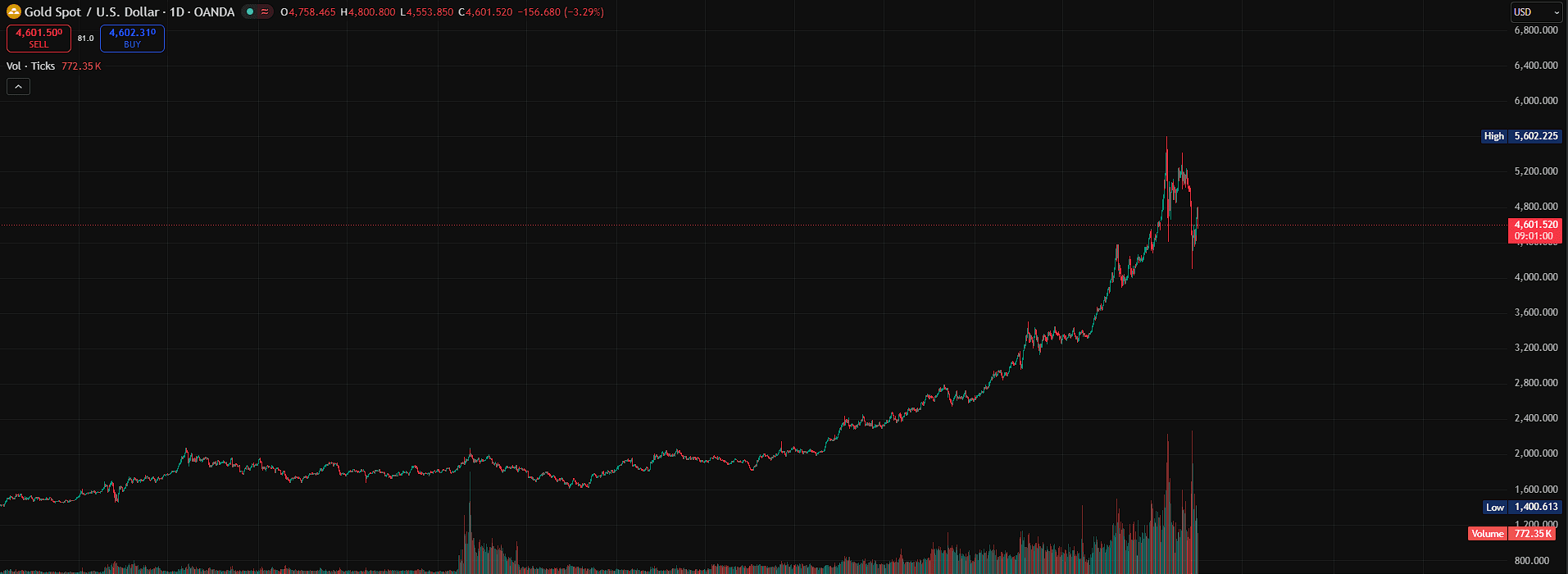
When the United States and Israel struck Iran on February 28, 2026, and Iran's Revolutionary Guards effectively shut down the Strait of Hormuz, the setup looked like precisely the kind of crisis that gold was built for. And gold did, in fact, rally for a few hours. What followed was nothing like what investors expected: gold retreated from its February peak of ~$5,589 all the way to a ~$4,079-4,557 range by mid-March a correction of roughly 18-19% from the high. The monthly loss of 11-15% represented the sharpest single-month drawdown since the 2008 Global Financial Crisis.
The problem was not the war itself. The problem was which economic mechanism the war set in motion. Hormuz closed, oil surged, inflation expectations jumped, Fed rate cuts were pushed back, the dollar strengthened and non-yielding gold absorbed the full force of every one of these channels. For the classic 'geopolitical risk = gold up' script to play out, the crisis needed to bypass the inflation channel. In March 2026, the opposite happened.
What Actually Happened in March 2026?
The chronology, stripped to its essentials: February 28, war began. March 3, Hormuz closed. March 9, Brent crude crossed $104. By mid-March it reached $119.50 a single-month surge of roughly 60%, the largest monthly price increase since the 1990 Gulf War.
Gold's response unfolded in two distinct phases. In the first phase within hours of the initial strikes spot gold genuinely spiked to $5,278. That was the expected geopolitical response: uncertainty surged, safe-haven demand activated. But the reaction lasted only a matter of hours. In the second phase, markets stopped pricing the war and started pricing what the war meant. A Hormuz closure was an oil shock. An oil shock meant inflation. Inflation meant a restrictive Fed. A restrictive Fed meant no rate cuts. That chain translated into a clear and direct headwind for gold.
On March 3, gold fell approximately 6% while Hormuz headlines were still running. The apparent contradiction was entirely rational. Once the initial shock faded, gold was absorbed into the macro repricing regime. And in that regime, conditions were sharply unfavorable.
The March 18 FOMC meeting landed the final blow. The Fed revised its 2026 PCE inflation median forecast to 2.7% above the previous projection. The dot plot penciled in only a single rate cut for 2026, and not until the final quarter. CME FedWatch had begun pricing zero cuts for the full year. Gold, trading near $5,000, fell to approximately $4,079 across four trading sessions.
For context: Q1 2026 net performance was still +4% positive. Gold had been structurally strong heading into the year. The sell-off was not a repudiation of the long-term thesis it was a violent reset of an overcrowded position colliding with an abrupt macro context shift.
Macro Transmission Mechanism: From Oil to Rate Repricing
The spine of this analysis rests on a single chain: War → Oil ↑ → Inflation expectations ↑ → Rate cut expectations ↓ → Dollar and real rates ↑ → Gold and silver sell-off. Every link in this chain fired. Together, they formed a self-reinforcing pressure cascade.
On the oil front: Brent crude was trading near $73 before the Iran strikes. It peaked at $119.50 in March a ~60% monthly gain. A Reuters poll of oil analysts revised their 2026 Brent average forecast upward by approximately 30% in a single month the largest single-month poll revision since 2005. Goldman Sachs projected that oil could remain above $120 for as long as Hormuz stayed closed.
On inflation: The US February PPI reading came in above expectations (+0.7% month-on-month) in the weeks after the oil shock. Market inflation break-even rates spiked. The Fed's upward revision of its 2026 PCE median forecast from 2.3% to 2.7% confirmed that the central bank was absorbing this inflationary signal into its baseline.
On rate cut expectations: As of March 2, CME FedWatch data priced roughly 37 basis points of cuts for 2026 down from over 60 basis points in January. After the FOMC meeting, that figure dropped to zero. KB Valbury analysis noted that even the June 2026 meeting was priced at only 50% probability of a 25bp cut.
On the dollar and yields: DXY rose from approximately 96 in early February to ~100.50 by mid-March a gain of roughly 4.7% and a 10-month high. The 10-year US Treasury yield climbed to 4.40%, its highest level since July 2025.
Every link in the chain was operative. But there is a critical nuance: the chain hit this hard because the starting conditions had set the stage. Gold was trading near all-time highs; positioning was extremely crowded; markets had spent years pricing a rate-cutting cycle. The oil shock shattered that balance instantaneously. The result: a pressure cascade in which everything turned negative simultaneously.
Why Didn't Gold Behave Like a Classic Geopolitical Hedge?
The more precise question is not 'does gold fall during wars?' but rather: which kind of war lifts gold, and which kind grinds it lower?
Recall the oil embargoes of the 1970s. Energy shocks struck, inflation surged and gold did rally, dramatically. The difference lay in the Fed's response: in that era, monetary policy reacted too slowly and too softly. Real rates remained deeply negative. That was gold's ideal environment eroding purchasing power, weak currencies, active demand for inflation protection.
The structural difference in 2026: the Fed was already positioned at a relatively restrictive 3.75% when the oil shock arrived. Every fresh inflation print pushed rate-cut expectations further back. The 10-year nominal yield hit 4.40%; real yields potentially climbed above 2%. For a non-yielding asset like gold, this represents a direct and measurable opportunity cost.
Saxo Bank's Ole Hansen summarized the mechanism: "Rising inflation expectations drove yields higher, reducing the appeal of non-yielding assets; a stronger dollar and falling rate-cut expectations added further pressure." Deriv's Prakash Bhudia was more direct: "Gold fell not despite the conflict but because of it. The war drove oil higher, oil raised inflation expectations, that killed rate cuts, that strengthened the dollar, that crushed gold."
The 'safe haven broken' narrative is therefore misleading. Gold functions as a cleaner safe haven in crises that do not ignite the inflation channel financial panics, deflation scares, banking stress. The Iran war did not belong in that category. It was a crisis that fired the inflation channel directly, and in that configuration the rates-sensitive identity of gold dominated its geopolitical identity.
The Forced Liquidation Dimension
Beyond the fundamental macro pressure, a second layer was deepening the decline: liquidity-driven forced selling.
CFTC Commitment of Traders reports showed managed money funds reducing their long positions in gold by approximately 20% through the end of March. This was not merely a macro view change it was the signature of leveraged position unwinding under duress.
In silver, this dynamic was significantly more violent. COMEX imposed back-to-back margin hikes in late January 2026: 11% on January 28 and 15% on January 30. This triggered a classic negative feedback loop: price rises, margin requirements increase, forced liquidation hits, price falls, new margin shortfalls emerge, more forced selling follows. The same loop re-engaged in March's deteriorating macro context.
For institutional investors, a separate mechanism was also at work: losses accumulating across broad portfolios created pressure to sell liquid assets. Gold and silver are among the most liquid commodity positions in leveraged portfolios. This is the 'safe-haven assets are sold first in stress events, then recover' behavior pattern documented in both the 2008 financial crisis and the March 2020 COVID shock.
The asymmetry between gold and silver becomes clear here. COMEX silver futures open interest represented 6.4% of total commodity index open interest versus 1.2% for gold. In commodity index-driven selling episodes, silver is dragged disproportionately.
The CBRT Sale and the Real Story of Official Sector Demand
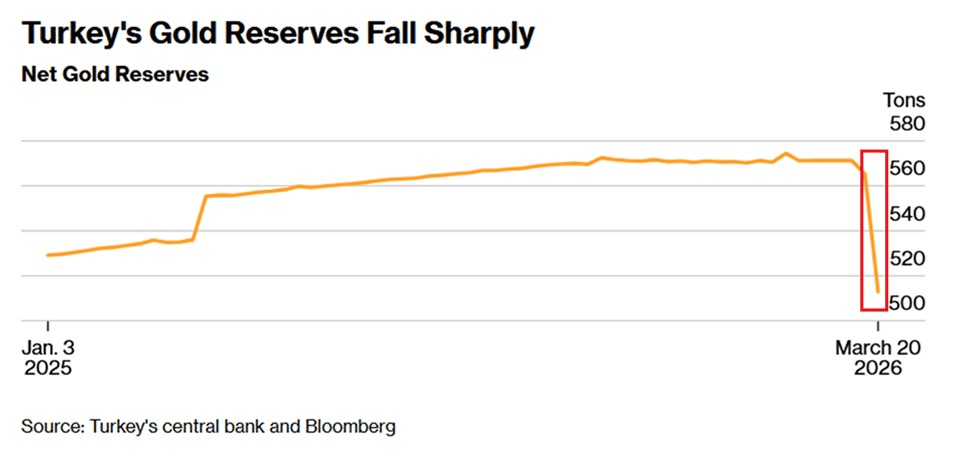
The Central Bank of the Republic of Turkey initiated a market-rattling move starting in the second week of March 2026. Based on Bloomberg and Reuters reporting drawing on IMF data: the week of March 13 saw 6 tonnes of gold reserves erased, followed by a further 52.4 tonnes the week of March 20 largest single-week gold reserve decline in seven years. Two-week combined total: approximately 58-60 tonnes, with a market value exceeding $8 billion.
The composition matters. Approximately 22 tonnes were outright sales; the remaining ~35-36 tonnes were structured as gold-for-forex/lira swap operations executed through the London market. A significant portion of Turkey's total gold reserves is custodied at the Bank of England a structure that facilitates London-executed swap operations logistically.
Why did it happen? The Iran war hit Turkey as a direct energy shock. Energy import costs spiked, capital outflows accelerated, and the lira came under serious pressure. Turkey's central bank has deployed similar reflexes in comparable conditions before during COVID and the 2018 currency crisis. Reserve mobilization was activated as a tool for managing local energy and exchange rate stress.
A critical distinction must be drawn here: this move represents local crisis management, not a reversal of the global official sector buying cycle.
The broader picture tells a different story. According to World Gold Council data, central banks purchased a net 863 tonnes of gold in 2025 roughly double the 473-tonne annual average of the 2010-2021 period. The WGC's 2026 forecast stands at approximately 850 tonnes. The buyer base is widening: Guatemala, Indonesia, Malaysia, Czech Republic, Serbia and other previously inactive or first-time participants have entered the table. Poland was 2025's single largest buyer at 102 tonnes. China made purchases for 15 consecutive months, lifting gold to approximately 10% of its total reserves.
In the WGC's central bank survey, 95% of respondents expect gold's share of global reserves to increase. January 2026 showed net purchases of 5 tonnes well below the monthly average of ~27 tonnes — but this is attributed to price volatility and seasonal factors, not structural reversal. Turkey is the exception. The structural buying trend in the official sector is a separate story entirely.
Reading Gold Correctly: Four Distinct Identities
Gold is not a homogeneous asset. It does not price off a single narrative; it shifts between identities depending on the macro regime. Understanding March 2026 requires holding all four identities in view simultaneously.
First identity — geopolitical hedge: War, geopolitical crisis, and institutional breakdown environments drive safe-haven demand for gold. But this function operates more cleanly in crises that do not trigger inflation. In 2008 and 2020, gold initially sold off as liquidity demands were met, then recovered sharply to new highs. In the Iran war, the inflation channel poisoned this identity.
Second identity — rates-sensitive macro hedge: In environments of low or negative real rates and a weakening dollar, this is gold's strongest propulsive force. It was the primary driver of the 2022-2025 bull run. In March 2026, precisely the opposite conditions prevailed: real rates rose, rate-cut expectations went to zero. This identity is the most mechanical and most directly measurable of the four.
Third identity — official sector reserve asset: Central banks are long-duration, price-insensitive buyers. Their demand does not directly move daily prices, but provides dip-buying support and establishes the long-term structural floor. 863 tonnes of net purchases in 2025 confirms this floor remains intact.
Fourth identity — asset that can be sold in liquidity stress but then recovers: Portfolio liquidation episodes crush gold; subsequently, oversold conditions and short covering drive recovery. In March 2026, the RSI fell to 27.6 — well below the 30 oversold threshold — the 50-week moving average provided support, and the 20% drawdown in managed money long positions opened significant space for a short-covering rally.
Why does holding all four identities matter? Because they can all be active simultaneously, but at different intensities and sometimes in opposing directions. In March 2026: the first identity (geopolitical hedge) fired weakly; the fourth identity (forced selling) dominated; the second identity (rates channel) deepened the pressure; the third identity (official sector buying) preserved the long-term floor but could not arrest the short-term decline.
Reading Silver Correctly: A Different Asset, Not Just High-Beta Gold
Silver set an all-time high of $121.64 in January 2026. By March, it had given back a substantial portion of those gains in certain phases falling to the $64-72 range, a decline of 40-47% from the peak. A move of that violence cannot be adequately explained by 'it's just gold with more beta.' Silver is a different asset different demand structure, different supply mechanics, different risk profile.
Why is it more volatile? Three structural reasons. First, market size: the silver market is a fraction of gold's; equivalent dollar flows produce disproportionate price moves. Second, index dependency: COMEX silver futures open interest represents 6.4% of commodity index total open interest versus 1.2% for gold. Third, hybrid identity: as both an investment metal and an industrial metal, silver faces ambiguous pricing in risk-off environments, which amplifies volatility.
Industrial demand structure: approximately 60% of total silver demand derives from industrial applications — solar panels, electric vehicles, AI infrastructure, semiconductors, medical devices. Gold has no equivalent analog. This makes silver partly an energy-transition and technology metal, while simultaneously introducing extra vulnerability during industrial slowdowns or recessions.
Structural deficit: According to Silver Institute data, silver has closed every year since 2021 in supply deficit. 2026 will be the sixth consecutive deficit year, with the projected shortfall at 67 million ounces. The cumulative deficit since 2021 has exceeded 800 million ounces roughly equivalent to one full year of global mine production. The 2024 physical balance: total supply 1 billion ounces, total demand 1.16 billion ounces, structural deficit of 148.9 million ounces. These are not incidental figures they are systemic.
Supply inelasticity: Approximately 70-75% of global silver production is a by-product of copper, zinc, lead, and gold mining. When silver prices rise, by-product silver supply remains subject to the production decisions of base metal miners. The price signal cannot rapidly call forth new supply structural supply elasticity is weak.
COMEX registered silver stocks have declined more than 70% from their 2020 peak. The gap between the paper market and physical market is widening.
Thrifting risk: Solar panel manufacturers are making incremental progress in reducing silver content per panel. Silver Institute projects a modest decline in photovoltaic sector silver demand for 2026. However, growth in EV, AI, and medical applications provides an offsetting counterweight.
The appropriate framing for silver: noisier, more fragile in the short run, but carrying a different long-term asymmetry than gold. The structural deficit is real, measurable, and has been compounding for six years. That narrative can be buried under short-term speculative turbulence but it does not disappear.
Why Did the Recovery Begin?
In the final week of March, several factors began shifting simultaneously. The recovery was real but it remains conditional.
The first catalyst was de-escalation signaling. On March 23-24, President Trump stated that talks with Iran were 'going well' and signaled a brief pause in military operations. Brent crude responded immediately: in a single session, it fell from $119 to $100. As oil retreated, the inflation narrative loosened; the primary pressure mechanism on gold weakened. Gold returned to $4,500; by April 1, it was trading at $4,720.
The second catalyst was technical conditions. RSI had reached 27.6 meaningfully below the 30 oversold threshold. The 50-week moving average provided structural support.
The third catalyst was short-covering potential. With managed money funds having reduced long positions by 20%, the positioning structure was heavily skewed short; any positive news flow triggers covering that provides price support.
The fourth catalyst was marginal easing in the dollar and rates. The 10-year yield pulled back from 4.44% to 4.37% on growth-scare driven bond demand; the dollar eased slightly.
But the critical reading is this: the recovery is conditional. De-escalation signals may not hold; Hormuz is not fully open; the Fed's stance has not changed; the dot plot still shows a single cut. What the market is pricing is not 'conditions have normalized' it is 'the probability that conditions could normalize has increased.'
The Five Variables to Watch
For investors, the core question is: how do you distinguish whether this recovery is durable or temporary? These five data points provide the framework.
1. Brent crude and Hormuz status: Brent holding a sustained close below $100 ideally retreating to the $85-90 range would ease inflation expectations and reduce pressure on the Fed. On the other side, any Hormuz re-closure news or regional escalation keeps the $120+ scenario alive and maintains the worst-case headwind for gold. Threshold that confirms recovery: Brent below $90 sustained. Threshold that breaks the thesis: re-escalation above $115.
2. DXY: The dollar index moved from ~96 to ~100.50. Cambridge Currencies projects DXY retreating to the 91-97 range in H2 2026. If that materializes, gold receives relief through both direct and indirect channels. DXY pushing to 103-105 would materially undermine the recovery scenario.
3. US 10Y yield and real rates: Nominal 10Y yield sustained below 4.0% and TIPS 10Y real yield holding below 2% would remove the structural headwind for gold. With the PCE forecast at 2.7% above target until this axis normalizes the ceiling remains tight.
4. CME FedWatch / rate cut pricing: A return to 50%+ probability of a June 2026 cut would be a meaningful catalyst. Under current zero-cut pricing with 10Y yields above 4%, gold operates with constrained upside.
5. Central bank gold flows (WGC monthly data): Whether any major central bank beyond Turkey has turned net seller; whether January 2026's 5-tonne figure was transitory; whether the buyer base continues to broaden. This axis is the most direct gauge of the long-term structural floor.
The Counter-Narratives
A rigorous analysis puts the real risks on the table not just the favorable scenarios.
If oil re-accelerates: As long as Hormuz remains operationally restricted, the catalyst for $100-120 oil persists. If the conflict broadens regionally, the $130-140 scenario returns to the table. In that environment, inflation expectations re-ceiling, gold tests the $4,000-4,200 support band, and silver faces additional pressure from industrial slowdown fear and risk-off selling.
If the dollar strengthens further: A DXY move to 103-105 hits gold through both direct (price in dollars) and indirect (deterrent effect on Asian central bank buying, ETF outflows) channels.
If the Fed turns more hawkish: Beyond the 'one cut in December' dot plot if the July 2026 FOMC withdraws even that cut, or if a rate hike is brought into discussion — the 10-year yield moves toward 5%. The real rate channel for gold re-opens, harder than before.
If other central banks also sell: Energy-import-dependent economies India, certain MENA countries, Southeast Asian central banks facing similar pressures and mobilizing reserves would erode the structural support function of official sector demand. No strong signal points in this direction currently but it warrants monitoring.
If industrial demand for silver breaks down: Silver Institute already projects a modest decline in photovoltaic sector silver demand for 2026. If China's EV growth trajectory decelerates meaningfully or global industrial production enters recession, the 60% industrial segment of the demand base weakens. The structural deficit narrative carries meaningful sensitivity to this risk.
Final Synthesis
Was the March 2026 sell-off a thesis break or a forced reset? Forced reset. Clearly.
The structural variables that underpin the long-term case central banks buying at 800-900 tonne annual run-rates, the de-dollarization cycle, silver's growing physical deficit, demand for gold as a real asset reserve — remained intact as of late March. JP Morgan held its $5,000 year-end target. Goldman Sachs maintained $5,400. UBS kept $6,200. VanEck characterized the period as "a process in which the bull market thesis has not broken down, but volatility has increased."
The decline did not originate in a change of long-term value judgment it originated in the collision of a specific macro transmission mechanism with an overcrowded positioning structure. The oil shock, rate repricing, forced liquidation, and CBRT selling reinforced each other simultaneously. The thesis was not shaken. The price was violently reset.
Why didn't gold behave like a classic safe haven during this period? Because the Iran war was a rare crisis type one where gold collided not with fear alone, but with inflation. The war translated into an oil shock; the oil shock tied the Fed's hands; that combination meant both higher real rates and a stronger dollar pressing simultaneously on gold. Gold moved on its rates-sensitive identity — not its geopolitical hedge identity.
For gold and silver, the macro conditions required for the recovery to become durable: the Strait of Hormuz reopening or genuine de-escalation (to pull Brent to the $85-90 range); the Fed signaling a June or September 2026 cut; DXY retreating to the 96-97 range; the 10-year real yield sustaining below 2%. For silver specifically, the industrial demand growth outlook particularly in China needs to hold.
None of these conditions arriving simultaneously is easy but none is impossible. A Hormuz opening and the evaporation of the oil risk premium could trigger sequential improvement across every other variable. Until that clarity arrives with energy prices elevated, the Fed restrictive, and the dollar firm the pace and magnitude of the recovery remains constrained.
The thesis is intact. But the timeline has been deferred and how long that deferral lasts is still being written at the gates of Hormuz.


