
Explaining Ethereum always requires holding two conflicting narratives simultaneously. On one side: the world's largest smart contract platform — $99 billion in DeFi TVL, $18.8 trillion in annual stablecoin transaction volume, the only chain where BlackRock has launched products directly on-chain, and the network JPMorgan chose for its first tokenized money-market fund. On the other: an asset that has meaningfully underperformed Bitcoin since its 2025 peak; a network whose fee revenue fell 97% from its January 2024 highs; an ecosystem where Layer 2 networks capture the vast majority of generated value rather than returning it to ETH holders. Both realities coexist because in Ethereum, "usage" and "value accrual" have diverged structurally — and that divergence is the central question the market is currently debating.
Bitcoin's investment thesis is single-layered and clean: scarce, censorship-resistant, non-programmable digital store of value. Its value lives in that simplicity. Ethereum, by contrast, attempts to be programmable financial infrastructure — and that ambition imports complexity. Valuing Ethereum requires understanding not just supply-demand dynamics but gas economics, staking mechanics, L2 architecture, protocol upgrade timelines, and how much revenue flows back to the protocol itself. This complexity is precisely what makes Ethereum an interesting investment — and what makes it permanently susceptible to misunderstanding.
How Does Ethereum Create Value?
When you ask "why is this valuable?" of any asset, the answer must be built on cash flows or scarcity. Ethereum's model incorporates both — but neither fully.
You cannot understand Ethereum's economics without understanding gas. Every transaction on Ethereum burns gas — a unit that measures demand for computational resources. Price is determined by supply and demand: when the network is congested, gas is expensive; when idle, it's cheap. During the 2021 NFT boom, a single swap cost over $100. Today, on L2 networks, that same transaction costs fractions of a cent. That cheapening is the result of deliberate design choices — but those choices have also nearly eliminated Ethereum's fee revenue.
Before EIP-1559, all fees went directly to miners. The 2021 upgrade split the fee: the "base fee" component is permanently burned — removed from ETH supply — while only the "priority fee" (tip) continues flowing to validators. For investors, the significance is indirect: ETH holders don't receive fees directly, but when network utilization is high, the ETH they hold shrinks in total supply, benefiting them through scarcity mechanics.
Since August 2021, approximately 4.58 million ETH has been burned — worth roughly $7.3 billion at historical prices. That figure appears significant in isolation, but since the 2022 Merge, net ETH supply has still grown by approximately 0.51% annually — issuance has not consistently exceeded burn. The "ultrasound money" narrative — the idea of ETH supply perpetually contracting — is conditionally true, not structurally locked in.
Staking is the second value channel. With the 2022 Merge, Ethereum shifted to proof-of-stake. Miners were replaced by validators who stake ETH to secure the network. This transition cut daily issuance from ~13,000 ETH to ~1,700 ETH. Validators earn both issuance rewards and priority fees. Current APR: 2.4–3.1% depending on staking method. The Pectra upgrade (May 2025) raised the validator maximum stake limit from 32 ETH to 2,048 ETH and cut withdrawal times from 13 hours to 13 minutes — making institutional staking meaningfully more practical.
Ethereum's value flows through three channels: (1) supply contraction via the burn mechanism, (2) direct cash flows via staking yield, and (3) the security premium that emerges as the network's strategic importance grows. The combined contribution of these three channels oscillates dramatically depending on how much network activity is concentrated on mainnet versus routed through L2s.
The Fusaka Upgrade and the New Dynamics of ETH Supply
The central tension in Ethereum's value story — that usage grows while value accrual to ETH lags — was directly addressed by the Fusaka hard fork, which activated successfully on Ethereum mainnet on December 3–4, 2025 (epoch 411392). Fusaka was the network's second major upgrade of 2025, following Pectra in May, and it represents the most significant infrastructure advancement for Layer 2 economics since the Dencun upgrade.
What Fusaka Actually Delivered
Fusaka bundles 12 EIPs (Ethereum Improvement Proposals) addressing three core areas:
1. PeerDAS (EIP-7594) — The L2 Bandwidth Revolution
PeerDAS (Peer Data Availability Sampling) fundamentally changes how validators process Layer 2 data. Previously, validators had to download entire blob data chunks submitted by rollups. Under PeerDAS, each validator node downloads only approximately 12.5% of each blob — a random statistical sample that is sufficient for verification. The effect: bandwidth and storage requirements fall dramatically, while the network can safely support much higher data throughput. For L2 rollups like Arbitrum, Optimism, and Base, this translates directly into lower posting costs. Initial estimates put the L2 fee reduction at 40–60% immediately after activation, with potential for up to 95% reduction as blob capacity scales through subsequent BPO (Blob Parameter Only) forks in December 2025 and January 2026.
2. EIP-7918 — The Blob Fee Floor That Changes Everything
This is arguably Fusaka's most consequential component for ETH holders. Before Fusaka, blob fees (what L2 rollups pay to post data to Ethereum) had no minimum price and had been essentially stuck at 1 wei — nearly free — for extended periods. This meant L2 networks were occupying Ethereum network resources while contributing almost nothing to the ETH burn mechanism.
EIP-7918 introduced a reserve price: blob fees must now be ≥ 1/15.258 of the L1 execution base fee, directly anchoring blob pricing to actual network costs. The immediate market effect was striking: after Fusaka activated, the blob base fee surged by 15 million times. Blob fees are now included in the ETH burn mechanism, and analysts estimate this could contribute 30–50% of total ETH burns by 2026, depending on L2 transaction volume growth. Fidelity Digital Assets described EIP-7918 as a potential "clear inflection point" in Ethereum's rollup-centric roadmap.
The design is elegant: prices now reflect actual resource consumption, preventing L2s from freely occupying network resources. Companies running major L2 chains — including Coinbase (Base), Robinhood, and Sony's Soneium — face structurally higher fee commitments under the new rules.
3. Infrastructure Upgrades
The block gas limit was raised from 30 million to 60 million (EIP-7935), with a roadmap to 150 million — a theoretical 400% throughput increase. EIP-7951 added passkey support via the secp256r1 curve, enabling biometric wallet authentication (face recognition, fingerprint) instead of seed phrases — a fundamental UX improvement for mainstream onboarding.
Based Rollups: The Next Frontier Fusaka Enables
Beyond immediate fee mechanics, Fusaka lays the technical groundwork for what researchers call "based rollups" — an architectural model where Ethereum validators directly sequence L2 transactions, rather than relying on centralized L2 sequencers.
The implications are significant. Under the current model, centralized L2 sequencers capture MEV (Maximal Extractable Value), ordering fees, and pre-confirmation revenues entirely within the L2 domain. In a based rollup architecture, this revenue would flow to Ethereum validators — and through them, back to ETH stakers. Nansen Research Analyst Nicolai Søndergaard summarized it precisely: "Fusaka itself does not ensure value accumulation for ETH, but it facilitates it. The upgrade establishes the foundation for based rollups, where Ethereum validators take over L2 sequencing."
Taiko is already live as Ethereum's first based rollup, using Ethereum validators directly as its sequencers. The model demonstrates that based sequencing is technically viable — but whether major L2s like Base, Arbitrum, and Optimism voluntarily transition from their current centralized sequencer models remains an open question. The based rollup transition is opt-in, not compulsory.
How Fusaka Reshapes the L2 Paradox
The original paradox: L2 networks use Ethereum's security and settlement infrastructure but return minimal fee revenue to mainnet. In 2025, L2s collectively generated approximately $129 million in revenue but remitted only ~$10 million (7.7%) to Ethereum mainnet. Dencun (March 2024) had made blob fees so cheap they contributed almost nothing — mainnet fee burn revenue collapsed from $550 million/month in January 2024 to $14.1 million/month by August 2025, a 97% decline.
Fusaka represents the structural correction to this dynamic. EIP-7918's fee floor directly restores a minimum economic relationship between L2 activity and ETH burn. PeerDAS vastly expands capacity while making it economical for L2s to pay meaningful fees. The based rollup framework creates a future pathway for L2 MEV and sequencing revenue to flow to validators. The combination shifts the architecture from "L2s exploit Ethereum's security cheaply" toward "L2s pay proportionally for what they use, and Ethereum shares in their success."
However, important caveats remain. Blob fee revenue post-Fusaka, while dramatically higher in relative terms, is still modest in absolute terms. The "30–50% of total ETH burn" projection is contingent on L2 transaction volume continuing to grow substantially. The based rollup transition requires voluntary adoption by L2 teams that currently benefit financially from centralized sequencing. And the ultimate magnitude of value restoration to ETH depends on how aggressively blob capacity is expanded through subsequent BPO forks. VanEck's analysis noted that Fusaka will not "significantly restore L1 fee revenue" on its own — but it sets the conditions for restoration as L2 activity scales.
Staking and Validator Economics
After the Merge, Ethereum validators earn from three sources: consensus layer issuance, execution layer priority fees, and MEV. Each follows different economic dynamics, and none can be understood in isolation.
Consensus layer rewards shrink as more ETH is staked. With approximately 36 million ETH staked (29.3% of supply), APR has compressed from 5–6% in 2023 to 2.4–3.1% today. The Pectra upgrade's institutional improvements — higher validator limits, faster withdrawals — accelerated institutional staking adoption. BlackRock's ETHB staking ETF (launched March 12, 2026 on Nasdaq) routes approximately 70% of assets through Coinbase Prime and offers a net yield of approximately 1.75–2% after management fees — a meaningful figure for institutional portfolios in a compressed yield environment.
MEV is the least-discussed but significant validator income component. MEV represents additional profits validators extract by reordering or inserting transactions within blocks: arbitrage, sandwich strategies, back-running. Between 2022 and 2025, cumulative Ethereum MEV exceeded $1.8 billion. However, MEV profitability has compressed sharply as competition intensified. The structural concern: large staking pools (Lido, Coinbase) extract MEV far more efficiently than small operators, reinforcing centralization dynamics. Today, Lido controls approximately 28% of staked ETH and Coinbase manages approximately 39% of validators — a concentration that directly challenges Ethereum's "decentralized" narrative.
The yield asset question: Is ETH genuinely a yield asset? Technically yes — but sustainability is conditional. If staking participation exceeds 30%, APR compresses further. If network activity stays low, execution layer contributions remain thin. Pectra's institutional improvements have accelerated inflows, but more staked ETH means the pie is divided more ways. Staking yield should be read not as a fixed rate but as a function of network utilization.

Wall Street's Ethereum: The Institutional Shift
The institutional adoption of Ethereum in 2025–2026 has moved from narrative to production infrastructure, with consequences that are real but whose relationship to ETH token value remains more nuanced than the headlines suggest.
The BlackRock Axis. BlackRock's BUIDL fund — launched on Ethereum mainnet in March 2024 — reached nearly $2 billion in AUM by January 2026, paying yield directly on-chain and integrating with Uniswap. In Jay Jacobs' words: "Ethereum accounts for approximately 65% of all tokenized assets." BlackRock's March 2026 launch of ETHB — a staking-enabled Ethereum ETF on Nasdaq, the firm's third crypto product and first with a staking component — represents the clearest institutional signal yet that ETH is entering the "yield-bearing reserve asset" category.
JPMorgan's MONY. On December 5, 2025 — the same day Fusaka activated — JPMorgan launched MONY, its inaugural tokenized money-market fund, on Ethereum. The $4 trillion asset management division of the world's largest bank chose Ethereum as its settlement layer for a product that generates returns on short-term US Treasuries with daily on-chain payouts. This is not an experiment. It is production infrastructure.
The Institutional Mosaic. Ethereum's institutional adoption in early 2026 extends well beyond BlackRock and JPMorgan. Kraken launched xStocks on Ethereum, issuing tokenized versions of US equities as ERC-20 tokens. Google announced the Agent Payments Protocol (AP2) on Ethereum, enabling AI agents to execute autonomous stablecoin payments. UBS, PostFinance, Sygnum, and the Swiss Bankers Association piloted token deposits on Ethereum. Goldman Sachs, Morgan Stanley, and JPMorgan have collectively sold over $530 million in structured notes linked to crypto ETFs. According to one institutional survey, 82% of institutional investors are actively seeking Ethereum exposure.
The Important Distinction. BlackRock's strategy is primarily a bet on Ethereum's infrastructure, not directly on ETH the token. When BUIDL succeeds, it validates the tokenization standard and the settlement layer — it does not automatically generate mainnet gas burn in the way high-frequency consumer activity does. RWA (real-world asset) transactions are typically optimized for low fees and often run on L2s or permissioned sub-networks rather than direct mainnet. The ETHB ETF adds direct ETH token demand, but it is the exception rather than the rule in the institutional stack. Wall Street is building on Ethereum; that is structurally bullish — but the mechanism by which this translates to ETH price remains indirect and dependent on the same fee reform dynamics Fusaka has begun to address.
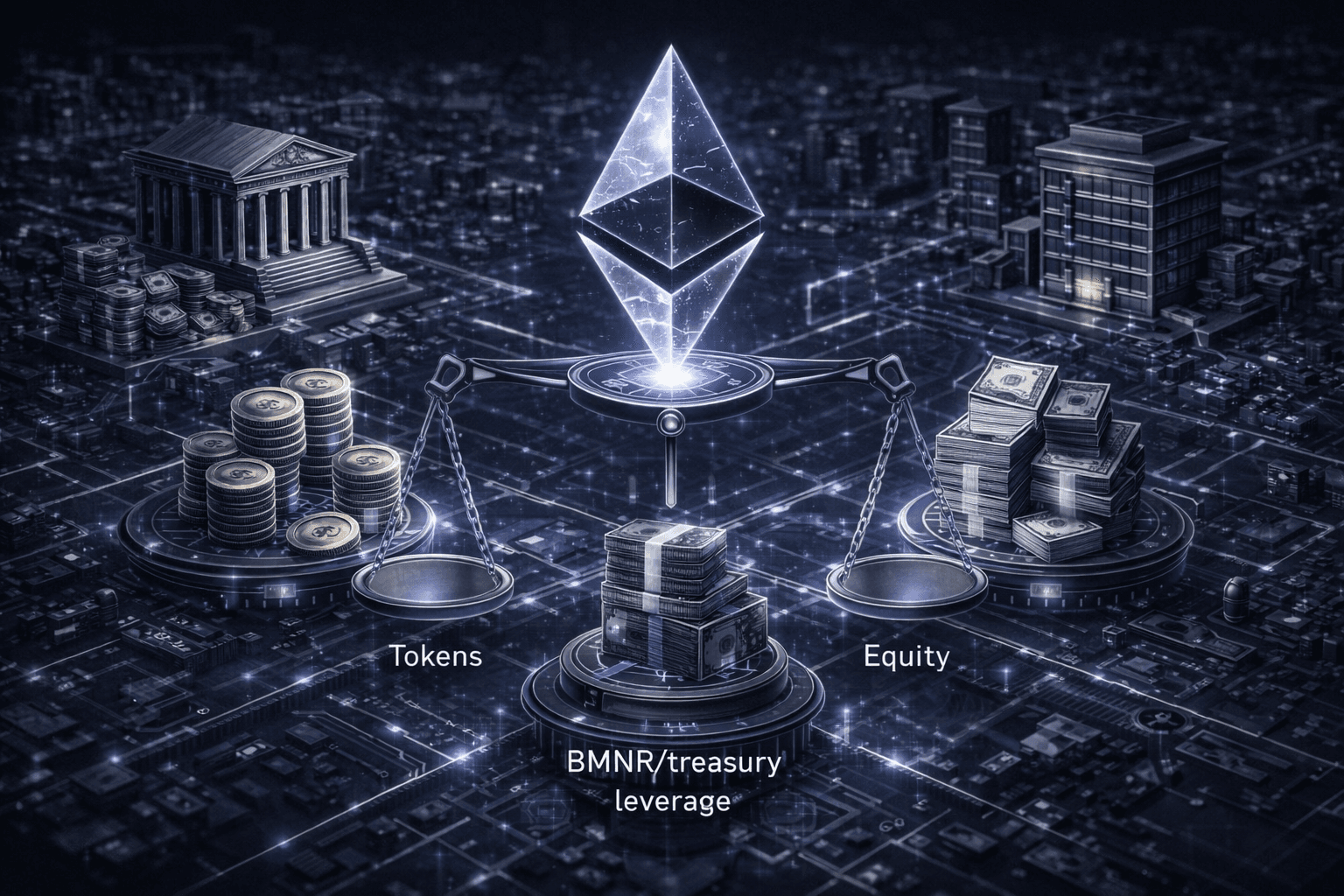
Tom Lee and Bitmine (BMNR): Wall Street Meets the ETH Treasury
No actor embodies Wall Street's direct bet on Ethereum as explicitly as Bitmine Immersion Technologies (NYSE: BMNR) and its Chairman, Tom Lee.
Who is Tom Lee?
Tom Lee is the co-founder and Head of Research at Fundstrat Global Advisors, an independent equity research firm in New York, and CIO of Fundstrat Capital. His institutional credentials are impeccable: 15 years as Chief US Equity Strategist and Managing Director at JPMorgan Chase. He became Bitmine's Chairman in June 2025, leading its strategic pivot from Bitcoin mining to Ethereum accumulation. In December 2025, appearing on CNBC's Power Lunch, Lee projected Ethereum could reach $7,000–$9,000 by early 2026, with a long-term potential of $20,000, citing Wall Street's accelerating interest in blockchain-based asset tokenization. In February 2026, he declared 2026 a "defining year" for Ethereum.
Lee's conviction has not wavered despite market pain. As ETH prices declined sharply from 2025 highs, BMNR absorbed over $6–8 billion in unrealized paper losses on its treasury. Lee's response was to accelerate accumulation — a posture that mirrors Michael Saylor's behavior with MicroStrategy's Bitcoin treasury, and carries analogous risks.
BMNR's Holdings: The Numbers
Bitmine's ETH accumulation trajectory is one of the most aggressive in crypto corporate history:
Date | ETH Holdings | % of Supply | Total Portfolio Value |
|---|---|---|---|
Dec 21, 2025 | 4.066M ETH | 3.37% | $13.2B |
Jan 11, 2026 | 4.168M ETH | 3.45% | $14.0B |
Feb 1, 2026 | 4.285M ETH | 3.55% | $10.7B |
Mar 1, 2026 | 4.474M ETH | 3.71% | $9.9B |
Mar 8, 2026 | 4.535M ETH | 3.76% | $10.3B |
Mar 23, 2026 | 4.66M ETH | 3.86% | ~$11B |
As of March 8, 2026, BMNR had staked 3,040,483 ETH ($6.0 billion) — making it the largest ETH staker in the world by any measure. At scale with the forthcoming MAVAN validator network, annualized staking rewards are projected at $259 million annually at a 2.91% yield. The company's institutional backers include Cathie Wood's ARK Invest, Founders Fund, Bill Miller III, Pantera, Kraken, DCG, and Galaxy Digital.
The goal: the "Alchemy of 5%" — acquiring approximately 6 million ETH, representing 5% of total circulating supply. As of late March 2026, BMNR is 76% of the way there in just 8 months of accumulation.
The BMNR Risk Framework: What mNAV Tells You
BMNR is not a straightforward ETH holding. It is an equity structure wrapped around an ETH treasury, and that structure introduces risks that pure ETH exposure does not.
1. mNAV Mechanics and Premium/Discount Risk
The mNAV (Market Net Asset Value) ratio measures how much premium or discount the market assigns to BMNR's holdings relative to the net asset value of the underlying ETH. When BMNR trades at a significant mNAV premium (say, 1.5–2x), the company can issue shares at that premium, use proceeds to buy more ETH, and increase ETH-per-share — the "flywheel" Lee describes. When mNAV approaches 1.0 (parity), this flywheel slows and share issuance becomes potentially dilutive. As of early February 2026, BMNR's mNAV had dropped to approximately 1.028x — essentially parity. This structural shift fundamentally changes the accretion math.
2. Massive Unrealized Losses
BMNR invested approximately $14.7 billion into crypto assets; as of late January 2026, market value had slipped to approximately $11.1 billion. This gap represents sizable unrealized losses primarily tied to ETH's drawdown from 2025 highs. Large institutional investors tend to remain on the sidelines when a company's treasury is materially underwater — a pattern visible in BMNR's Chaikin Money Flow (CMF) remaining below zero as of early 2026.
3. Dilution Risk: The 50 Billion Share Question
At BMNR's January 15, 2026 shareholder meeting, management sought to increase authorized shares from 500 million to 50 billion. While authorized shares ≠ issued shares, this creates substantial dilution overhang. The core risk: if BMNR issues shares at below-NAV prices, the amount of ETH backing each share permanently decreases. Critics note that the company's aggressive ATM (at-the-market) equity issuance program, while strategically rational during premium phases, becomes dilutive to shareholders when the premium collapses.
4. Valuation Disconnect
Traditional valuation frameworks produce uncomfortable numbers. A Dividend Discount Model analysis estimated BMNR's intrinsic value at approximately $0.18 per share against a trading price of $20+ — a gap of over 11,000%. A DCF analysis similarly estimated future cash flow value at $0.18/share. While these frameworks are arguably inappropriate for a crypto treasury company (they assume BMNR's value derives from operating cash flows rather than asset appreciation), they highlight that BMNR's current valuation relies entirely on ETH price appreciation and continued market willingness to pay a premium for leveraged ETH exposure.
5. ETH Price Concentration
BMNR's stock is essentially a high-beta ETH proxy. A 90-day price decline of 48.69% as of March 2026 demonstrates the amplification: ETH fell roughly 35–40% from 2025 highs, but BMNR fell approximately 49% as the mNAV premium also compressed. The structure amplifies both upside and downside. When ETH recovers strongly, BMNR can outperform — but the inverse is equally true.
6. Governance and Concentration Risk
A single corporate entity controlling 3.86% of ETH supply creates systemic considerations. Any forced liquidation or major rebalancing of BMNR's holdings would represent a structurally significant ETH sell event. The company's investment in non-ETH "moonshots" (including a $200 million stake in Beast Industries, MrBeast's company) introduces execution risk beyond crypto markets.
The Bull Case for BMNR (and Lee's Thesis)
Lee's argument is not irrational. At its core: Ethereum is becoming the settlement layer of institutional finance, BMNR is accumulating ETH before that thesis is fully priced, staking provides structural yield generation, and first-mover scale creates network effects as the dominant institutional ETH treasury. If ETH reaches Lee's $7,000–$9,000 target, BMNR's NAV per share would surge, the mNAV flywheel would re-engage, and the staking yield on 4.66M ETH would become a formidable revenue machine. The risk is timing, leverage, and dilution management — not the underlying thesis.

Layer 2: The Ecosystem That Grew Up
Ethereum's L2 ecosystem experienced explosive growth in 2025–2026, and Fusaka's impact on this ecosystem is worth examining in detail.
The pre-Fusaka problem: After Dencun (March 2024), blob fees were so cheap as to be essentially free. L2s like Base, Arbitrum, and Optimism were posting transaction data to Ethereum for fractions of a cent while collectively generating hundreds of millions in sequencer revenue. In 2025, Base generated $75.4 million in revenue while remitting only ~10% to mainnet. The value flow was: users pay L2 → L2 sequencer captures → Ethereum gets almost nothing.
Post-Fusaka dynamics: EIP-7918's fee floor immediately changed the economics. Blob fees surged 15 million times in relative terms upon activation. L2 operators now pay a structurally meaningful price proportional to L1 network costs. For users, fees on Arbitrum, Base, Optimism, and zkSync fell 40–60% as PeerDAS dramatically improved data availability efficiency. The combination — users pay less per transaction, but L2 operators pay more to Ethereum — is the intended design: expanding the market while restoring Ethereum's economic relationship with it.
The based rollup emergence: Taiko's operation as a live based rollup demonstrates that the architecture works. Ethereum validators sequence Taiko's L2 blocks directly, meaning MEV extraction and ordering revenue flows to validators rather than a centralized sequencer operator. Taiko's Shasta upgrade (January 2026) reduced the cost of proposing blocks by 22x and proving costs by 8x. If major L2s migrate to based sequencing over 2026–2027, the value flow inversion becomes substantial.
The 2026 L2 picture: L2 TVL at the end of 2025 exceeded $648 million on L2Beat's tracked chains. Arbitrum reported 2.1 billion lifetime transactions, $20 billion in total value secured, and 1,000+ projects. L2 activity is not competing with Ethereum — it is Ethereum, from a user perspective. The question is whether the protocol architecture ensures that as L2 activity scales, ETH captures an increasing share of the economic value it enables. Fusaka shifts the answer toward yes — but the full resolution depends on based rollup adoption and continued blob capacity expansion.
Ethereum's 2026 Roadmap: What Comes After Fusaka
Fusaka is not the end of Ethereum's scaling arc — it is a pivotal milestone in an ongoing roadmap.
Glamsterdam (H1 2026): The next major upgrade targets parallel transaction execution, further increasing throughput. Gas limits beyond 100 million are planned. Parallel execution would allow multiple transactions to be processed simultaneously rather than sequentially, potentially increasing effective TPS several times over.
Hegotá (Late 2026): Further infrastructure work, specific EIPs still being finalized by core developers.
ZK Validation — The Multi-Year Play: 2026 is projected as the year Ethereum begins transitioning to ZK (zero-knowledge) proof validation at scale. Rather than validators re-executing every transaction to verify correctness, they would simply verify a ZK proof. Researcher Justin Drake demonstrated that verifying proofs on a standard laptop is already possible. The planned rollout: 1 in 10 validators adopts ZK proof verification before end of 2026, with full rollout over subsequent years. The end state: a network potentially capable of 10,000 TPS on L1, with each block proven cryptographically rather than re-executed — a transformation comparable in scale to the Merge itself.
Competition: Solana, Permissioned Chains, and Real Trade-offs
Ethereum's dominance in institutional tokenization is real but not permanent.
Solana's 2025 RWA growth of 218% is a signal beyond simple numbers: Ethereum's tokenization monopoly is being contested. Solana's technical advantages — 3,000–4,000 TPS capacity, average transaction cost of $0.017, the Firedancer upgrade targeting 1 million TPS — make it genuinely competitive for high-frequency consumer applications. But its monolithic architecture concentrates sequencing risk in a leader node model, and its ~3,000 validator count presents a very different security profile than Ethereum's ~1 million validators.
JPMorgan, Franklin Templeton, and BlackRock chose Ethereum — not for raw performance but for decentralization's censorship resistance, for the depth of developer tooling, and for the institutional credibility of an asset the SEC has classified as a utility token rather than a security. These properties are not easily replicated.
The real competitive threat is permissioned chains (JPMorgan Onyx, Broadridge DLT) and application-specific networks. These systems don't use public Ethereum at all — they run private ledgers optimized for specific institutional workflows. If a significant share of RWA tokenization migrates to permissioned infrastructure, Ethereum's addressable market for fee generation shrinks. The evidence so far: institutions prefer public Ethereum for products requiring composability with DeFi and cross-institutional settlement; they prefer permissioned chains for intra-institutional workflows. Both can coexist, but the split matters for Ethereum's fee base.
Risks: Structural and Emerging
L2 Value Leakage: Despite Fusaka's improvements, the fundamental dynamic persists. L2s still capture the majority of fee revenue. EIP-7918's fee floor raises the floor but doesn't transform L2 economics wholesale. The based rollup transition remains voluntary. Until major L2s meaningfully adopt based sequencing, the value leakage continues — attenuated, but not resolved.
Staking Centralization: Lido (~28% of staked ETH) and Coinbase (~39% of validators) create concentration that challenges Ethereum's decentralization narrative. If staking control consolidates further, the "censorship resistance" argument that underlies institutional preference for Ethereum over permissioned alternatives weakens.
RWA Market Diversification: The $35 billion RWA market will not remain Ethereum-dominated indefinitely. Solana, Stellar, and permissioned alternatives are actively competing. Ethereum's current ~58% RWA market share is a position to defend, not a given.
Fee Revenue Recovery Timeline: Even with Fusaka's improvements, blob fee revenue recovery to meaningful levels requires L2 transaction volume to continue growing substantially. VanEck's pre-Fusaka estimate — that L2 volume would need to grow 22,000x to compensate for lost calldata revenue — is no longer the baseline scenario post-Fusaka, but the gap between current blob revenues and pre-Dencun fee levels remains enormous. Recovery is a multi-year process, not a binary event.
Regulatory: GENIUS Act (July 2025) was net positive for Ethereum by establishing federal stablecoin frameworks. The CLARITY Act clarified ETH's utility token status. But Fed Policy 9(13) still casts scrutiny on banks' relationships with open blockchains. Any high-profile DeFi security incident or smart contract exploit could freeze institutional momentum.
The Narrative Already Priced: Despite record institutional activity in 2025 — BlackRock BUIDL, ETF inflows, JPMorgan MONY — ETH significantly underperformed BTC. The ETH ETF saw Q3 2025 inflows of $2.4 billion, but ETH/BTC ratio remained compressed. In early 2026, weekly ETH ETF outflows were recorded even as institutional infrastructure expanded. The market appears to be pricing in infrastructure adoption without yet crediting the fee revenue restoration that Fusaka initiates.
Three Scenarios
Bear: Infrastructure Without Value Capture
In this scenario, Fusaka's fee improvements prove insufficient to close the L2 value gap meaningfully. Based rollup adoption stalls — major L2 operators protect their sequencer revenue models. Blob fees rise but remain a fraction of historical mainnet fee levels. Staking APR compresses below 2% as supply locks up further. Ethereum becomes the settlement layer for institutional finance — validating BlackRock and JPMorgan's infrastructure bets — but ETH the token accrues only marginal value from this activity. Solana and permissioned chains capture incremental market share. The "infrastructure token trap" materializes: network grows, token underperforms.
Base: Gradual Recovery, Asymmetric Upside Not Yet Captured
Ethereum retains RWA dominance but faces increasing competition. Fusaka's EIP-7918 floor raises blob revenues meaningfully, but not transformatively, in 2026 — ETH hovers near inflation/deflation parity. Staking ETFs (ETHB) drive institutional demand and keep APR in the 2.5–3% range. The ETH/BTC ratio gradually recovers as GENIUS Act-driven stablecoin growth expands mainnet activity. Based rollup adoption begins at the margin — Taiko proves the model, two or three mid-tier L2s follow by end of 2026. Long-term holders are rewarded, but the journey is slow and not without volatility.
Bull: The Settlement Layer Flywheel Activates
Fusaka-enabled blob capacity expansion through BPO forks drives L2 transaction volume 3–5x over 2026. EIP-7918's fee floor turns structural: blob fee burn contributes 30%+ of total ETH burn as projected. One major L2 (possibly Base or a JPMorgan-affiliated chain) adopts based sequencing, triggering validator MEV revenue from L2 activity. GENIUS Act drives stablecoin volume to $30–40 trillion annually on Ethereum, generating substantial mainnet activity. ETH turns structurally deflationary. ZK validation deployment begins. BlackRock's ETHB accumulates $10B+ AUM. ETH becomes simultaneously "ultrasound money," "yield-bearing reserve asset," and "Internet finance settlement layer" — all three narratives validated at once. BMNR's treasury position becomes legendary rather than cautionary. This scenario carries the highest asymmetric return — precisely because it is not yet priced.
Final Synthesis: Where Does Real Value Accumulate?
What matters most right now: Fusaka is not a speculative promise — it is a live, functioning upgrade with verifiable mechanics already operating on mainnet. EIP-7918's fee floor is active. Blob fees are no longer free. PeerDAS is reducing L2 costs. These are facts, not projections. The question for investors is not whether these changes occurred but how fast their second-order effects compound.
The BMNR signal: Tom Lee's Bitmine, for all its risks and aggressive financing mechanics, functions as the clearest institutional signal about Ethereum conviction at scale. A former JPMorgan Chief Equity Strategist, backed by Cathie Wood, Pantera, and Founders Fund, accumulating 4.66 million ETH while absorbing $6–8 billion in paper losses is not rational behavior unless the underlying thesis is genuine. Whether the vehicle (BMNR's equity structure) is the right one is a separate question from whether the thesis itself is directionally correct.
The Wall Street paradox: BlackRock, JPMorgan, Goldman Sachs, Google, UBS, Kraken — these institutions are collectively building the infrastructure of the next financial system on Ethereum. That construction is happening now, in production, not in pilots. The mechanism by which this activity translates into ETH holder returns — mainnet gas burn, blob fee revenue, staking demand, based rollup MEV — is improving with each protocol upgrade. But the translation is not instantaneous, and it is not guaranteed. The gap between Ethereum's usage story and its value capture story is closing. How fast it closes is the investment question for 2026.
The asymmetry: The "ultrasound money" narrative and the "yield-bearing settlement layer" narrative are now both operating simultaneously — conditionally. Fusaka has strengthened the conditions. Based rollups offer a path to structural improvement. Institutional adoption removes the existential regulatory risk that shadowed earlier periods. The remaining uncertainty is whether the protocol can translate its network dominance into token value at a pace that satisfies holders who have waited through years of underperformance.
The network is real. The upgrades are real. The institutions are here. The open question is the timeline — and, as always with Ethereum, the precision of the mechanism by which value flows from the network's activity to those who hold the token.


