
Opening: Caught Between Two Wrong Readings
There are two easy ways to analyze Apple — and both are wrong.
The first is to keep reading Apple as an iPhone vendor. This misses how the company actually makes money, how much capital it returns to shareholders, and how deeply its high-margin recurring revenue layer has compounded. The second is to throw Apple into the "AI loser" bucket simply because it isn't matching Microsoft, Amazon, or Meta on data center capex. That reading ignores Apple's 2.5 billion active device distribution advantage, its on-device compute architecture, and the economic power derived from platform control.
The real tension sits here: iPhone is still the center of the economic engine, but the genuine quality layer lives in Services. Apple isn't the biggest AI spender, but it may have a distinct advantage in distribution and action orchestration. Regulation threatens Services quality. And iPhone Fold plus WWDC 2026 could reshape the narrative within months. Without holding all these threads simultaneously, building a clean investment view on Apple is impossible.
What Kind of Company Is Apple Today?
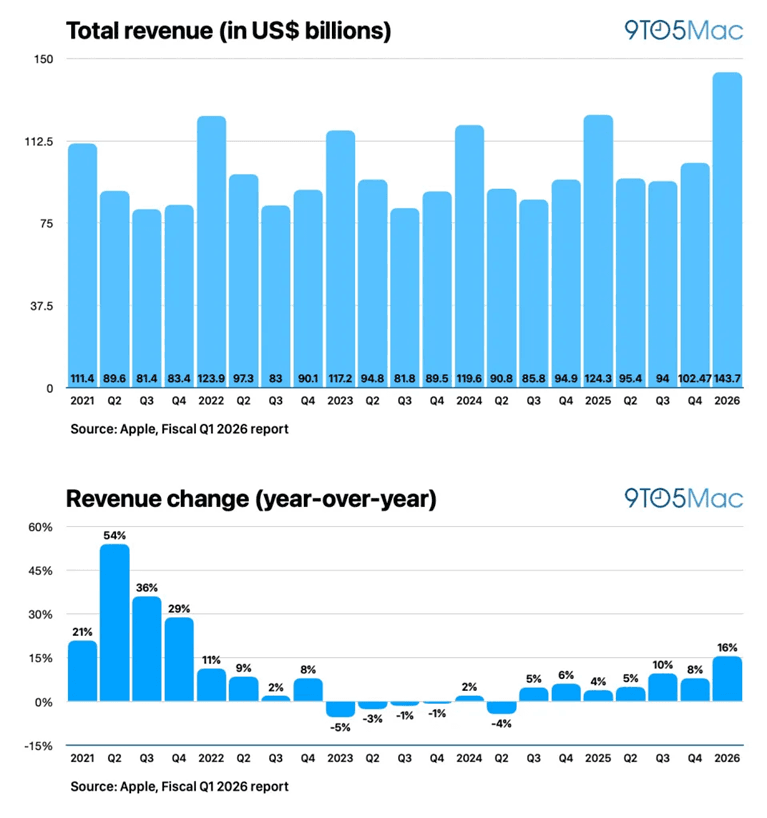
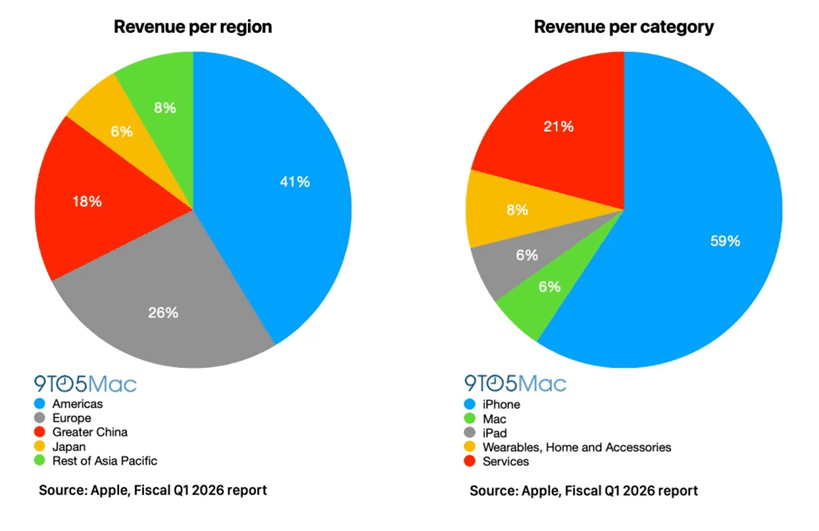
Apple's FY2025 revenue came in at $416.16 billion — roughly 6% growth year-over-year. iPhone's share of that sits at approximately 47-48%. But the more relevant number is what happened in Q1 FY2026 (the December quarter): $143.8 billion in revenue, $42.1 billion in net income — both all-time records. Operating cash flow hit $53.9 billion. iPhone revenue in that single quarter reached $85.3 billion (+23% YoY), while the Services segment touched $30 billion, cementing its position as a $100B+ annual business.
Reading these numbers as "large company continues growing" misses the structural shift underneath. Apple's revenue composition has changed meaningfully over five years. The Services segment now generates roughly 40% of the company's total gross profit — at nearly double the revenue, hardware produces less. The reason is simple arithmetic: Services gross margin reached 75.7% in Q2 FY2025; hardware margin sits at 35.9%. Every incremental dollar of Services revenue is nearly twice as profitable as every incremental hardware dollar.
On the moat question: Apple's genuine defensive perimeter against its most capable competitors comes not from iPhone technology but from ecosystem lock-in. 2.5 billion active devices generate a sustained spending stream through the App Store. Once users are embedded in Apple Silicon and iOS — photo libraries, message history, Apple Watch integration, AirDrop habits, App Store purchases — switching cost is real. That closedness is the platform's strongest economic fortress, and simultaneously the precise target of every major regulator.
The four-layer framework that makes this company legible is: the iPhone engine feeding the installed base; the Services and App Store engine monetizing that base at high margins; the platform control layer enforcing the economic rules of participation; and the AI and new product option layer, which today contributes limited direct revenue but signals where ecosystem expansion could go next.
Capital Efficiency: Why Apple Operates Differently
Apple's capital expenditure in FY2025 was $12.15 billion. Against $416 billion in revenue, that represents roughly 3% of the top line allocated to capex. Compare this to Microsoft, Amazon, and Meta — all running tens of billions in annual capex, the majority going toward data center and AI infrastructure. This contrast crystallizes Apple's model choice: rather than building AI infrastructure, Apple routes others' infrastructure through its own ecosystem and monetizes the distribution.
Net PP&E stood at approximately $49.83 billion in FY2025. Generating $416 billion in revenue from that asset base — roughly 8.3x revenue per dollar of PP&E — is made possible by Apple's outsourced manufacturing model. TSMC fabricates the chips, Foxconn and Pegatron handle assembly, Samsung Display provides OLED panels. Apple controls design, software, brand, and platform economics. This model keeps the cost structure light and concentrates the margin inside Apple.
Free cash flow for FY2025 reached $98.77 billion. Nearly all of it — $106.1 billion — was returned to shareholders: $90.7 billion in buybacks and $15.4 billion in dividends. That return capacity is not just financial discipline; it signals that the company doesn't need external capital to grow. Amazon's AWS, Microsoft's Azure, and Meta's AI infrastructure all require heavy investment today. Apple has consciously chosen to remain on the other side of that equation.
There is, however, a structural vulnerability in this model. TSMC notified clients of 8-10% price increases on sub-5nm processes for 2026, and the A20 series on 2nm carries an estimated 50% premium over prior generation pricing. Apple's outsourced manufacturing advantage is exposed to supplier pricing power. Tariff uncertainty adds to this: the 2025 Trump tariff wave generated short-term exemptions, but structural risk persists. Apple will either pass these costs to consumers or absorb them as margin erosion — and at $2,000+ price points for iPhone Fold, that test gets more complicated.
Apple's AI Game Is Being Played on a Different Field
Apple Intelligence launched with iOS 18 and was expanded at WWDC 2025: Live Translation, Visual Intelligence, Image Playground, enhanced Shortcuts AI integration, and writing tools. But the real technical claim behind Apple Intelligence is the combination of an approximately 3-billion-parameter on-device foundation model with Private Cloud Compute (PCC) — a server-side infrastructure running on Apple Silicon with zero data retention, designed so that not even Apple can access user data.
This architecture is a deliberate departure from the rest of the AI industry. OpenAI, Google, and Anthropic run cloud-first models where user queries travel to servers. Apple's model is device-first; cloud is optional. The strategic intent is a privacy premium: enterprise users and privacy-conscious consumers get a meaningfully different value proposition. On-device processing means faster latency for core tasks, lower exposure to data breaches, and independence from connectivity.
The bad news was real, however. The Siri overhaul missed its original iOS 18 target and was pushed to Spring 2026. This wasn't a marketing timing issue — it was an execution gap that gave the "Apple is behind in AI" narrative legitimate oxygen throughout 2025. The gap between what Apple promised and what shipped visibly damaged confidence among analysts and developers.
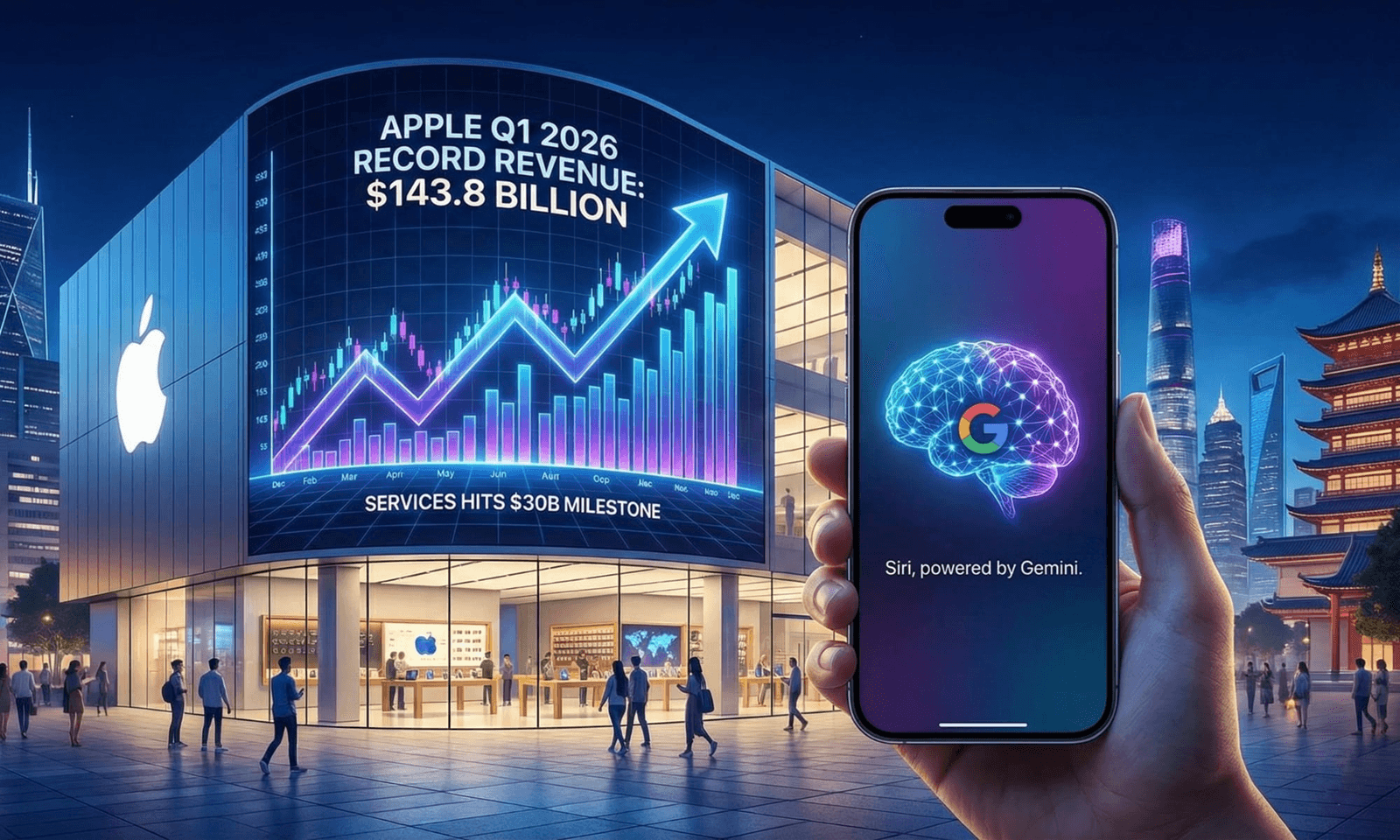
The January 2026 Google Gemini partnership announcement reads as a two-sided signal. On the surface, it looks like an acknowledgment that Apple couldn't build sufficient model capacity on its own. Looked at more carefully, it fits a consistent platform strategy: externalize model development risk, own the distribution layer and the trust infrastructure. Gemini will run through Apple's PCC architecture — Google pays Apple for access to 2.5 billion devices, similar in structure to the $20 billion annual TAC payment for Safari default search. In this framing, the Gemini partnership is not weakness — it's distribution ownership.
The next critical test is WWDC 2026, announced for June 8-12, where major Siri AI upgrades and iOS 27 are expected. If Apple delivers a compelling Siri experience, the delay becomes a footnote and the Fall 2026 iPhone cycle gains a powerful narrative accelerant. If the demo falls short, the "Apple behind in AI" story runs for several more quarters.
App Intents and the Action Layer: Apple's Hidden Structural Bet
App Intents is Apple's cross-platform integration framework that allows developers to expose app functions to Siri, Spotlight, Shortcuts, and Apple Intelligence. Introduced in iOS 16 as a successor to SiriKit, it made a significant leap at WWDC 2024 with Assistant Schemas: Siri can now call any app action using LLM-powered natural language understanding. WWDC 2025 deepened this model — developers publish a "capability manifest" for their app's actions, and Siri combines them with Apple Intelligence to respond to open-ended user commands.
The investment relevance here is architectural, not superficial. Apple is not building a super-app in the WeChat sense — it isn't trying to contain everything inside a single application. Instead, it is building a secure, permissioned action orchestration layer where every third-party app maintains its own function but those functions can be called, chained, and routed through Siri. The routing runs on Apple Silicon, on-device, within Apple's platform rules.
From the lens of the agent economy, this positioning is strategically meaningful. OpenAI, Anthropic, and Google's AI agents need API integrations and web access to operate in the mobile app world. Apple's App Intents infrastructure already exists: app actions are pre-defined, permission models are in place, and user trust is embedded in the platform. This means Apple has arguably pre-solved one of the hardest problems in the agent economy — reliable, permissioned action execution on mobile devices — through infrastructure it built before the agent wave was even named.
Monetization from this layer is currently indirect. There is no "agent API fee" today. But the mechanism is clear: deeper App Intents integration embeds applications more deeply in the iOS ecosystem, strengthens developer dependency, reinforces App Store stickiness. Every application that builds deeper into this layer is an application whose users remain in the App Store billing pipeline. The medium-term option value is an enterprise Apple Intelligence API tier — a direct revenue stream that doesn't yet exist but is structurally plausible.
The critical vulnerability is the same as the moat: App Store rules that make this action layer powerful are the same rules regulators are targeting. Apple's platform control is both the economic fortress and the regulatory bull's-eye.
The New Product Cycle: Is iPhone Fold a Real Catalyst?
iPhone Fold is not yet an official product. But that sentence needs immediate qualification: supply chain signals have meaningfully crossed a threshold. Ming-Chi Kuo reported Samsung Display as sole OLED supplier with production data pointing to 20 million panel orders. Forbes in March 2026 published a corroborating production ramp story. Fine M-Tec has emerged as the crease-free hinge supplier. Apple's TSMC 2nm capacity reservation covers A20 Pro production for both iPhone 18 and iPhone Fold. Taken together, a September 2026 launch has moved from "possible" to "strong supply chain expectation."
What does this mean for the investment thesis? The foldable category remains small — under 2.5% of global smartphone shipments in 2025, dominated by Samsung and Huawei after years of effort. Consumer surveys suggest a meaningful share of buyers remain indifferent to foldable form factors. And a $2,000-$2,500 starting price points to the uppermost tier of an already premium segment. First-year sell-through of 10-13 million units is plausible, but "plausible" is not "transformational."
The more important argument is narrative, not unit math. A Fall 2026 launch with both iPhone 18 and iPhone Fold simultaneously is a different kind of upgrade cycle signal than any single-product launch. Two new form factors in one season, against the backdrop of a revamped Siri, is the kind of configuration that moves fence-sitters in Apple's installed base. Average selling price expansion and upgrade demand intensity are the metrics to watch — not just unit volumes.
Apple's brand and hardware execution quality could genuinely differentiate a foldable in ways Samsung and Huawei haven't yet managed: software integration, build quality, repairability narrative, ecosystem coherence. But Vision Pro's 390,000-unit 2024 result is a standing reminder that Apple's premium new form factors don't automatically find mass audiences at launch.
Vision Pro, Wearables, and Real Option Value
Framing Vision Pro as Apple's primary answer to the AI era or next computing paradigm is analytically unsound. The device sold approximately 390,000 units in 2024, fell to 45,000 units in Q4 2025, and Apple halted production. The M5 model refresh did not meaningfully move the sales trajectory. At $3,499+, with weight challenges and no clear killer app outside narrow enterprise use cases, Vision Pro has not found mass-market PMF.
That said, dismissing Vision Pro as a failed product misreads Apple's historical pattern. Major platform transitions at Apple typically run through an early version that sticks in a niche before a second or third generation achieves scale. A lighter, less expensive Vision model in 2026 or 2027 remains a possibility. For current investment purposes, Vision Pro contributes no meaningful revenue and should not be modeled as a near-term driver. It holds long-duration optionality on spatial computing — real but not actionable at current prices.
Apple Watch, AirPods, and the broader wearables category tell a different story. Even with FY2025 wearables revenue showing softness, the strategic function of this hardware layer is clear. Every Apple Watch sold deepens the user's commitment to iOS health data, Apple Fitness+, and the broader Services spending ecosystem. The investment value of wearables is not in direct hardware margin but in what each unit does to Services ARPU and App Store stickiness over time.
Regulation: Apple's Largest Structural Liability
The regulatory risk deserves a mechanistic treatment — not the generic "faces regulatory headwinds" frame, but a specific accounting of which revenue line is being targeted, by whom, and how.
EU Digital Markets Act: The European Commission issued a DMA violation ruling against Apple in June 2025. Apple responded with App Store rule changes in June 2025, but new third-party app store conditions and the Core Technology Fee structure remain contested. European App Store revenue represents approximately 15-20% of Apple's total App Store business — several billion dollars of margin-quality revenue. Long-term DMA enforcement could systematically erode the European App Store commission model.
Epic Games ruling: In April 2025, a federal judge found Apple in contempt and expanded the injunction requiring Apple to permit external payment system links in the U.S. App Store. The Ninth Circuit partially reversed this in December 2025 — Apple can charge a "reasonable commission" on external transactions but cannot fully block them. A partial win, but U.S. App Store platform control is now structurally contested territory.
DOJ antitrust lawsuit: The dismissal motion was rejected in June 2025; the case proceeds. Trial is likely 2028 or later. But the case's existence creates a persistent overhang on Apple's hardware-software integration practices. A ruling that forces interoperability changes could reach the core of Apple's ecosystem lock-in.
Google TAC ($20 billion/year structural risk): This is the single largest discrete financial exposure. Google pays Apple approximately $20 billion annually to remain the default search engine in Safari — a payment that represents an estimated 16-20% of Apple's Services revenue. JPMorgan analysts estimated the revenue impact at $12.5 billion in a worst-case scenario where antitrust courts force its removal. The September 2025 court ruling preserved the TAC structure, but the process is ongoing. Apple's move to add AI search alternatives to Safari — and the Gemini partnership — reads as an active hedge against this risk.
The aggregate picture is this: Apple's greatest economic power is platform control, and regulators across three jurisdictions are simultaneously targeting exactly that layer. EU, U.S., and other enforcement channels are advancing in parallel. Services revenue quality — and the premium multiple the market assigns to it — carries structural uncertainty that is not fully resolved in any of these channels.
Who Wins, Who Gets Pressured by Apple's Moves?
Samsung Display / Samsung Electronics (005930.KS): Samsung Display is the sole OLED supplier for iPhone Fold — a direct supply chain beneficiary of the most anticipated Apple hardware launch in years. A 20 million panel order meaningfully impacts Samsung Display's FY2026 revenue profile. The complication: Samsung Electronics' Galaxy Z series competes directly with iPhone Fold in the premium foldable segment. This dual positioning — largest beneficiary and most direct competitor — makes Samsung the most interesting asymmetric name in the foldable launch ecosystem. Short-term net positive; medium-term market share displacement risk.
TSMC (TSM): Apple has reserved the majority of TSMC's 2nm capacity for the A20 and A20 Pro series. Two flagship products in one cycle means Apple's 2026 order volume at TSMC could set a new record. Short-to-medium term strong positive. The persistent risk: geopolitical concentration and TSMC's own pricing power being used against its most important customer.
Alphabet / Google (GOOGL): The Apple-Google relationship is multi-layered. The $20 billion annual TAC payment survived the September 2025 court ruling. But the Gemini partnership creates a different kind of dependency — Apple routes Gemini through its PCC infrastructure, and Google pays for access to Apple's installed base. As Apple's on-device AI capacity grows, Google's "default search" position weakens. Apple is simultaneously Google's most important distribution partner and its most consequential potential disruptor in AI-native search. Mixed effect, medium-term horizon.
Meta Platforms (META): Apple's App Tracking Transparency framework structurally limits Meta's cross-app tracking and targeting quality. The peak impact of this dynamic hit in 2021-2022 and is already priced into Meta's model. Incremental damage is limited. But Apple's privacy-first structural stance remains in persistent friction with Meta's advertising model — this tension doesn't resolve.
Qualcomm (QCOM): No Qualcomm dependency exists inside Apple's iOS chip stack — Apple designs its own A-series and M-series silicon. Apple still uses Qualcomm modems in iPhone 17, but internal modem development is ongoing. Medium-to-long-term, Qualcomm's Apple revenue shrinks. Qualcomm hedges through Android OEM portfolio exposure, but Apple Silicon's competitive advantages cascade into Android OEM competitive pressure as well.
Spotify (SPOT), Netflix (NFLX), Airbnb (ABNB): Epic and DMA rulings are progressively loosening the App Store commission structure. Spotify has fought the 30% App Store commission for years; the Epic injunction expanded external payment link permissions in the U.S. App Store. Further policy liberalization would reduce the platform fees these companies pay — a marginal cost tailwind. Not a significant valuation mover, but directionally positive as App Store policy continues shifting.
Microsoft (MSFT): Direct competition with Apple is narrow. But from the large-cap tech investor's perspective, these two companies represent contrasting AI approaches: Microsoft building heavy Azure/Copilot infrastructure at scale, Apple remaining lean on capex while monetizing others' infrastructure. Investors choosing between these two are effectively choosing between "AI infrastructure builder" and "AI distribution monetizer." Indirect overlap primarily in enterprise endpoint and productivity.
Amazon (AMZN): Direct competition with Apple is limited. AWS and Apple's model strategy operate in different value chain positions. But Apple's iCloud+ and enterprise device management increasingly touch Amazon's cloud-workflow tooling. The more relevant framing for investors: Apple's low-capex/high-monetization model stands in structural contrast to Amazon's infrastructure intensity — a narrative comparison that shapes large-cap tech capital allocation decisions.
OpenAI and the AI startup app ecosystem: Apple's ChatGPT integration represents a partnership. But the App Intents agent layer could evolve into Apple's own prioritization mechanism for agentic apps — where Apple's native applications get first-class Siri routing while third-party AI apps operate as second-tier. If that happens, OpenAI and similar companies risk being treated as browser-like containers on iOS rather than the orchestration layer itself.
Cirrus Logic (CRUS), Skyworks Solutions (SWKS), Qorvo (QRVO): These three are Apple's analog and RF component suppliers. Two flagship products launching in the same Fall 2026 cycle — iPhone 18 plus iPhone Fold — means component demand volume could spike meaningfully. Short-term cyclical positive. Primary risk: iPhone sales coming in below expectations or tariff-driven supply chain disruption.
Fine M-Tec (Korea, OTC): The crease-free hinge supplier for iPhone Fold. With 13-15 million unit production targets in 2026, Fine M-Tec is the most concentrated direct beneficiary of the foldable launch in Apple's immediate supply chain. Worth keeping on the radar — with the caveat that any change in Apple's hinge technology sourcing decision represents binary risk.
Catalyst Map: Where Does the Next 12 Months Break?
FY26 Q2 Earnings (April/May 2026): The March quarter will surface the first concrete evidence of U.S. tariff policy impact on iPhone supply chains. It also tests whether Q1 FY2026's record performance was a sustainable trend or a one-quarter spike. Services gross margin holding at 75%+ and Greater China remaining positive are the two confirmation data points the thesis requires. Q1 FY2026 guidance pointed to 13-16% revenue growth — tracking against that range signals trajectory.
Capital Return Refresh: Apple announces new share repurchase authorization annually in the spring cycle. FY2025 returned $106.1 billion. A sustained or expanded buyback program signals capital discipline and provides structural downside support. Q1 FY2026 alone saw $24.7 billion in buybacks — this pace, if maintained, functionally puts a floor under meaningful selloffs.
WWDC 2026 (June 8-12): The single most important Apple event of 2026. Siri overhaul quality, Apple Intelligence depth in iOS 27, App Intents new capabilities, and the Gemini integration's user experience will all be evaluated in real time. A compelling Siri demo ignites the Fall 2026 upgrade cycle narrative before the product is even announced. A weak demo extends the "Apple behind in AI" story another two to three quarters. Very few events in the calendar carry this level of binary narrative consequence.
FY26 Q3 Earnings (July/August 2026): The first earnings print to show post-WWDC developer momentum in the data. Services gross margin trend and China market share readthrough are the headline metrics. Any official confirmation of iPhone Fold production or commercial plans could come in proximity to this earnings cycle.
Fall 2026 iPhone 18 + iPhone Fold Cycle: Two form factors launching simultaneously. First-week order volumes for iPhone Fold, iPhone 18 upgrade demand, and ASP expansion are the variables to watch. If iPhone 17 was "staggering" and WWDC 2026 delivers a credible Siri, Fall 2026 has the ingredients for Apple's strongest product cycle in several years. If either leg disappoints, the premium valuation faces pressure.
EU DMA Enforcement: Ongoing and likely to produce new compliance actions in H2 2026. Near-term financial impact is manageable, but each enforcement event reinforces the long-term App Store commission erosion narrative and complicates how the market should discount Services revenue quality.
U.S. Antitrust / Epic Remand: DOJ trial is a 2028+ event — distant as a risk but active as an overhang. The Ninth Circuit's evolving Epic jurisprudence is the nearer-term signal: each appellate ruling incrementally defines what "reasonable commission" means in practice, and by extension, how much of current U.S. App Store economics Apple can durably defend.
Counter-Narratives: Where Can the Thesis Break?
This analysis would be incomplete without a direct treatment of where the bull case legitimately fails.
Apple may genuinely be behind in AI. The Siri delays were not just a launch timing issue — they reflected real model capability gaps. OpenAI, Google, and Anthropic run models that are demonstrably more capable for open-ended reasoning, code generation, and multi-step task completion than Apple's current on-device foundation models. If users are keeping iPhones out of ecosystem inertia rather than AI capability appreciation, Apple Intelligence may never become the upgrade catalyst the narrative projects.
Services quality is real, but regulation can and will erode it. The App Store commission model is simultaneously being targeted by EU DMA enforcement, Epic injunctions in the U.S., DOJ antitrust proceedings, and similar regulatory actions in South Korea, Japan, and the Netherlands. If these channels converge, the Services multiple the market assigns today may not be sustainable. The Google TAC loss alone, at $12.5 billion in a worst-case scenario, would be a material EPS impact in isolation.
Foldable may not create a new cycle. Every supply chain signal points to production. But production is not demand. Samsung has had premium foldables for six years; the category remains under 2.5% of global shipments. Vision Pro selling 390,000 units in a year at $3,499 is a standing lesson in how even Apple cannot always force category creation at premium price points. A $2,000+ entry price for iPhone Fold faces the same question.
Low-capex efficiency has limits in AI-intensive competition. Apple's outsourced, asset-light model is elegantly profitable today. But Private Cloud Compute infrastructure will need to scale as Apple Intelligence adoption grows. If competitive pressure forces meaningful increases in server-side AI investment, Apple's capex footprint must grow — narrowing the efficiency gap that currently differentiates it from Microsoft, Amazon, and Google.
China remains structurally exposed. Q4 2025 and Q1 2026 were strong — Greater China +38% in Q1 FY2026. But this recovery follows Q1 2025's significant sales compression versus Huawei. HarmonyOS NEXT with native AI features and Chinese government preferential procurement policies for domestic technology keep Apple's China position perpetually fragile. Geopolitical escalation could reverse recent gains rapidly.
Final Synthesis: Where Is Value Accumulating?
Have recent developments changed the Apple thesis? Partially yes.
Q1 FY2026's record numbers, the iPhone 17 cycle outperforming expectations, Greater China's strong recovery, and the Gemini partnership all strengthened the short-term momentum story. iPhone Fold supply chain signals moving into confirmed mass production territory gave Fall 2026 a dual-launch structure that hadn't been priced before. These are thesis-supporting developments.
But structural uncertainty also intensified over the same period. EU DMA violation ruling, Epic contempt finding, DOJ case advancement, and Google TAC risk — four separate regulatory fronts moved forward simultaneously in 2025. Services revenue quality now carries a layer of legal risk that wasn't as concretely priced twelve months ago. Against a 30-33x forward PE multiple, these risk premia matter.
What is the market pricing in Apple today? The consensus view appears to assume Services growth trends are durable, iPhone 17 momentum carries into 18, and WWDC 2026 resolves the Siri narrative. What the market is likely underpricing is the App Intents and agent layer thesis — the probability that Apple's action orchestration infrastructure becomes a deep platform lock-in mechanism in the agent economy that makes Services ARPU growth durable beyond what current models project.
The asymmetric opportunity sits in this specific underpricing. If App Intents and an upgraded Siri genuinely become the permissioned action routing layer for AI-native mobile behavior, Apple holds a structural moat the AI infrastructure builders cannot easily replicate: trust, device embeddedness, and permission architecture at 2.5 billion device scale. If that transition happens, Services ARPU compounds for longer than consensus expects and the current multiple looks reasonable in hindsight.
The counter: if regulators force open App Store access, if Siri continues underperforming, and if third-party AI agents route around Apple's action layer rather than through it, the premium platform economics erode — and the multiple compresses accordingly.
Apple remains a genuinely exceptional monetization machine: $98.77 billion in free cash flow, 75.7% Services gross margin, over $100 billion in annual shareholder return capacity, and a 2.5 billion device installed base. That quality of economics weathers substantial pressure. But Apple's new platform role in the AI era — as a trusted action orchestrator, not a model builder — remains unproven. WWDC 2026 and Fall 2026 are the two most important data points for testing that thesis. The question for investors is whether the premium valuation is justified before those proofs arrive.


