
The market tends to read the AI narrative through a single lens: GPU shipments, hyperscaler capex announcements, and megacap tech companies' data center investment cycles. That reading isn't wrong — it's just incomplete. Because the physical infrastructure powering those GPUs — electricity, transformers, switchgear, cooling, and the fuel chain — isn't growing at the same pace. And the more important point: some of the critical components that physical infrastructure depends on are tied to an extraordinarily narrow supplier base.
Getting chips is becoming easier. NVIDIA, AMD, and Intel are expanding capacity; new entrants are emerging; pricing remains competitive. But supplying the electricity to run those chips is a different equation entirely. Lead times on large power transformers have stretched to two to four years. Order books on large gas turbines are filled well past 2028. Western uranium enrichment capacity has nearly zero spare room. The great repricing in the software and chip layers is largely done. The physical energy infrastructure layer — especially the most constrained component manufacturers — hasn't been priced to the same degree.
The question this essay tries to answer: In the AI-driven energy boom, does the real value accumulate in the energy producers themselves, or in the narrow, critical infrastructure component manufacturers that the market has yet to fully price?
Why Now? Getting the Macro Framework Right
The numbers matter here, because without understanding the scale, neither the bottleneck nor the opportunity makes sense.
The combined 2026 capex of Amazon, Microsoft, Google, Meta, and Oracle exceeds $600 billion, with roughly $450 billion — approximately 75% — directed at AI infrastructure specifically. That's a single year. Goldman Sachs projects total hyperscaler capex for 2025–2027 at close to $1.15 trillion. To translate that into physical reality: 15–20 gigawatts of new data center capacity. That is roughly equivalent to 15 large nuclear plants' worth of new generation capacity needing to come online.
Global data center electricity consumption is projected to reach approximately 945 TWh by 2030 — nearly double today's levels. In the US specifically, data centers could add 3–6 Bcf/day to gas demand by 2030, representing 3–6% of current total US gas consumption. A single large-scale AI training cluster can consume 100 megawatts — the annual electricity equivalent of 80,000 homes.
There is a structural point worth stating plainly: the major repricing in the software and chip layers was largely completed between 2023 and 2025. The physical energy infrastructure layer — particularly the most supply-constrained component producers — has not yet taken an equivalent share of that repricing. The first wave of energy producers was priced; Constellation Energy, GE Vernova, and Siemens Energy were among those companies. But some of the suppliers those producers depend on remain below the market's radar.
Where AI Breaks the Energy System
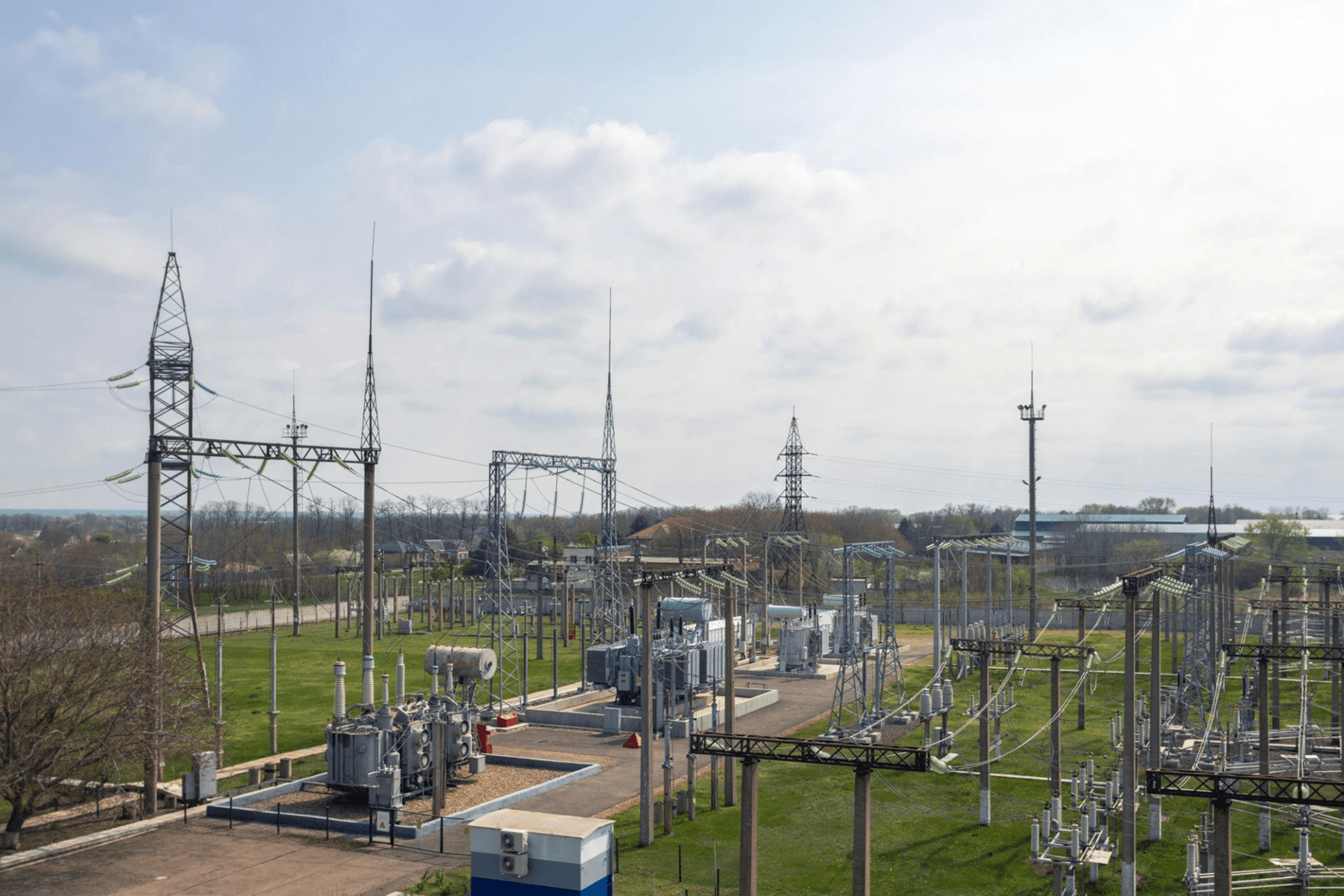
AI workloads differ from conventional data center workloads in one fundamental dimension: continuous, high-density power demand. A traditional server rack draws 5–15 kilowatts. An AI GPU cluster consumes 40–132 kilowatts per rack; some advanced configurations exceed 250 kilowatts. That difference doesn't just amplify the cooling challenge — it requires a complete redesign of transformer sizing, switchgear configuration, and grid interconnection points.
AI workloads are also structurally incompatible with the intermittency of solar and wind. A model training run or an inference cluster cannot be paused for a few hours and restarted. This 24/7 baseload power profile directly drives the preference for nuclear and natural gas as primary supply sources. So what sits in the chain that feeds those plants?
The earliest and most acute bottleneck is power transformers. Lead times on large power transformers have reached 128–144 weeks — over three years — with some high-voltage classes hitting four years. Distribution transformer demand is up 116% since 2019; generator step-up units are up 274%. Transformer prices across most categories have risen 60–80% since 2020.
The transformer crisis surfaces a second, quieter crisis underneath it: grain-oriented electrical steel, or GOES. Every power transformer's core is built from GOES, and the only domestic US producer of that material is Cleveland-Cliffs. One company. What that means for pricing power will become clear in the sections below.
Moving up the grid, large gas turbines represent the next layer. The large gas turbine market is globally controlled by GE Vernova, Siemens Energy, and Mitsubishi Heavy Industries, with their combined market share exceeding 85%. Siemens Energy reported a record backlog of €136 billion; GE Vernova's 2028 target backlog exceeds $200 billion. Both companies have order books filled through the end of the decade. Average delivery on new units is pointing toward 2028–2029.
Uranium enrichment is positioned to become the most structurally constraining bottleneck over the long term. The Western nuclear fuel chain carries a significant vulnerability in its dependence on Russia's Rosatom, which controls over 40% of global SWU (separative work unit) capacity. That import stream is effectively banned under US legislation starting in 2028. The capacity to fill that gap in the West does not currently exist.
Nuclear: The Layer Behind the Visible Narrative
Nuclear energy has become the most discussed long-term solution for AI power demand. Microsoft, Google, and Amazon signing nuclear PPAs; Constellation Energy restarting reactors; Talen Energy's plans to co-locate a data campus on a plant site — all of this brought the nuclear narrative into mainstream market attention. That narrative is real. It's also incomplete.
Building a nuclear plant — or restarting an existing one — depends on dozens of critical components. Some of those components have an extremely narrow supplier base, and that is where real pricing power has accumulated.
Reactor pressure vessel forgings: The pressure vessel is the most critical component of a large nuclear reactor, and manufacturing it requires enormous forging presses. There are two facilities in the world capable of producing them at this scale: Japan Steel Works M&E and South Korea's Doosan. JSW M&E holds approximately 80% of the global market, and no other entrant could realistically reach this capacity in anything less than decades. This isn't speculation — it's a direct function of the number of existing 14,000-ton free-forging presses in the world and the timeline to build new ones. JSW M&E has supplied pressure vessels for more than 130 reactors; new capacity entry isn't even on the agenda.
Uranium enrichment and HALEU: The Western SWU market faces a dramatic inflection in 2028. When the legal ban on enriched uranium imports from Russia takes effect, the West will face a material deficit in SWU capacity. Urenco (the Netherlands-Germany-UK consortium) and France's Orano become more important in that environment — but neither has sufficient capacity to close the gap on its own.
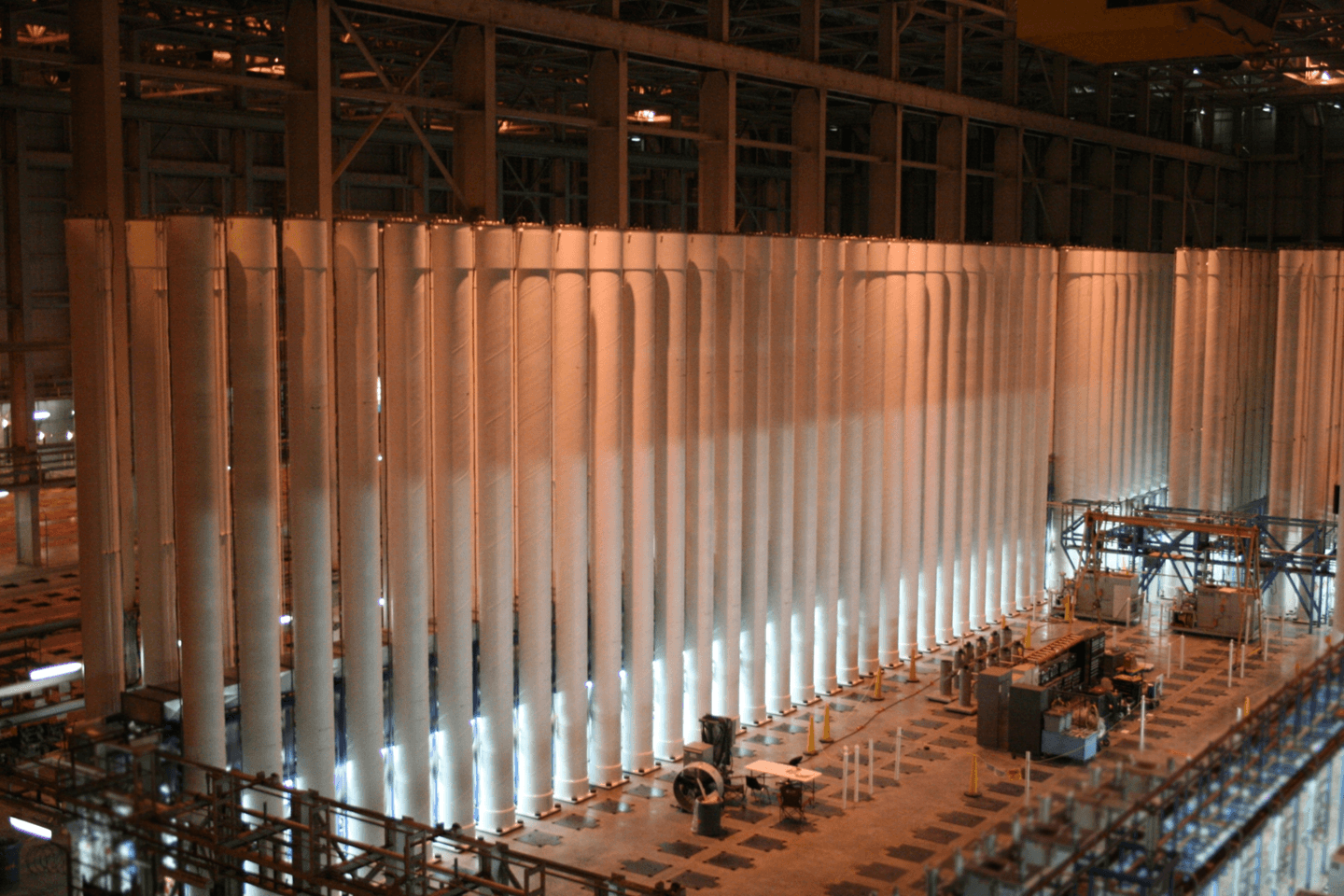
More critical still is HALEU. High-assay low-enriched uranium — enrichment above 5% — is the fuel for every SMR and advanced reactor design. The only company in the West currently with commercial-scale HALEU production capacity is Centrus Energy. Let that stand without softening: every SMR project is HALEU-dependent. Every design that Microsoft, Google, Amazon, and other technology companies are backing requires HALEU. Centrus holds a $900 million DOE task order and carries $2.3 billion in contingent LEU sales backlog for the capacity coming online in 2029. As the decoupling from Rosatom accelerates, this position only strengthens.
SMR component manufacturing: BWX Technologies has emerged as the dominant Western player in this segment. The company has produced more than 400 naval nuclear reactors and installed 325 steam generators. Its 2025 backlog growth was 119% year-over-year — a rate that is difficult to ignore. It signed a steam generator agreement with Rolls-Royce SMR; BWXT content value per SMR is estimated above $100 million. The combination of ASME nuclear certification, security clearances, and NRC qualification creates a barrier that takes years for new entrants to clear. Curtiss-Wright also occupies notable ground here, having signed a preferred strategic supplier agreement with X-energy.
Nuclear cooling infrastructure: Flowserve has installed more than 5,000 primary coolant pumps across 200+ reactors. The NRC nuclear safety qualification process runs on a multi-year cycle; switching suppliers is practically impossible for operating plants. CIRCOR holds a similar position in nuclear valve supply. Both names are typically dismissed under a generic "industrial equipment" label — but both carry genuinely structural moats.
Natural Gas / LNG: Who Powers AI in the Short and Medium Term?
It is now consensus that AI data centers will be powered predominantly by natural gas in the near and medium term. The EIA's projections support this; gas already accounts for roughly 40% of US electricity generation and will absorb the majority of incremental demand. In 2026, the US maintains its position as the world's largest LNG exporter, with financed capacity of 14 Bcf/day coming online by 2030.
The large gas turbine oligopoly is the dominant structural feature of this picture. GE Vernova, Siemens Energy, and Mitsubishi Heavy Industries control 85% of the global market and could not meet demand even if production capacity were multiplied many times over. Under conditions of chronic scarcity, backlog provides long-dated revenue and margin visibility — and that effect has not yet fully worked its way through to P&L. GE Vernova plans to increase annual production from 50 to 80 large units; that 60% increase still falls short of demand.
The less discussed but economically highly leveraged dimension of this picture is natural gas compression. Archrock is the second-largest gas compression provider in the US Permian Basin, operating with fleet capacity of 4.9 million horsepower. The company maintained 95% fleet utilization for eleven consecutive quarters. The logic is simple but durable: data center buildout → gas demand growth → Permian production growth → compression demand growth. Every link in that chain holds. Wells Fargo assigned an Overweight rating with a projected 20% return; 2025–2027 EBITDA CAGR is estimated around 9%. At roughly 7x forward EV/EBITDA, it trades at a material discount to midstream peers.
On LNG compressors, Baker Hughes, Siemens Energy, and MAN Energy Solutions control the market. In pipeline controls and critical flow valves, Flowserve and Emerson Electric are decisive; the safety-critical nature of these applications makes switching costs effectively prohibitive.
Solar and Wind: Secondary but Not Dismissible
Solar remains the fastest deployable capacity source near data center sites. Construction timelines are short; modular structure offers flexibility. But the supply chain carries a significant shadow: deep dependence on China.
In polysilicon production, the top five companies control 64–75% of global capacity, and the majority are Chinese: Tongwei (17% share), GCL Tech, Wacker Chemie, and Daqo. In wafers, LONGi, Zhonghuan, and JA Solar account for more than 80% of global production. In inverters, Huawei and Sungrow share leadership; WoodMac data shows the top ten companies controlling 71% of the global market. This structure makes solar both the fastest-to-deploy and the most geopolitically fragile segment.
For Western investors, the tracker segment is more accessible. Nextracker holds approximately 26% global market share; Arctech and Array Technologies follow. The top three collectively control 55–60% of the market. The solar tracker market does not carry the same China concentration as inverters, and that difference is meaningful.
In wind, the bottlenecks take a different form. Offshore wind projects face a critical constraint in monopile foundations. US offshore monopile manufacturing capacity is effectively zero; EEW, SIF, and Steelwind are the dominant European players. The WTIV (wind turbine installation vessel) shortage is equally structural: there are not enough vessels globally, and a new ship order requires 5–7 years to deliver. In turbine blades and gearboxes, entry barriers are lower, but NdFeB rare earth magnet dependence imports China's dominance into this segment as well — China controls over 90% of NdFeB production.
Both segments matter. But when the question is where the most acute bottlenecks and the strongest pricing power sit, the nuclear and gas side of the ledger is far more concentrated and far more constraining.
Monopoly and Oligopoly Power: Where Does Real Pricing Power Live?
From an investor's perspective, sector growth alone is not a profitability guarantee. The real question is: to whose pricing power does that growth translate?
In the US GOES steel market, the answer for Cleveland-Cliffs is unambiguous. The company is the only domestic US producer of GOES. One company. Transformer demand is surging, lead times are stretching into years, and in that environment, GOES pricing encounters not demand elasticity but supply constraint. This is not an ordinary period in which a steel company benefits from favorable cost pass-through — it is a moment where a bottleneck position converts into concrete pricing power. Amorphous metal (Metglas) could theoretically displace GOES in transformer cores, but industrial-scale substitution takes years, during which Cleveland-Cliffs' position is preserved.
Japan Steel Works M&E's position in large reactor forgings is even more striking. Two facilities in the world can perform forgings at this scale. Building a new one requires decades and demands that nuclear construction demand be visible far in advance. This is a monopoly derived from the physics and economics of investment cycles, not from market manipulation.
HALEU enrichment describes Centrus Energy's position. No other Western company has commercial-scale HALEU production capacity. The Russian import ban takes effect in 2028; from that point forward, every SMR project requiring HALEU will depend on Centrus. SILEX laser enrichment technology is in development as an alternative, but reaching commercial scale is, by the most optimistic estimates, a mid-2030s story. That window is meaningful for Centrus.
The large gas turbine oligopoly — GE Vernova, Siemens Energy, MHI — operates a different dynamic. The scale of their backlogs and the depth of existing capacity constraints establish the conditions for significant margin expansion over the coming years. The entry barrier here is a combination of technology, certification, and manufacturing scale; no new entrant can develop a competitive product on a realistic timeline.
Transformer insulation materials — dominated by Weidmann and DuPont — receive less attention. UL certification requires 12–18 months; new supplier acceptance processes are longer still. This is a quiet bottleneck sitting below the surface of the transformer crisis.
In nuclear cooling pumps, Flowserve's installed base of 5,000+ pumps across 200+ reactors makes customer switching effectively impossible. In SMR components, the ASME nuclear certifications held by BWXT and Curtiss-Wright require multi-year qualification processes; that barrier is enough to prevent new entrants from competing on any near-term horizon.
Hidden Winners: Five Companies, Five Distinct Cases
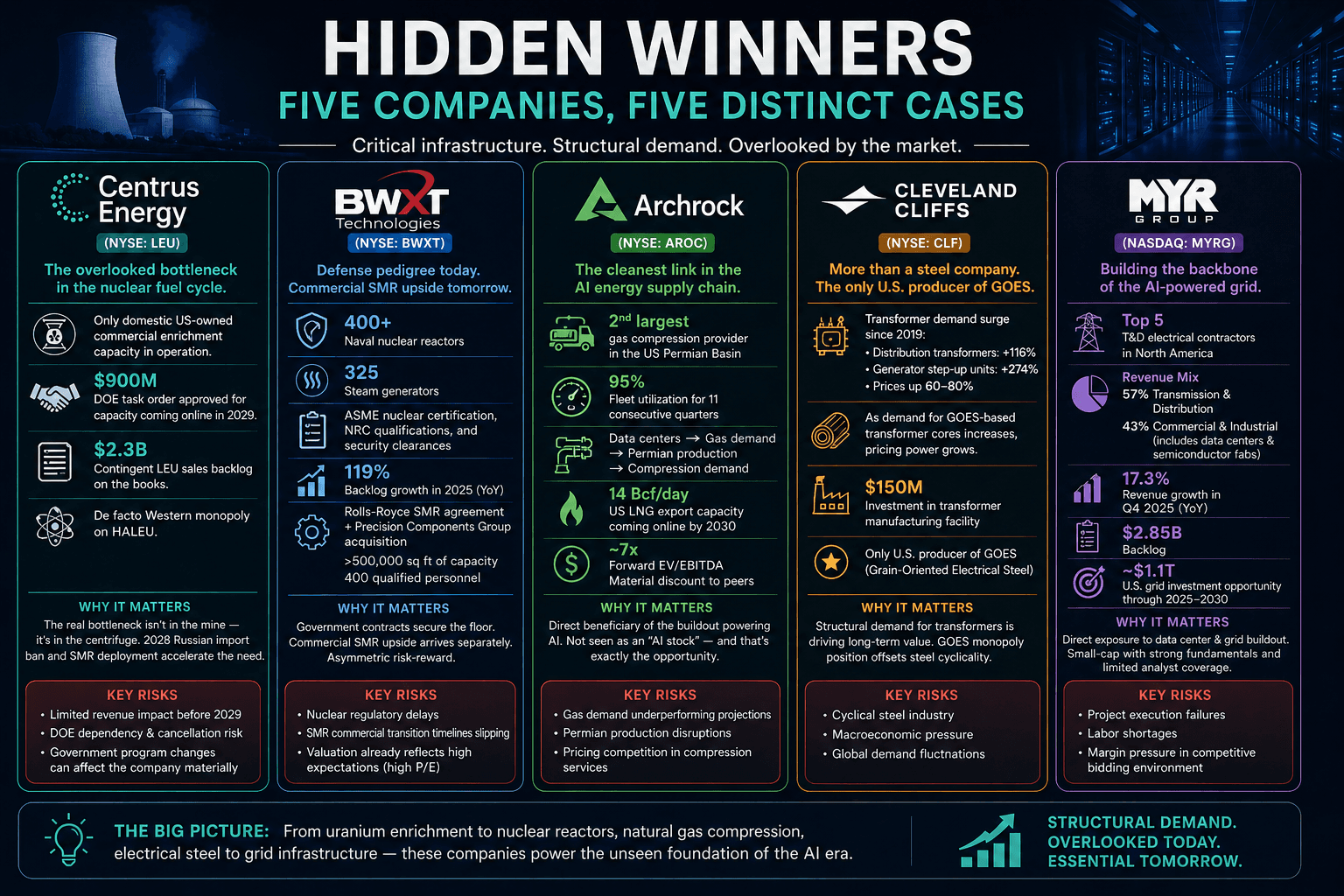
Centrus Energy (NYSE: LEU)
Centrus represents the most systematically overlooked connection in the AI energy narrative. When uranium spot prices and mining companies dominate the conversation, the enrichment layer is routinely skipped. But the real bottleneck isn't in the mine — it's in the centrifuge.
Centrus is the only domestic US-owned commercial enrichment capacity that has operated since the country's last large facility closed in 2013. The DOE's $900 million task order was approved for capacity coming online in 2029; $2.3 billion in contingent LEU sales backlog is on the books. The de facto Western monopoly on HALEU sits with this company.
The conditions under which this thesis breaks are real: revenue impact before 2029 is limited; DOE dependency carries cancellation risk; government program changes can affect the company materially. But the 2028 Russian import ban and the pace of SMR deployment work against those risks.
BWX Technologies (NYSE: BWXT)
BWXT is typically labeled a defense and naval company. That label isn't wrong — it's just incomplete. The commercial SMR story hasn't been priced into the P&L yet.
More than 400 naval nuclear reactors, 325 steam generators, ASME nuclear certification, NRC qualifications, and security clearances operating together create a barrier that takes years to build. The 2025 backlog grew 119% year-over-year. The Rolls-Royce SMR agreement and the Precision Components Group acquisition are feeding that growth — over 500,000 square feet of heavy manufacturing capacity and 400 qualified personnel added. Government contracts secure the floor; commercial SMR upside arrives separately. That combination creates an asymmetric risk-reward profile.
Risk: Nuclear regulatory delays; SMR commercial transition timelines slipping; current valuation already carries a high P/E multiple.
Archrock (NYSE: AROC)
Archrock is among the names whose connection to the AI story is least directly drawn — yet the economic mechanism is remarkably clean.
The company is the second-largest gas compression provider in the US Permian Basin. Eleven consecutive quarters of 95% fleet utilization reflects durable operational strength. Data center buildout → gas demand growth → Permian production growth → compression demand growth: no broken link in that chain. The 14 Bcf/day of US LNG export capacity coming online by 2030 adds further flow to that direction.
At roughly 7x forward EV/EBITDA, it trades at a material discount to midstream peers. Wells Fargo initiated coverage at Overweight, projecting ~20% upside. It is not seen as an "AI stock" — and that is precisely what maintains the asymmetry here.
Risk: Gas demand underperforming projections; Permian production disruptions; pricing competition in compression services.
Cleveland-Cliffs (NYSE: CLF)
Cleveland-Cliffs is a steel company. It is also the only US producer of GOES. The distance between those two identities explains the distance between how the market currently prices the company and how it arguably should.
Transformer demand has been surging since 2019: distribution transformers up 116%, generator step-up units up 274%. Prices are up 60–80%. As that demand surge increases the need for GOES-based transformer cores, Cleveland-Cliffs' pricing power grows with it. The $150 million transformer manufacturing facility investment makes the vertical integration from GOES production explicit.
The cyclical nature of the steel industry and macroeconomic pressure are genuine risks. But the structural value of the GOES monopoly position partially offsets that cyclicality — because transformer demand is structural, not cyclical.
MYR Group (NASDAQ: MYRG)
Quanta Services and Eaton receive extensive coverage; MYR Group remains in the background as a small-cap. Yet the operational profile is strong.
The company is among the top five T&D electrical contractors in North America. Revenue is split roughly 57% transmission and distribution, 43% commercial and industrial — the latter category encompasses data center and semiconductor fab construction directly. Q4 2025 saw 17.3% year-over-year revenue growth; backlog stands at $2.85 billion. The addressable market for US grid investment through 2025–2030 is approximately $1.1 trillion. Small-cap status and limited analyst coverage leave room for repricing.
Risk: Project execution failures; labor shortages; margin pressure in a competitive bidding environment.
Stock Impact Map: Priced and Not Yet Priced
This distinction needs to be drawn precisely, because "winning from this theme" and "winning from this stock" are not the same thing.
Largely priced leaders: Vertiv (VRT) trades at roughly 40x forward P/E; the AI data center power management and cooling story is now widely known. Eaton (ETN) carries a similar profile — high quality but already in the price. Quanta Services (PWR), as the T&D and data center contractor with a $2.4 trillion addressable market narrative, is strong but largely priced.
Partially priced, P&L impact still arriving: GE Vernova and Siemens Energy have become known for their backlog scale, but the margin effect of those backlogs will flow through to P&L over the coming years — and that conversion is not fully priced. nVent Electric (NVT) holds a strong position in data center thermal management, where liquid cooling penetration remains below 10%; its partnership with Siemens on AI data center cooling adds to this profile. Hitachi Energy is investing an additional $250 million in transformer capacity while operating against 30+ month delivery lead times. Nextracker (NXT) trades at a reasonable valuation in a solar tracker oligopoly.
Less discussed, more asymmetric names: Centrus (LEU), BWXT, Archrock (AROC), Cleveland-Cliffs (CLF), and MYR Group (MYRG) — all covered above. Flowserve (FLS) trades below the implied value of its structural position in nuclear pump and valve infrastructure; in a medium-to-long-term nuclear buildout scenario, it carries meaningful repricing potential.
Time Horizon Analysis: Which Thesis Works When?
Energy infrastructure investing does not fit into a single time horizon. The strategy operates across three interlocking cycles.
Short term (0–12 months): The transformer and GOES crisis is at its peak. Lead times have reached 3–4 years; prices are elevated; Cleveland-Cliffs' pricing power is immediate. Archrock is generating cash flow at high utilization. MYR Group and Quanta are logging strong order intake against growing backlogs. GEV and Siemens Energy backlog margins are beginning to flow into P&L.
Medium term (1–3 years): SMR decisions are crystallizing. Microsoft, Google, and Amazon are signing increasing numbers of nuclear PPAs; technology companies' energy portfolios are taking on meaningful nuclear exposure. BWXT and Centrus are the primary beneficiaries. Gas turbine production expansion brings GEV and Siemens Energy margin growth into visibility. Transformer manufacturing capacity begins growing with new investment, but the full alleviation of pressure isn't reached until 2027–2028.
Long term (3–10 years): The nuclear fuel chain reaches structural scarcity. The 2028 Russian ban plus new reactor construction creates permanent pricing power for Centrus and Urenco/Orano. SMR commercial deployment through 2030–2035 brings BWXT, Curtiss-Wright, and Japan Steel Works M&E into contact with substantial volumes. The rare earth magnet independence theme comes into focus over this horizon.
How Capex Flows: Where Does Value Accumulate?
The mechanism by which hyperscaler capex converts into energy demand is not linear, but it creates flows toward specific components.
Hyperscaler spending first reaches data center power infrastructure: transformers, switchgear, and cooling. Hitachi Energy, ABB, Siemens Energy, and nVent operate at this layer — but the GOES materials inside those transformer cores flow to Cleveland-Cliffs. The next layer is T&D construction: Quanta Services, MYR Group, and Primoris Services execute this work. At the power generation capacity layer, GE Vernova, Siemens Energy, and MHI produce the gas turbines; Archrock and USA Compression provide the compression that keeps those plants fed. In the long-dated nuclear component and fuel layer, BWXT, Curtiss-Wright, Japan Steel Works M&E, Centrus, Urenco, and Orano are the recipients.
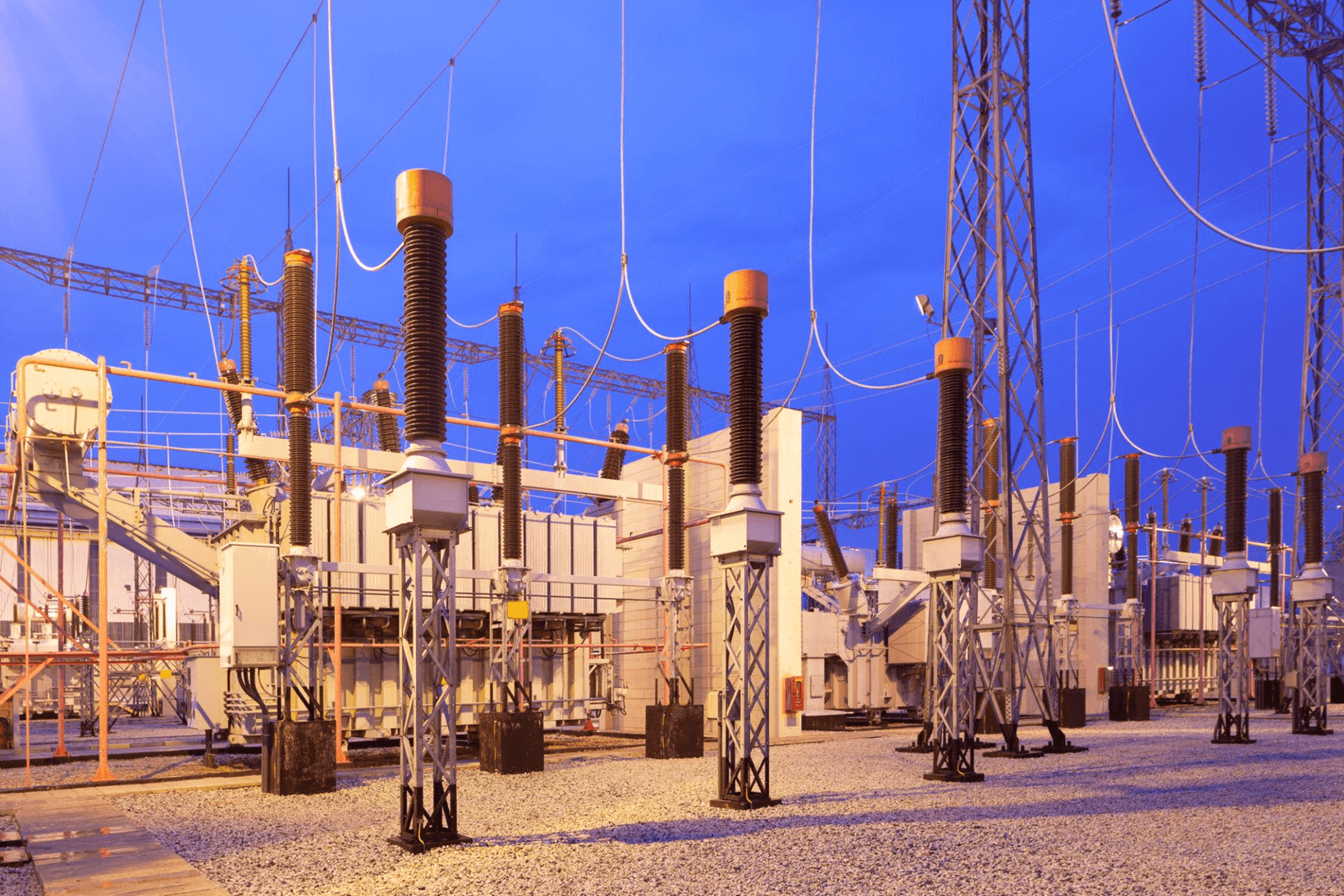
What is critical to recognize in this chain: each layer's dependence on the next means that the value of constrained supply accrues not to the final product price but to the bottleneck component. The general rule holds here — in every major infrastructure expansion cycle, the greatest value concentrates in the components with the highest demand and the lowest available supply.
Leading Indicators: What to Track
For an investor following this theme, which indicators actually signal something?
Transformer lead time surveys — WoodMac and Edison Electric Institute's quarterly publications — are among the earliest indicators in this theme. If lead times begin to shorten, the bottleneck has peaked and pricing power may be diminishing. GOES spot prices can be tracked through Cleveland-Cliffs IR releases. SWU spot prices appear in UxC and TradeTech's weekly reports; this figure is a key barometer for both the Centrus thesis and the enrichment capacity constraint more broadly.
Hyperscaler capex guidance is delivered in quarterly earnings calls; any downward revision propagates through the entire supply chain. DOE HALEU production milestone announcements are foundational catalysts for the Centrus thesis. GE Vernova and Siemens Energy backlog conversion rates show how much of the large gas turbine theme has worked through to the income statement.
Nuclear PPA announcements — in the mold of Microsoft/Constellation — strengthen both the SMR component theme and the fuel theme when they materialize. SMR FIDs (final investment decisions) carry the same effect. LNG terminal FIDs flow directly into gas compression and LNG compressor demand; 14 Bcf/day is already in the pipeline. Large grid modernization bids reinforce the T&D contractor theme.
Risks and Counter-Narratives
Each of these theses carries genuine risks, and they deserve serious treatment.
Nuclear licensing delays at the NRC can extend every projected timeline; SMR deployment dates have a history of slipping. If exceptions or delays appear in the scope of the Russian uranium ban, pricing momentum toward Centrus could soften. This risk is real — government decisions are variable.
A hyperscaler capex pullback or AI ROI disappointment could push the entire supply chain into a down cycle. If Meta or Microsoft revises capex guidance downward for the next two years, transformer orders, turbine backlogs, and compression service demand are all affected. The magnitude of this risk should not be minimized; as of early 2026, questions about the sustainability of AI investment conviction are legitimate.
Some alternative technology risks are real; some are overstated. Amorphous metal (Metglas) could theoretically displace GOES in transformer cores, but industrial-scale transition takes years — during which Cleveland-Cliffs' pricing power is preserved. Battery storage cost declines could reduce gas baseload requirements over the long term; this is a valid scenario, but not for the mid-2020s. SILEX laser enrichment technology continues in development, with CAGR expectations around 11%, but commercial scale before the mid-2030s is not realistic.
China supply chain risk remains decisive on the solar side. Inverter and wafer dependence on China exceeds 80%; tariff changes can disrupt that chain. China's 90%+ control of NdFeB production continues to create structural fragility for wind and EV sectors alike.
What Has the Market Priced, and What Has It Missed?
Three questions deserve direct answers.
Where is the real bottleneck in the AI power boom? In the short term: power transformers and GOES steel — lead times peaked at 3–4 years, and this crisis will not ease before 2027–2028 at the earliest. In the medium term: large gas turbine production capacity — the existing backlogs confirm that demand has crossed into structural scarcity. In the long term: uranium enrichment, and specifically HALEU — the Russian ban and SMR deployment make this constraint structural.
What is the market pricing correctly today, and what has it missed? Energy producers — Constellation Energy, GE Vernova, Siemens Energy — have been substantially repriced; that repricing wasn't unwarranted. Data center power management leaders like Vertiv and Eaton have also been substantially priced. What remains underweighted is the narrow supplier layer those producers depend on: Cleveland-Cliffs in its GOES monopoly, Centrus and BWXT in their SMR/HALEU positioning, Archrock as an underfollowed but economically leveraged name, and MYR Group as a small-cap with direct exposure to T&D growth. None of these are seen as "AI stocks" — and that is precisely what preserves the asymmetry.
Where is the most asymmetric opportunity: fuel, grid, equipment, or services? Short term, equipment and services: transformers, GOES steel, and T&D contracting offer the most immediate cash flow visibility. Medium term, a combination of equipment and fuel: gas turbine backlog margin conversion and the beginning of the SMR component cycle add value across both layers. Long term, the most asymmetric position is in fuel: the structural scarcity in the uranium/HALEU chain has not been fully priced, and the only thing delaying that pricing is the length of the time horizon.
The point, in the end, is this: selecting the right theme in the AI energy trade is a starting point, not a conclusion. The right theme and the right stock are not the same thing. Energy producers were the first layer to be repriced. The narrow, oligopolistic, underfollowed component manufacturers they depend on are waiting for the second wave. And what every major infrastructure expansion cycle has historically shown is that the second wave tends to be slower and less dramatic — but also less competitive and more durable.


