
"Solar Stock" and "Solar Winner" Are Not the Same Thing
Solar energy is one of the decade's most unambiguous macro themes. Installed capacity keeps growing, costs are falling, policy support — fragile as it may be — remains in place, and the relentless 24/7 energy demand from AI data centers is injecting fresh momentum into the story. The market's standard access point to this theme has been predictable: panel manufacturers, solar-focused ETFs aimed at broad exposure, and occasionally an inverter company. The narrative feels clean: put up a panel, capture sunlight, generate electricity.
But this framing conceals a critical analytical error. Panel manufacturing is the most visible layer of the solar value chain — and historically, the layer where the least economic rent accumulates. China's investment of roughly $130 billion into polysilicon, wafer, cell, and module capacity over the past five years has sent global panel prices into near-freefall, making margin protection in this category structurally difficult. Buying a panel manufacturer under these conditions is, in many ways, a bet placed directly into a competitive price war.
The real question is this: as solar grows, who actually captures the economic value? The answer, consistently and across multiple layers of the supply chain, is not the companies wearing the "solar stock" label. Value tends to accumulate in the quieter, more critical layers — components without which the system cannot function, components that are prohibitively expensive to replace, components produced by companies the market still prices as a glass manufacturer, a construction contractor, or a small mid-cap nobody covers. This essay is about those layers, those companies, and that logic.
How the Solar Supply Chain Actually Works
For a solar panel to generate electricity, a long chain must function without interruption. Running that chain through an investor's analytical lens reveals dramatically different competitive dynamics, different barriers to entry, and entirely different economic logic at each layer.
The chain starts with quartz sand. At the polysilicon layer, quartz is refined into ultra-high-purity silicon — an extraordinarily energy-intensive process. China controls 93.2% of global polysilicon production, and Western companies are not meaningfully competitive here. On the U.S. side, Hemlock Semiconductor (HSC) — a Corning affiliate — stands as essentially the sole entity with significant production capacity.
One step up is ingot and wafer production. Polysilicon is melted, drawn into crystalline ingots, and sliced into very thin wafers. Global wafer production is 96.6% China-controlled — the single most lopsided segment in the entire chain. On the U.S. side, Corning's Michigan facility came online in the third quarter of 2025; beyond that plant, there is no meaningful domestic wafer capacity.
At the solar cell layer, the wafer is processed to form a P/N junction, giving it photovoltaic properties. China controls 92.3% of global cell production. U.S. cell capacity stands at approximately 3.2 GW as of 2025 — while domestic module capacity has reached 56.5 GW. This asymmetry is critical: module factories have been built in the United States, but the cell production needed to feed them has not yet materialized.
The module layer is where competitive pressure is most intense and pricing power lowest. China controls 86.4% of global module production. The one meaningful exception is First Solar (FSLR), operating its proprietary Cadmium Telluride (CdTe) thin-film technology entirely outside China's c-Si supply chain. We will return to why this distinction matters enormously.
Moving downstream — to inverters, trackers, electrical balance of systems (EBOS), and grid connection — the picture changes dramatically. Chinese dominance is far weaker here. Large U.S. companies hold genuine market power. And every single one of these layers is non-negotiable for system operation. In a utility-scale project, absent a tracker, energy yield drops approximately 25%. Absent an inverter, DC power cannot reach the grid. Absent EBOS, the system cannot operate safely. And without a grid connection, nothing matters at all.
Why the Panel Story Is Not Enough
Understanding China's capacity investment is a prerequisite for any serious analysis of this sector. By 2023, China had poured approximately $130 billion into solar manufacturing, pushing global panel prices toward $0.12–0.15 per watt — levels at which most Western manufacturers cannot break even. When production capacity far exceeds demand, a price war becomes structurally unavoidable. That is the panel segment's defining challenge.
"We manufacture solar panels" frequently translates, in economic terms, to "we compete in a commodity market against a state-subsidized opponent with unlimited capacity." Anti-dumping tariffs in the U.S. and Europe have provided partial insulation, but they cannot change the fundamental supply-demand imbalance in crystalline silicon (c-Si) module production.
First Solar (FSLR) must be clearly separated from this analysis — and this separation matters. FSLR's proprietary CdTe thin-film technology makes it entirely independent of China's c-Si supply chain. The polysilicon–wafer–cell–module sequence that defines its competitors is simply irrelevant to how First Solar operates. In 2025, net sales reached $5.22 billion and production hit 16.1 GW. Crucially, c-Si competitors face tariffs exceeding 500% in the U.S. market — effectively conferring on FSLR a de facto monopoly in domestic utility-scale module supply. CdTe modules also carry a carbon footprint four times lower than c-Si equivalents, and an energy payback period five times shorter.
Yet when 2026 revenue guidance came in at $4.9–5.2 billion — below elevated expectations — the stock sold off sharply. First Solar's technological moat and tariff protection are real. But a strong company and a strong stock are not the same thing, and the gap between those two concepts is among the most important discipline a serious investor can maintain.
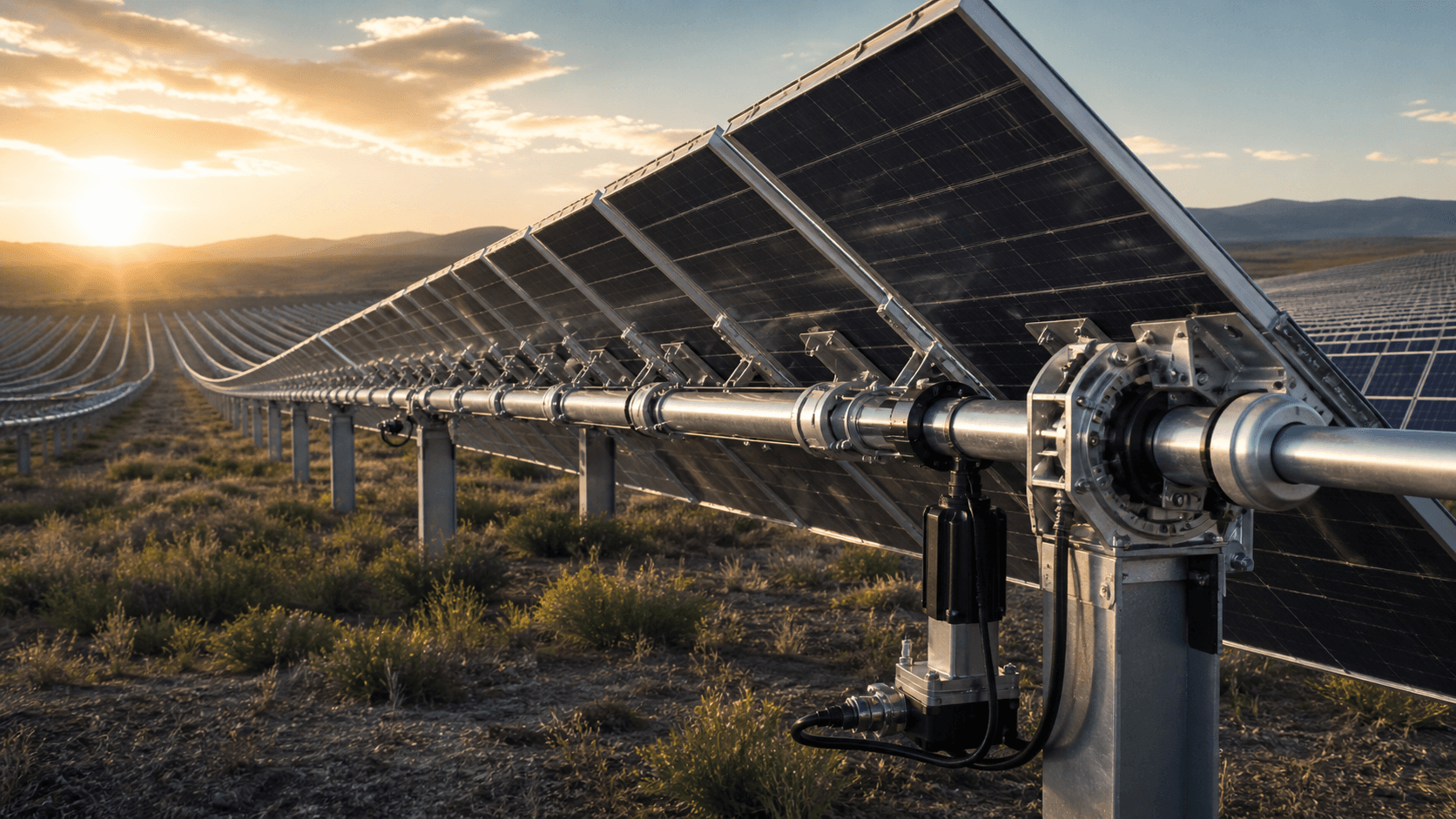
Trackers, EBOS, and the Layers That Actually Run the System
Picture a utility-scale solar farm: thousands of panel arrays spread across hundreds of acres. Should those panels remain fixed, or should they track the sun across the sky? The math is unambiguous: single-axis trackers increase energy output by approximately 25% over fixed-tilt systems. On a 200 MW project, that means producing the equivalent of 250 MW without purchasing a single additional panel. No developer facing that arithmetic builds a large-scale project without trackers.
Two U.S.-listed companies dominate this market: Nextracker (NXT) and Array Technologies (ARRY).
Nextracker has been named the global solar tracker market leader ten consecutive times, commanding approximately 26% world market share and approximately 28.5 GW in annual shipments. The competitive position is not just numerical — it is structural. Nextracker's software-based TrueCapture platform optimizes energy capture on a project-by-project basis, meaning the system continues generating value well after installation. For fiscal year 2025 (ending March 2025), Nextracker reported approximately $3 billion in revenue with adjusted EBITDA growing 49% to $776 million. Q4 FY2025 alone generated $924 million in revenue. The company also acquired Bentek in 2025 to move into electrical BOS (eBOS) — a clear signal of a strategy to control more layers of the value chain simultaneously.
Array Technologies reported FY2025 revenue of $1.3 billion (+40% year-over-year) and guided for $1.4–1.5 billion in 2026. ARRY's critical differentiator in the current regulatory environment is its 100% domestic content certification using Nucor and SDI steel — a decisive selection criterion for U.S. developers seeking to maximize IRA tax credits. NXT and ARRY together hold more than 90% of the U.S. domestic tracker market — a textbook oligopoly structure.
Perhaps the most analytically underappreciated name in this analysis is Shoals Technologies Group (SHLS). The company manufactures cable assemblies, combiners, disconnects, junction boxes, and wireless monitoring systems for utility-scale solar — the electrical connectivity layer that integrates the entire project. Without Shoals' systems, or equivalent alternatives, the project cannot operate safely. The company went public on NASDAQ in early 2021 and has remained one of the sector's least-discussed but most economically critical players.
Full-year 2025 revenue came in at $475.3 million (+19%). Year-end backlog hit a record $747.6 million (+17.8% year-over-year). 2026 guidance is $560–600 million. These are not dramatic growth numbers — but they come with gross margins above 30%, high customer switching costs, essentially no Chinese competition in this specific category, and an expanding footprint into battery energy storage systems (BESS), where backlog already includes $67 million in orders. The combination of monopoly-adjacent market structure and quiet, steady execution is exactly the profile that tends to be undervalued by markets seeking a narrative.
Why does it get overlooked? Because "solar BOS provider" is a label that generates no excitement. Reframed as "U.S. EBOS monopolist with sticky customer relationships and 30%+ gross margins," the picture looks quite different.

Corning, Wafer, and the Logic of Hidden Monopoly
Corning (GLW) is a glass company. At least, that is the frame most investors apply: fiber optic cable glass, display panel glass, specialty materials for aerospace and automotive. This framing is precisely what obscures Corning's emerging strategic value in the solar chain.
In Q3 2025, Corning commissioned what it described as the United States' largest solar ingot and wafer manufacturing facility, located in Michigan. This plant represents essentially all meaningful U.S. solar wafer production capacity; there is no credible domestic competitor of scale. Norway's NorSun, which had announced an Oklahoma facility, halted that project. Corning's position is not one among several — it is the position.
More importantly, more than 80% of the facility's capacity was sold before production began — a level of demand visibility that is unusual in any manufacturing business. The partnership with T1 Energy targets delivery of wafers beginning in the second half of 2026, with the stated goal of enabling fully American-made solar panels. Corning's stated solar revenue target for 2028 is $2.5 billion — a figure that would make solar a significant contributor to total company revenue.
Why does this constitute a "hidden monopoly"? Because Foreign Entity of Concern (FEOC) rules take full effect starting in 2026. Under these rules, solar projects incorporating components from Chinese-linked entities cannot claim IRA manufacturing tax credits. This regulatory shift structurally raises demand for U.S.-sourced wafer and cell production — and Corning is the only large-scale domestic supplier. IRA Section 45X production tax credits also cover wafer manufacturing directly, making Corning one of a very small number of U.S. companies that qualify for these incentives at scale.
The conclusion: Corning is priced as a glass company, but occupies a monopoly position in U.S. solar wafer production. As FEOC enforcement tightens and the Michigan facility ramps, this mislabeling should gradually correct. The question is timing, not direction.

Grid Connection: The Real Weakest Link in Solar Scaling
Most solar analyses examine wafer, cell, module, and inverter dynamics in detail, then treat grid connection as an afterthought. This is an analytical mistake — and it generates one of the most important misunderstandings about where value is actually accumulating in this sector.
Here is the reality: as of 2026, more than 2,600 GW of generation capacity is waiting in the U.S. grid interconnection queue. That is several multiples of total current U.S. installed capacity. There are more than 10,300 active projects in queue, of which 956 GW is solar. The median wait time from application to commercial operation now exceeds five years.
The structural drivers of this backlog are not easily resolved: large transmission projects require multi-state coordination, cost-sharing negotiations, lengthy permitting processes, and skilled labor that cannot be created overnight. A solar panel can move from factory to job site in weeks. The same project may sit in an interconnection queue for half a decade. Until that bottleneck is addressed, solar growth is, in a meaningful sense, theoretical — power is being generated but cannot reliably reach the grid.
This is where Quanta Services (PWR) and MYR Group (MYRG) demand serious attention.
Quanta Services is the largest U.S. player in energy infrastructure engineering and construction. In 2025, the company reported record revenue of $28.5 billion (+20% year-over-year). Its year-end backlog reached $44 billion — a figure that provides extraordinary multi-year revenue visibility. Quanta is not simply a solar EPC contractor; it is the dominant operator across transmission, distribution, renewable energy buildout, and increasingly, data center infrastructure. As the interconnection queue deepens and the pressure to resolve it grows, the pool of qualified contractors capable of executing these projects does not expand quickly. Quanta's experienced workforce, utility relationships, and regional licensing create barriers that cannot be replicated in short order.
MYR Group is less well known — and that gap in recognition is precisely what creates the opportunity. In 2025, MYR reported record full-year revenue of $3.66 billion. The company specializes in T&D (transmission and distribution) infrastructure and has reported strong growth from both solar and data center projects. Analyst coverage is thin; media attention is minimal. That combination historically correlates with pricing inefficiency.
The point should be stated plainly: the real bottleneck in solar scaling is not panel prices, not inverter capacity, not even polysilicon supply. It is grid connection infrastructure. The companies that can relieve that bottleneck — Quanta, MYR, MasTec — are beneficiaries of a structural constraint that is not resolving quickly. Every year the queue grows, their backlog grows with it.
Monopoly and Oligopoly Analysis: Where Pricing Power Actually Lives
The foundational question for identifying value in any supply chain is: how freely can this company set its price? Who needs this component and how many alternatives exist?
First Solar (FSLR) — CdTe Monopoly. In U.S. thin-film module production, there is no competitor. Proprietary technology, 40 years of accumulated R&D, and complete independence from China's supply chain give the company genuine monopoly pricing power in its domestic market. Entry barrier is very high; the technology cannot be rapidly replicated.
Shoals Technologies (SHLS) — EBOS Quasi-Monopoly. Once a Shoals system is installed in a utility-scale project, switching costs are substantial. Equipment is project-customized, hardware is integrated, and Shoals' monitoring software accumulates project-specific data that would be lost in a transition. Sticky customer base, record backlog, and the absence of a credible large-scale U.S. competitor produce pricing power that the "balance-of-systems provider" label does not communicate.
Corning (GLW) — U.S. Wafer Monopoly. No U.S. competitor exists at scale. Five years of forward capacity pre-sold. FEOC rules and IRA incentives structurally reinforce the position. The primary risk is that the solar segment remains small relative to total Corning revenue — ramp-up delays would extend the value realization timeline.
Nextracker (NXT) + Array Technologies (ARRY) — Tracker Oligopoly. Together, more than 90% of the U.S. domestic market. GameChange Solar, the third significant player, is private and therefore not accessible to public market investors. NXT's software layer and international presence, combined with ARRY's domestic content compliance, give both companies strong structural positions. Oligopoly pricing power is real, though less absolute than a full monopoly.
Enphase Energy (ENPH) + SolarEdge Technologies (SEDG) — Residential Inverter Duopoly. Enphase commands 48–75% market share in U.S. residential microinverters. SolarEdge is under financial pressure but maintains a commercial and industrial footprint. In residential markets, hardware-software integration and installer familiarity create meaningful switching resistance — homeowners do not upgrade inverters the way they upgrade phones.
Quanta Services (PWR) + MYR Group (MYRG) — Grid & EPC Oligopoly. Experienced workforce, safety certifications, utility relationships, regional licenses, and project history accumulated over decades create entry barriers that new entrants cannot overcome quickly. Margin pressure through competitive bidding is real, but project complexity at scale consistently favors incumbents.
Wolfspeed (WOLF) — SiC Power Semiconductor. Modern high-efficiency inverters require silicon carbide (SiC) MOSFETs — materials far more efficient than conventional silicon and far more resistant to high temperatures. Wolfspeed filed for Chapter 11 in July 2025 and emerged from bankruptcy in September 2025 after substantially reducing its debt load. Post-restructuring, the company retains approximately 53% market share in SiC substrates — a dominant position in a growing market. Risk remains high; but the asymmetry for investors with high risk tolerance is notable.
Hidden Winners: A Company-by-Company Analysis
Nextracker (NXT): The market views NXT as a solar stock — and that characterization is partially correct. But the software-hardware integrated model and growing international presence distinguish Nextracker from a commodity hardware supplier. The company has demonstrated consistent operational execution since spinning out of Flex in 2023, and its FY2025 figures — revenue growth, EBITDA expansion, backlog quality — validate the thesis. Primary risk: tariff uncertainty can delay project timelines and erode the order pipeline.
Shoals Technologies (SHLS): Few investors outside the sector can define "EBOS" — and that conceptual opacity is precisely what keeps Shoals undervalued. The company generates no technology narrative, no big-theme headline, no viral moment. But inside the business: 30%+ gross margins, record backlog, zero dependence on China, a growing BESS footprint, and near-absence of U.S. competition. This combination is the quiet profile that tends to compound. Primary risk: large utility-scale project delays can directly compress backlog conversion.
Corning (GLW): The $2.5 billion 2028 solar revenue target is small relative to Corning's total today — but the strategic quality of that revenue is exceptional. Pre-sold monopoly capacity with no domestic competitor, FEOC-tailwind, and IRA incentive eligibility creates a compounding position. The lag between the Michigan facility commissioning and Wall Street's recognition of its strategic significance is the pricing gap this thesis exploits. Primary risk: ramp-up delays or execution difficulties would push the revenue timeline further out.
Quanta Services (PWR): The market has begun to partially recognize Quanta's value — $44 billion backlog and 20% revenue growth are not easily ignored. But the full implication of Quanta's position at the intersection of three concurrent capex supercycles — solar buildout, AI data center infrastructure, and grid modernization — remains underappreciated. Each cycle individually would sustain multi-year growth; the three overlapping simultaneously is exceptional. Primary risk: cost inflation and project margin compression in a competitive labor market.
MYR Group (MYRG): The small-cap discount and limited analyst coverage leave MYR with a valuation that does not fully reflect its 2025 record revenue performance and the structural tailwinds driving T&D project demand. For investors who do the work on names with thin Street coverage, MYRG represents the type of asymmetric setup — strong fundamentals, low visibility premium — that tends to produce durable outperformance. Primary risk: project execution volatility and customer concentration.
Wolfspeed (WOLF): Post-bankruptcy restructuring, post-debt-reduction, and still retaining dominant SiC substrate market share. The company's success or failure now hinges on operational execution and demand realization from inverter, EV, and industrial customers who need SiC as efficiency requirements tighten. This is not a core holding thesis — but for investors with appropriate risk tolerance, the asymmetry between failure (further decline) and success (dominant position in a critical material for the energy transition) makes it a legitimate, carefully sized position.
Bloom Energy (BE): Technically not a solar company — fuel cells are the core business. But Bloom's ability to provide 24/7 reliable power to hyperscale data centers as a grid-bypass solution, culminating in a $2.65 billion deal with Brookfield for AI data center power, positions it as a direct beneficiary of the same underlying demand trend that drives solar. As AI energy intensity grows and grid constraints persist, Bloom's value proposition strengthens. The connection to solar is indirect; the connection to the AI → energy demand theme is very direct.
AI → Energy → Solar → Money Flow
A large language model training cluster cannot tolerate unpredictable power interruptions. A 72-hour training run interrupted by a single power event can erase dozens of GPU-hours of computation. This is not a marginal operational concern — it is a fundamental constraint on how AI infrastructure must be built and powered.
Every major hyperscaler — Microsoft, Google, Amazon, Meta — has signed utility-scale solar power purchase agreements (PPAs) exceeding 100 MW. But the mathematics of renewable integration are demanding: because solar generates nothing at night and less on cloudy days, powering 100 MW of continuous data center load requires approximately 300–400 MW of installed solar capacity plus battery storage. This multiplier means that every new AI data center places outsized demand on the solar supply chain.
Data centers are projected to consume 10–12% of total U.S. electricity demand by 2030. Morgan Stanley estimates a 36 GW shortfall in U.S. data center power infrastructure. This is a structural demand signal for every layer of energy infrastructure — and it is not abating.
Tracing the money flow:
Hyperscaler capital expenditure → data center construction → power agreements (PPA) → solar farm development → grid connection queue (where Quanta and MYR Group immediately become essential) → solar farm construction → trackers (NXT, ARRY) + EBOS (SHLS) + modules (FSLR and imported c-Si) + inverters (ENPH, SEDG) + wafers and cells (Corning/GLW → T1 Energy) → polysilicon (predominantly China, marginally Hemlock/HSC).
The strongest positioned links in that chain are: grid connection infrastructure (structural bottleneck), EBOS (monopoly logic), wafer (U.S. monopoly with FEOC tailwind), and tracker (oligopoly with domestic content compliance advantage). Panel manufacturing, by contrast, remains the most exposed layer to both Chinese price competition and policy uncertainty.
Priced In or Not?
A company being strong and a stock being a good investment are different things. Applying that distinction across the solar supply chain is essential.
Panel manufacturers are largely priced in — either downward to reflect price-war economics, or upward to reflect tariff protection. FSLR's technical moat and tariff shield are real; but the stock's valuation already embeds significant expectation, as the post-guidance selloff in early 2026 illustrated.
Solar trackers are partially priced. NXT at roughly 25x earnings is reasonable but not cheap given its visibility. ARRY is more volatile; margin constraints and residual China exposure remain unresolved questions.
EBOS (SHLS) is largely not priced in. The monopoly logic, backlog quality, margin durability, and BESS optionality are not reflected in a valuation that still treats the company as a commodity BOS provider. This is the type of systematic mislabeling that creates durable pricing gaps.
Corning's solar segment is essentially unpriced. The $2.5 billion 2028 target has not been meaningfully incorporated into how the Street models or values GLW as a whole. The facility is operational. The capacity is pre-sold. The regulatory tailwind is arriving. The recognition has not.
Grid and EPC (PWR, MYRG) are partially priced. Quanta has received some recognition as a premium infrastructure holding; MYR Group remains in a lower-coverage tier where pricing efficiency is weaker.
Space-based solar is not priced at all. NOC, RTX, and BA are priced as defense and aerospace businesses. No premium for space solar programs exists in current valuations — which is arguably rational given development timelines, but which also means the option value is currently available at zero cost.
SiC (WOLF) is speculatively priced. Restructuring execution determines outcome; both upside and downside are material from current levels.
Earliest Signals: What to Track
For the practitioner, this is the most actionable section of the essay. These are the data points and events that will most meaningfully update the thesis in the months ahead:
Corning Michigan wafer ramp-up. Capacity utilization rates and customer diversification beyond T1 Energy will determine whether the $2.5 billion 2028 target is on track. Any announcement of a second major long-term offtake agreement would be a significant positive catalyst.
T1 Energy Austin facility opening (targeted H2 2026). First commercial-scale delivery of fully U.S.-produced solar wafers confirms the supply chain thesis in practice, not just on paper.
LBNL "Queued Up" annual interconnection report. Lawrence Berkeley National Laboratory's tracking of queue size and wait times is the most authoritative public data source on whether grid bottlenecks are resolving or deepening.
FERC interconnection reform implementation. Regulatory changes to the interconnection study process directly affect Quanta and MYR Group project timelines — both positively (faster approvals) and negatively (uncertainty during transition).
FSLR order book and backlog growth. The pace of 2027–2028 contract signings is the most direct indicator of revenue visibility. A compression in backlog relative to capacity is an early warning signal.
NXT and ARRY quarterly reservation commentary. Both companies report order intake on a quarterly basis; trajectory and geographic mix signal demand quality.
SHLS gross margin sustainability above 30% and BESS backlog growth. These two metrics are the best test of whether the pricing power thesis is holding in practice.
Hyperscaler PPA announcements. Any single announcement above 500 MW creates a demand wave across the entire downstream supply chain. The timing and structure of these deals are leading indicators for all component suppliers.
IRA 45X credit continuity. Any legislative or regulatory action affecting manufacturing tax credits would directly impact the economics of every U.S.-based solar manufacturer — Corning, First Solar, Nextracker, Array Technologies.
DARPA POWER program Phase 2 results. A successful Phase 2 demonstration of sustained long-range optical power transmission would validate the RTX space solar position and re-price the option value embedded in that stock.
Northrop Grumman Arachne satellite update. Any launch confirmation or on-orbit technology demonstration from the SSPIDR/Arachne program would be the first public validation of in-space solar-to-RF conversion.
Risks and Counter-Narratives
An essay written with investment discipline must engage seriously with the scenarios that break the thesis.
China supply chain concentration and fragility. China's 93.2% polysilicon, 96.6% wafer, 92.3% cell, and 86.4% module control represents a geopolitical concentration risk of a magnitude found almost nowhere else in major industrial supply chains. Any meaningful deterioration in U.S.-China trade relations — export controls, retaliatory tariffs, technology restrictions — could disrupt global solar project economics in ways that are difficult to hedge.
Tariff and FEOC complexity. Anti-dumping and countervailing duty cases against Vietnam, Cambodia, Malaysia, and Thailand, followed by investigations into Laos, India, and Indonesia, have created a shifting "safe harbor" geography that changes faster than long-term supply contracts can adapt. This uncertainty raises procurement costs and complicates project financing.
IRA and OBBBA political risk. The "One Big Beautiful Bill" has introduced legislative uncertainty around some solar incentives. While the 45X manufacturing production credit has been preserved so far, the political environment remains unstable. Any reduction in incentives would materially alter project economics and capital allocation decisions across the supply chain.
Grid modernization delay. Resolving the 2,600 GW interconnection queue is not purely a technical or economic problem — it is a regulatory, political, and social coordination challenge. If structural reform moves slower than the thesis assumes, project timelines extend, capital costs rise, and the growth rates implied in Quanta and MYR Group valuations become harder to sustain.
SiC supply chain uncertainty. Wolfspeed's bankruptcy disrupted customer relationships and production continuity in the SiC market. Post-restructuring operational recovery is not guaranteed. If Wolfspeed encounters ongoing difficulties, inverter manufacturers face component sourcing constraints that could delay project completion timelines.
Panel price war contagion. The structural collapse in panel margins has, to date, not fully propagated into tracker, EBOS, and inverter pricing. Should competitive dynamics shift — particularly if Chinese companies attempt to extend downstream into tracker or BOS markets — the pricing power thesis in those segments would face genuine stress. This scenario has not materialized at scale, but it warrants ongoing monitoring.

Space-Based Solar Power: Frontier or Actionable Option?
Space-based solar power (SBSP) is an elegant concept: in orbit, sunlight is available 24 hours a day, 365 days a year, with no atmospheric losses. Capture that energy via satellite, transmit it to Earth via radio frequency (RF) or laser, and you have a power source that is continuous, weather-independent, and globally distributable.
Is it viable?
NASA's 2023 assessment concluded that SBSP is not currently viable as an operational power source, either technically or economically. Launch costs, in-space large-structure assembly, energy conversion efficiency, and ground receiver antenna economics represent barriers that cannot be resolved with existing technology at competitive cost. Even in the most optimistic scenarios, SBSP does not reach competitive economics before approximately 2050.
But "not viable today" is not the same as "irrelevant."
DARPA POWER Program (RTX Corporation as lead team). The Persistent Optical Wireless Energy Relay program is testing long-range optical laser power transmission. In July 2025, approximately 800 watts were successfully transmitted over 5.3 miles (8.5 km) — a world record. The three selected teams are RTX Corporation, Draper Laboratory, and BEAM Co.. RTX, with $88.6 billion in 2025 revenue and dominant defense positioning, is the most directly investable public-market exposure to this program.
AFRL / Northrop Grumman SSPIDR (Arachne). The Air Force Research Laboratory awarded Northrop Grumman a contract valued at more than $100 million in 2018 to develop space solar power transmission technology. The Arachne satellite is designed to demonstrate solar-to-RF conversion and power beaming in orbit. Northrop also manufactures the space solar arrays that power major platforms including the James Webb Space Telescope and GPS satellites — real, operating infrastructure, not just program bids.
Boeing Spectrolab. Boeing's Spectrolab subsidiary manufactures multi-junction III-V group solar cells that power approximately 60% of the world's currently operational satellites. These cells operate at efficiencies far exceeding terrestrial panels and would form the energy-capture core of any future SBSP system. Boeing's headline challenges in its commercial aviation business consistently overshadow Spectrolab's strategic significance.
Lockheed Martin (LMT) maintains long-term space solar cell supply relationships supporting its defense satellite systems. Coherent Corp. (COHR) produces laser and optical components with potential roles in power-beaming applications as the technology matures.
The honest framing: SBSP is not a current investment thesis for near-term returns. Its first commercial applications will likely be military — powering forward operating bases without requiring fuel logistics — and those could emerge between 2030 and 2035. The broader commercial electricity market opportunity is a 2040–2050 story at the earliest. Today, NOC and RTX are priced as defense companies with no premium for space solar. That means the option value embedded in these programs is currently available at no cost. As program milestones accumulate, that option value should become visible in valuations.
Final Synthesis
1. In a growing solar sector, where does economic value actually accumulate?
Not in commodity panel manufacturing, where Chinese state-subsidized capacity has structurally compressed margins and where pricing power is largely absent. Value accumulates in the layers that the system cannot do without — in the layers with real barriers to entry, in layers where the United States has genuine domestic production capability, and most durably, in the layers that the market has mislabeled and therefore mispriced. The EBOS monopolist (Shoals), the U.S. wafer monopoly (Corning), the grid infrastructure oligopoly (Quanta, MYR), and the thin-film monopoly (First Solar) are the consistent answer to that question.
2. What is the market pricing correctly today, and what is it missing?
The market has largely priced in the panel story — in both directions. It has partially priced in the tracker duopoly. It has not priced Shoals' monopoly logic into its valuation, has not recognized Corning's wafer position as a strategic monopoly asset, and has not fully internalized the structural, multi-year revenue compounding potential of grid infrastructure contractors operating in a market where demand is structurally constrained and qualified supply is limited. Space solar option value is available in defense stocks at zero additional cost.
3. Where is the most asymmetric opportunity — panels, components, or grid connection?
Solar growth is real. The demand for new electricity generation capacity, driven by AI, electrification, and basic energy security, is durable. But panel manufacturing and economic value creation are not coordinates on the same map. The most asymmetric opportunities — by definition — are concentrated in companies that do not look like solar stocks: the company the market calls a glass manufacturer but which holds the only U.S. solar wafer monopoly; the construction firms the market files under "infrastructure contractor" but which are the only entities capable of resolving the single most binding constraint on solar scaling; the unglamorous BOS provider nobody covers that is, in practice, the only supplier of record in its category for the largest solar projects in the country.
Solar energy is building the power infrastructure of the next twenty years. But the investors who capture the most durable returns from that buildout will likely not be the ones holding solar panels — they will be the ones who understood which layers of the system were irreplaceable, who was positioned in those layers, and how long it would take the market to figure out the difference.


