
Markets typically read the physical AI and robotics theme through its most visible layer: Tesla's Optimus demos, Boston Dynamics' Atlas, Figure AI's humanoids working factory floors. The video demonstrations are impressive, the narratives exciting, the valuations inflated. But the real investment question lies elsewhere: what actually makes the robot move? Where does the cost structure concentrate? Which component is the bottleneck? And most importantly: in the physical AI economy, will the real economic value accumulate in robot brands, or in the narrow supply chains that enable these robots—chains the market hasn't fully priced yet?
This article's core thesis is simple but contrarian to market consensus: in the robot economy, real value will likely accumulate not in robot manufacturers, but in critical component suppliers—especially in the actuator and motor control layers. Because what determines a robot's viability isn't the AI model or software, but the cost of physical motion. And that cost structure is shaped by an oligopoly dominated by two Japanese companies. Their names: Harmonic Drive and Nabtesco. Yet the market hasn't fully discovered these names. Because these players aren't listed on U.S. exchanges and have low analyst coverage. In this piece, we'll examine both this hidden monopoly layer and the strongest proxies accessible to U.S. investors. Because the "NVIDIA of the robot economy" may not be a single stock; the real profit could be distributed across several invisible component layers.
The Real Bottleneck of the Robot Economy: The Actuator Layer
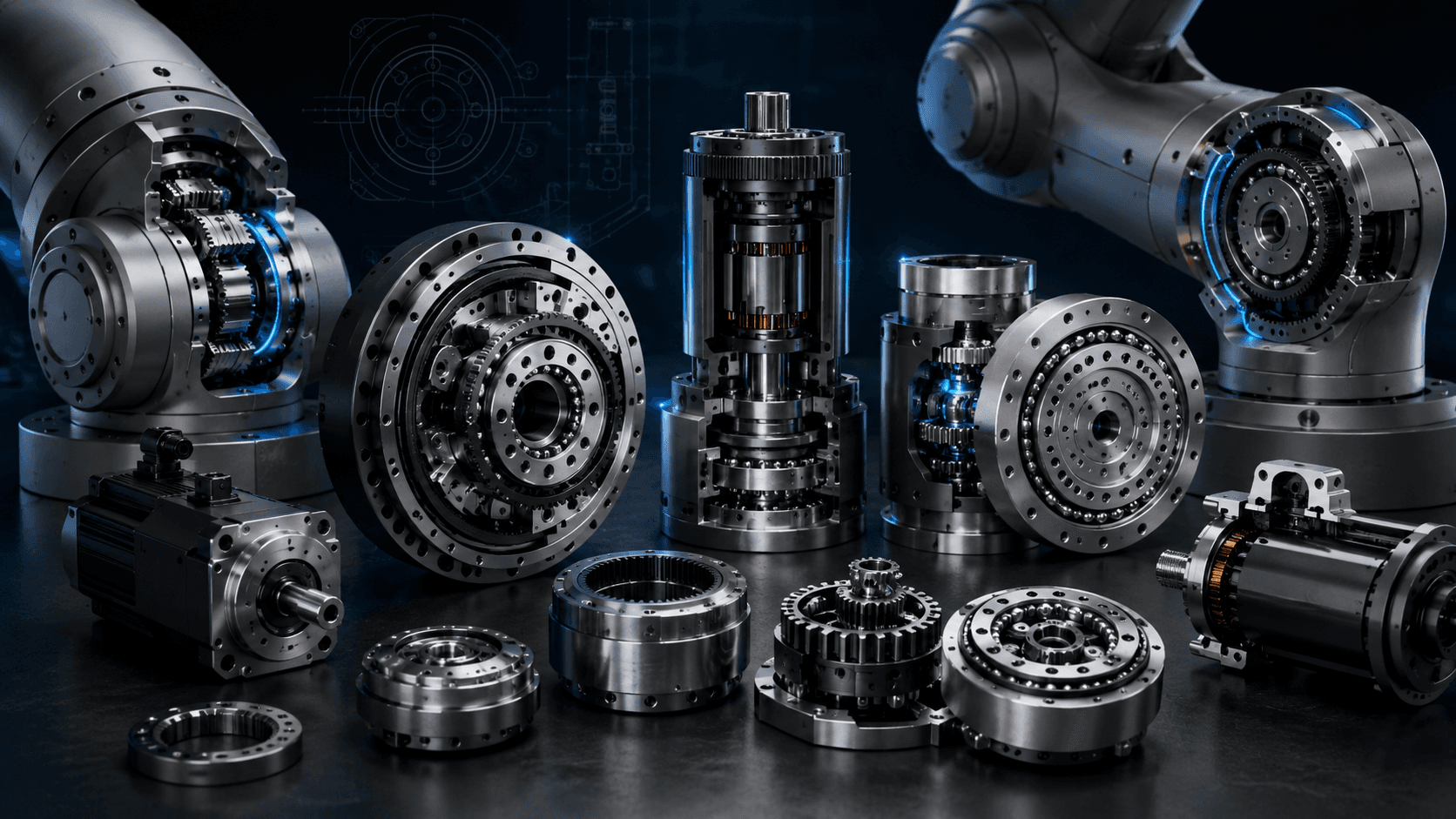
Robotics discussions typically concentrate on AI chips, computer vision, software infrastructure. NVIDIA's Isaac platform, OpenAI's multimodal models, Tesla's FSD stack. These matter, but in physical AI, software alone isn't sufficient. Because a robot is ultimately a physics problem: moving joints, precise position control, transmitting high torque. And this physics problem has created an economy where 40–55% of the cost accumulates in the actuator layer.
An actuator is the integration of motor, reducer (gear system), and controller. A single high-performance actuator can cost between $500 and $2,000. Considering a humanoid robot has 20–30 joint points, the total hardware cost for just the motion system can easily reach $10,000–$30,000. Bill of materials (BOM) analyses of Tesla's Optimus Gen2 show total hardware cost around $55,000; approximately half of that is in the actuator layer. This is a fundamentally different cost structure from battery economics in EVs or GPU economics in AI servers. In robots, actuator economics dominates, not compute or battery.
Why is this layer so expensive? Because precision manufacturing requirements are extremely high. Robotic actuators must strike a delicate balance between high torque density, low backlash tolerance, long life, compact size, and low weight. The precision gear systems used to achieve these characteristics—particularly technologies like harmonic drive (strain wave) and RV cycloidal reducers—require decades of R&D and manufacturing expertise. Entry barriers are high: patent portfolio protection, high capex, long customer validation processes. This is why the market has evolved into an oligopolistic structure.
Let's clarify the critical ranking: component priority in the robot economy ranks as follows:
- Actuators – Most critical and most expensive layer
- Battery systems – Second major bottleneck (2–4 hour runtime limit)
- Semiconductors – AI chips and motor control ICs
- Sensors – Cameras, lidar, force sensors
- Control software & materials – Lower margin, higher competition
This ranking tells us: physics comes before software. For a robot to deploy in the field, it must first be able to move, then operate long enough. Until these two conditions are met, no matter how advanced the AI model, robotic deployment cannot scale. This is why the actuator layer is the true bottleneck of the physical AI economy.
Hidden Monopoly: Harmonic Drive and Nabtesco
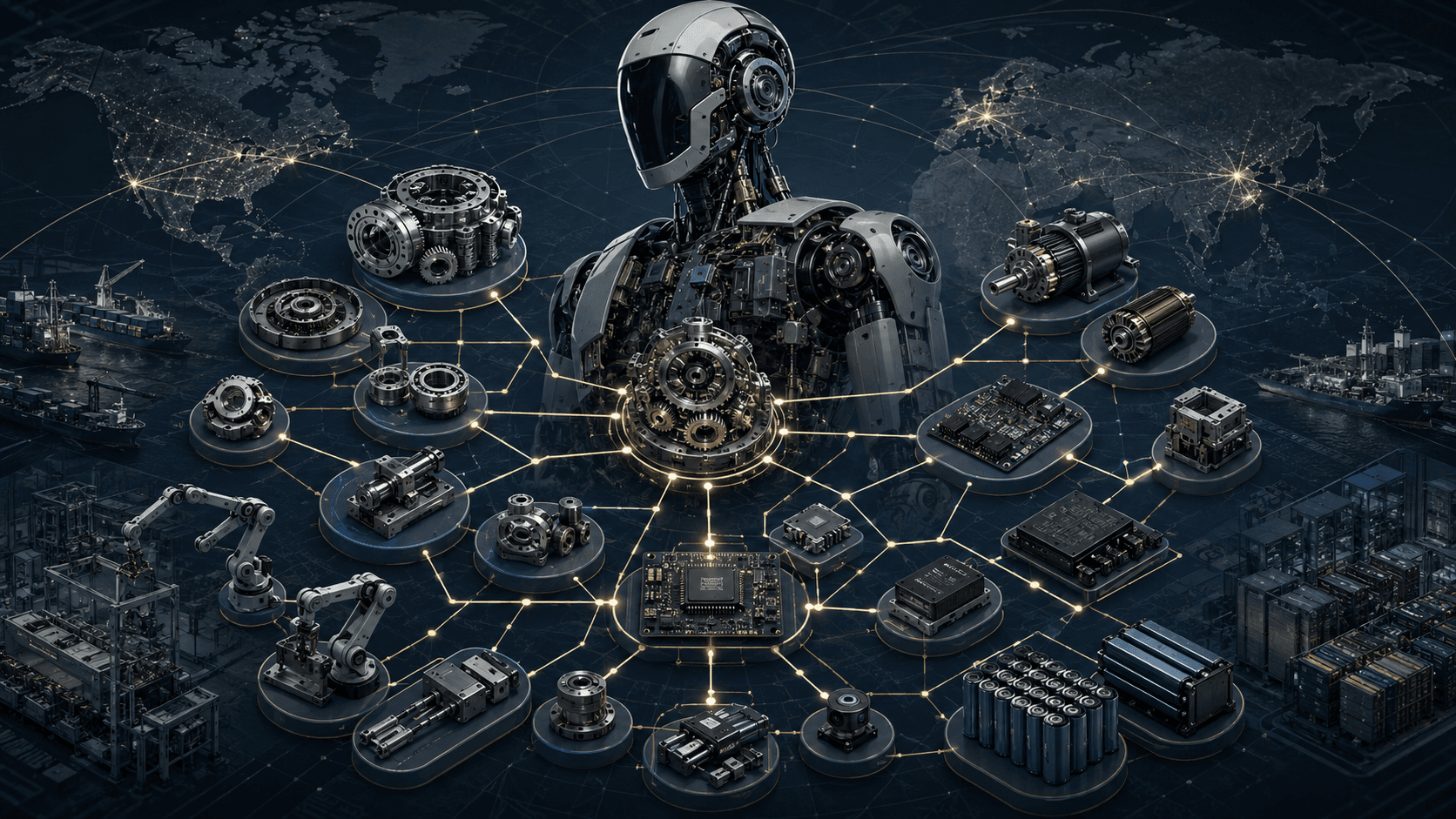
The narrowest and most profitable layer of the robot supply chain is precision gear manufacturers. And 75% of this market is in the hands of two Japanese companies: Harmonic Drive Systems (Tokyo: 6324.T) and Nabtesco (Tokyo: 6268.T). These two players are embedded in the supply chains of nearly all major robot manufacturers, from Boston Dynamics to Tesla Optimus, Figure AI to FANUC. Yet the market's knowledge of these players is limited. Because they're not listed on U.S. exchanges, their analyst coverage is low, and their media visibility is far less than robotic OEMs. This gives them "hidden gem" status.
Harmonic Drive and Nabtesco specialize in different technological domains. Harmonic Drive produces strain wave (harmonic) reducers. This technology is preferred for small joints, wrist movements, lightweight humanoids, and precision manipulator applications because it offers high precision with compact size and low weight. Harmonic Drive's market share in the strain wave segment is approximately 15–20%. Nabtesco dominates RV cycloidal reducer technology. This system is used in large and medium joints, shoulder movements, base motors—applications requiring high torque. Nabtesco's share in the precision gear market approaches 60%. The combined dominance of these two companies covers approximately 75% of the robot actuator market.
The power of this oligopoly doesn't come only from market share. Entry barriers are also extremely high. Precision gear manufacturing involves precise mechanical engineering, materials science, thermal management, and production processes requiring hundreds of iterations. Harmonic Drive and Nabtesco have decades of accumulated expertise in this field. For a new player to reach this level could take years, even decades. Patent portfolios provide protection, customer validation processes are long, capex is high. This creates strong pricing power. However, if robots move to mass production, cost pressure could increase. OEMs may turn to vertical integration strategies or seek alternative suppliers to reduce per-actuator cost. But these transitions won't be quick.
There's a critical investment distinction here: the strongest robot component players are not listed on U.S. exchanges. This means U.S.-based investors must gain exposure through indirect routes. For investors without direct access to the Tokyo exchange, second-tier proxies become critical. We'll examine these proxies now.
Most Critical Proxies Listed on U.S. Exchanges
The most important stocks that can provide U.S. investors access to the robotics supply chain:
Texas Instruments (NASDAQ: TXN)
Texas Instruments is a leader in motor control ICs and analog semiconductors. The company's analog segment revenue reached approximately $14 billion in 2025. Industrial and automotive markets constitute approximately 70% of TI's total revenue. TI has developed isolated modulators (like AMC0106M05, AMC0136) and motor control MCUs specifically designed for robotic applications. These products play a critical role in robotic servo drivers. TI's robotics exposure isn't direct but it's strong. Because every robot has motor control electronics in every joint, and TI is one of the dominant players in this market. However, the market prices TI as a general semiconductor company; its robotics exposure hasn't fully entered the mainstream narrative.
Analog Devices (NASDAQ: ADI)
Analog Devices generates $4.3 billion and $2.8 billion in revenue from industrial and automotive segments respectively. ADI's Trinamic motor driver and motion controller ICs have become industry standards for robotic automation. ADI has a more diversified revenue mix than TI; this reduces concentration risk but also makes robotics exposure slightly more indirect. Still, as robotics scales, demand for ADI's motor control products will directly increase. Like TI, ADI is read by the market as a "general analog company," not a "robotics player." This could create underpriced exposure opportunity.
NVIDIA (NASDAQ: NVDA)
NVIDIA dominates the software layer of the physical AI ecosystem with its Isaac platform and Omniverse. It has formed partnerships with robotics leaders like FANUC, ABB Robotics, YASKAWA, KUKA; these partnerships cover more than 2 million robots. Jetson modules are being integrated into robot controllers. However, NVIDIA is not a robotics hardware manufacturer; it's a platform provider. This doesn't provide direct exposure to robotics hardware demand but does provide ecosystem dominance. NVIDIA's robotics story is already visible and largely priced. This makes NVIDIA the least "hidden" player in the robotics supply chain.
Rockwell Automation (NYSE: ROK)
Rockwell Automation produces industrial automation equipment, motor control devices, sensors, safety components, and software systems. With its Allen-Bradley brand, it offers motor drives and automation solutions. Rockwell's robotics exposure is medium-high. The company is a "toll-road" player that will directly benefit from factory automation as robotic deployment increases. However, Rockwell has gained approximately 63% over the past year; this shows the market is beginning to price the automation theme. Valuation concerns have increased.
QuantumScape (NYSE: QS)
QuantumScape is developing solid-state lithium-metal batteries. The company announced production ramp plans for 2026 and is collaborating with PowerCo (Volkswagen). QS's market cap was approximately $7.6 billion in November 2025. However, QS is still in the pre-revenue stage. Solid-state battery technology could be critical for humanoid robots because current lithium-ion systems face a 2–4 hour runtime limit. But solid-state mass deployment points to post-2030. QS is a long-term and speculative robotics option. Not for near-term robotic deployment, but for investors wanting to bet on the solid-state transition in a 5–10 year horizon.
Cognex and Velodyne (LiDAR Exposure)
Cognex produces machine vision systems. It offers camera and image processing systems for industrial automation and quality control applications. As robotic deployment increases, vision players like Cognex could benefit. However, there's an important note on Velodyne Lidar: some humanoid projects like Tesla Optimus adopt a vision-first approach and don't use LiDAR. This creates a long-term risk for LiDAR suppliers. Velodyne has robotics exposure but the sustainability of this exposure is uncertain.
Supply Chain Map: Who's in Which Layer?
We can divide the robotics supply chain into five main layers: actuators, semiconductors, batteries, sensors, control systems. Each layer has different leading companies, competitive structure, U.S. listing status, and pricing power levels.
Actuators (Precision Reducers, Motors)
Leading companies: Harmonic Drive, Nabtesco
Competitive structure: Oligopoly (2 players with 75% market share)
Listed in U.S.?: No
Pricing power: Very high
Entry barrier: Very high
This layer is the narrowest and highest-margin part of the robotics supply chain. Pricing power is strong due to Harmonic Drive and Nabtesco's dominance. However, when mass deployment begins, OEM cost pressure could increase. Still, because it will take years for new entrants to enter this layer, the current oligopoly's dominance appears likely to continue in the short-medium term.
Semiconductors (AI Chips, Motor Control ICs)
Leading companies: NVIDIA, Texas Instruments, Analog Devices
Competitive structure: Competitive oligopoly
Listed in U.S.?: Yes
Pricing power: Medium-high
Entry barrier: High
NVIDIA dominates on the platform side, TI and ADI are strong on motor control. This layer has more players than the actuator layer, so pricing power is somewhat more limited. However, as robotic deployment increases, semiconductor demand will directly increase. TI and ADI's robotics exposure may not yet be fully priced by the market.
Batteries (High-Nickel NMC/NCA, Solid-State)
Leading companies: Samsung SDI, LG Energy Solution, QuantumScape
Competitive structure: Oligopoly
Listed in U.S.?: Only QuantumScape (pre-revenue)
Pricing power: Medium
Entry barrier: High
The battery layer is the second major bottleneck for robotic deployment. Currently, high-nickel NMC/NCA chemistry dominates. Samsung SDI and LG Energy Solution lead in this area but trade on South Korean exchanges. QuantumScape is U.S.-listed but still pre-revenue and speculative. The near-term robotics battery trade is the current lithium-ion supply chain, not solid-state.
Sensors (Cameras, LiDAR, Force Sensors)
Leading companies: Velodyne, Cognex, Sony
Competitive structure: Fragmented
Listed in U.S.?: Partial
Pricing power: Low-medium
Entry barrier: Medium
The sensor layer has a more competitive and fragmented structure. On the LiDAR side, there are players like Velodyne and Luminar, but LiDAR demand is uncertain because some robot OEMs adopt vision-first approaches. Machine vision players like Cognex are strong on the industrial automation side. However, pricing power in this layer is more limited compared to other layers.
Control Systems (Industrial Automation)
Leading companies: Rockwell Automation, ABB, FANUC
Competitive structure: Oligopoly
Listed in U.S.?: Only Rockwell
Pricing power: Medium
Entry barrier: High
Players like Rockwell, ABB, and FANUC provide industrial automation equipment. As robotic deployment increases, demand for these companies' automation solutions will increase. Rockwell is U.S.-listed and the robotics theme has started to be priced. ABB and FANUC trade on different exchanges.
Battery & Energy: The Second Major Bottleneck
Though not discussed as much as the actuator layer in robotics discussions, the battery side is the second major bottleneck. Because most humanoid robots today face a 2–4 hour runtime limit. Tesla Optimus Gen2 has 2.3 kWh battery capacity and provides approximately 2 hours of dynamic operation. Unitree H1 offers less than 4 hours of static operation with 0.864 kWh battery. These durations aren't sufficient for real industrial deployment. A robot working in a factory environment needs at least 8 hours of runtime per shift. This is why improvements on the battery side are critical for robotics viability.
Currently, the dominant chemistry is high-nickel ternary lithium (NMC/NCA). Samsung SDI and LG Energy Solution lead in this area and are forming robot battery partnerships with automotive manufacturers like Hyundai/Kia and Mercedes. However, these companies aren't listed on U.S. exchanges but in South Korea. The only direct option for U.S. investors is solid-state battery startups like QuantumScape. But solid-state technology hasn't yet reached the commercialization stage. QuantumScape announced production ramp plans for 2026 but the company is still pre-revenue. Mass deployment of solid-state points to post-2030.
According to TrendForce projections, humanoid robot battery demand could reach 74 GWh by 2035. This represents approximately 1000x growth from 2026 levels. This growth could accelerate the solid-state transition because solid-state batteries offer higher energy density and better safety profile. However, cost is still very high. Until solid-state battery costs drop to $100 per kWh, mass deployment will be challenging. This is why the near-term robotics energy trade is the current battery and power stack, not solid-state. In the long term, however, the solid-state transition appears inevitable.
Robot BOM Economics and Cost-Down Logic
The key to mass viability for robotic deployment is cost reduction. And regardless of which layer this cost reduction occurs in, it will have the biggest impact in the actuator layer. Because 40–55% of the robot BOM is in actuators. Tesla Optimus Gen2's total hardware cost is around $55,000. Approximately half of that accumulates in actuators. The remaining portions are sensors (10–15%), battery and electronics (a few thousand dollars), and structural components (aluminum, carbon fiber body parts).
This cost structure is fundamentally different from battery economics in EVs or GPU economics in AI servers. In EVs, battery cost constitutes 30–40% of total BOM; in AI servers, GPUs cover 50–60% of BOM. In robots, mechanical motion is the dominant cost item, not compute or battery. This means what determines robotics deployment viability isn't the AI model or battery capacity, but actuator economics.
If per-actuator cost drops 30–50%, total robot BOM drops dramatically. For example, if a robot using 25 actuators sees each actuator's cost drop from $1,000 to $500, total cost reduction is $12,500. This pulls robot price from $55,000 to $42,500. This level is still too expensive for the mass consumer market, but much closer to the viability threshold for industrial deployment. Tesla's long-term goal is to bring Optimus below $20,000. This target is only possible with 50%+ reduction in actuator costs and annual production exceeding 10,000+ units. Tesla targets 1 million unit humanoid production by 2030; this corresponds to approximately 40% of global production. At such scale, per-actuator cost reduction becomes inevitable.
However, this cost reduction isn't easy. Because precision gear manufacturing requires high capex and long iteration processes. Players like Harmonic Drive and Nabtesco have decades of accumulated expertise in this field. New entrants must spend years to reach this level. This is why OEMs like Tesla and Figure AI are turning to vertical integration strategy: they want to produce their own actuators, batteries, sensors in-house. This provides advantages of cost control, IP protection, fast iteration, and reducing supplier concentration risk. However, vertical integration isn't always the most economical solution. As scale grows, a modular supplier ecosystem can become more efficient. We'll examine this in more detail in upcoming sections.
CapEx Cycle and Money Flow
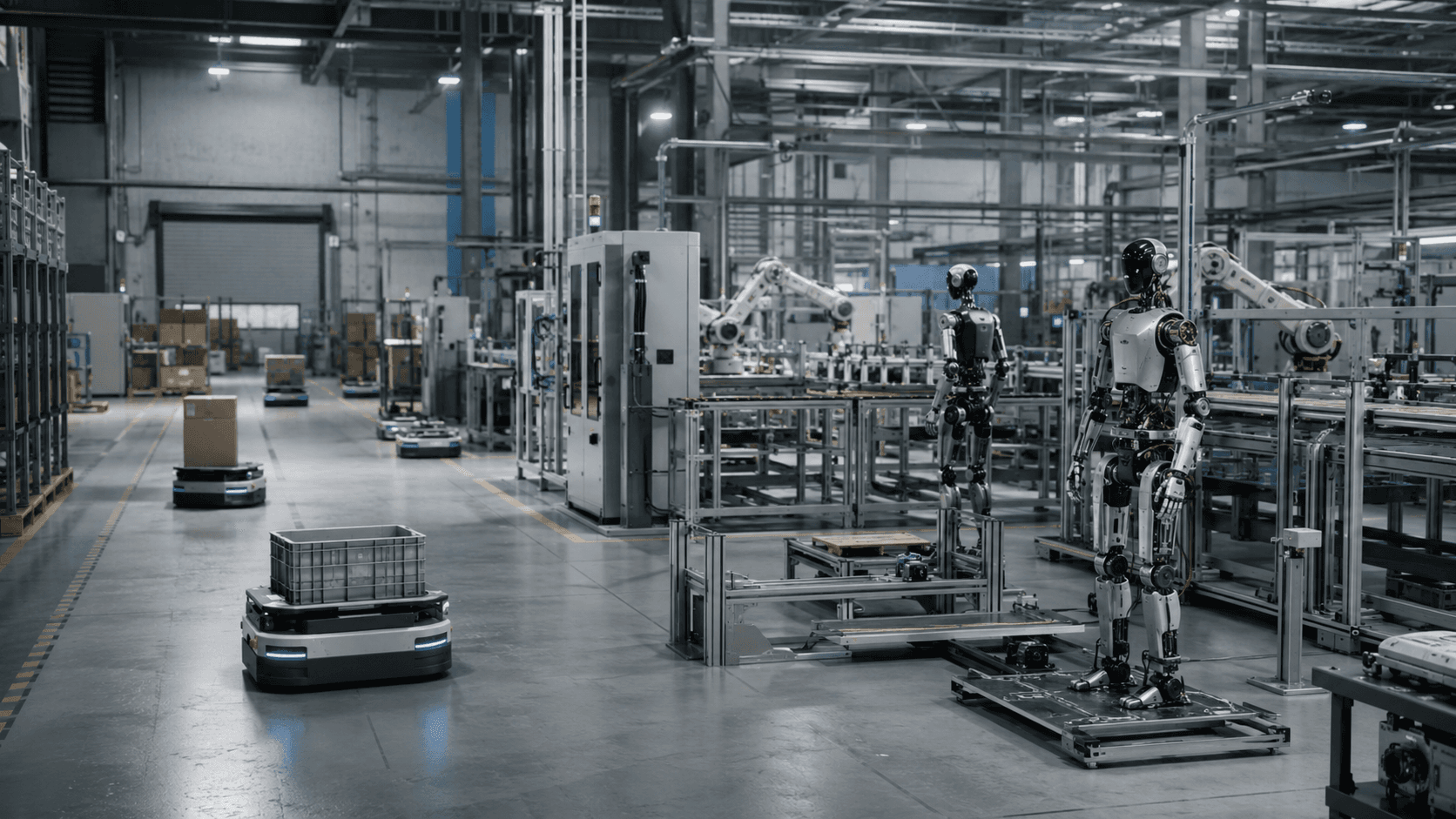
Is the robotics theme hype, or is it turning into a real capex cycle? The answer to this question lies largely in capex commitments and deployment numbers. Tesla announced $25 billion capex for 2026; this is approximately 3x the previous year. A large portion of this capex goes to AI infrastructure, Optimus robot production lines, and autonomous vehicle technologies. Optimus production begins in July 2026. This shows robotic deployment is no longer a theoretical concept but a capex cycle with real production commitments.
Humanoid market growth also supports this story. Humanoid shipments are expected to reach 50,000+ units in 2026 and show 700%+ YoY growth. The first wave (2025–2030) focuses on industrial applications with prices in the $80,000–$250,000 range. The BYD-UBTECH partnership executed the world's largest humanoid deployment: 100–200 units. GXO-Agility Robotics will deliver a 100-unit contract by 2026. These numbers are still small, but momentum is building.
We can read the money flow chain like this:
AI investments → robotics scaling → actuator manufacturers (highest margin) → semiconductor suppliers (motor control ICs) → battery manufacturers → sensor companies
In this chain, the highest economic rent will accumulate in the actuator layer. Because this layer is the narrowest and has the highest pricing power. The semiconductor side is also strong but more competitive. The battery side is important in the medium term but most current players aren't listed on U.S. exchanges. The sensor side is more fragmented and lower margin. This is why the most asymmetric exposure for investors is in the actuator and motor control layers.
The answer to whether the robotics theme is hype or real capex cycle: real capex cycle. Because major automotive players like Tesla, BYD, Mercedes, BMW are deploying, making capex commitments, and building production lines. However, mass adoption will begin between 2028–2030. We're currently in the early stage. This is why the most important question for investors is: in which layer, which companies will benefit most from this cycle?
Monopoly/Oligopoly Analysis: Where Is Pricing Power?
Each layer of the robotics supply chain has different competitive structure and pricing power levels. The cleanest map for investors looks like this:
Precision Gears (Actuator Reducers)
Number of players: 2–3 dominant
Monopoly/oligopoly: Oligopoly
Pricing power: Very high
Entry barrier: Very high
Because Harmonic Drive and Nabtesco together have 75% market share and entry barriers are very high, this layer has the strongest pricing power. However, as OEMs create cost reduction pressure, vertical integration or alternative supplier searches may increase. Still, this oligopoly's dominance will likely continue in the short-medium term.
AI Chips
Number of players: 3–5
Monopoly/oligopoly: Oligopoly
Pricing power: High
Entry barrier: Very high
NVIDIA dominates on the platform side. However, edge compute and AI inference chips are also important for robotic applications. Players like Qualcomm, Intel, AMD can compete in this area. Pricing power is high but not as narrow as the actuator layer.
Motor Control ICs
Number of players: 5–10
Monopoly/oligopoly: Competitive oligopoly
Pricing power: Medium-high
Entry barrier: High
Texas Instruments and Analog Devices are strong in this area but there are also players like ON Semiconductor, STMicroelectronics, Infineon. This is why pricing power is at medium-high level. However, as robotic deployment increases, motor control IC demand will directly increase and leaders like TI/ADI will be the players who can respond fastest to this demand.
High-Nickel Batteries
Number of players: 3–5
Monopoly/oligopoly: Oligopoly
Pricing power: Medium
Entry barrier: High
Samsung SDI, LG Energy Solution, CATL, Panasonic lead in this area. Pricing power is at medium level because major players in the EV market are already putting cost pressure on battery suppliers. Robotics battery demand is still very small; this is why robotics-specific pricing power hasn't formed yet.
LiDAR Sensors
Number of players: 10+
Monopoly/oligopoly: Fragmented
Pricing power: Low-medium
Entry barrier: Medium
The LiDAR market is fragmented and competitive. Also, LiDAR demand is uncertain because some OEMs adopt vision-first approaches. This is why pricing power in this layer is low.
Industrial Automation
Number of players: 5–10
Monopoly/oligopoly: Oligopoly
Pricing power: Medium
Entry barrier: High
Rockwell, ABB, FANUC, Siemens lead in this area. Pricing power is at medium level. As robotic deployment increases, demand for automation equipment will increase but this layer isn't as narrow as actuators.
Summary for investors: highest pricing power and narrowest competitive structure is in the actuator layer. Second place is motor control ICs. Third place is AI chips and high-nickel batteries. Weakest pricing power is on LiDAR sensors and industrial automation side.
Vertical Integration: Will OEMs Squeeze Suppliers?
Robotic OEMs like Tesla and Figure AI are pursuing vertical integration strategies on the actuator, battery, sensors, and electronics side. Tesla is developing its own actuators for Optimus. Figure AI similarly produces its own components in-house. Can this trend suppress supplier demand? And if so, are investments in actuator and motor control suppliers at risk?
The logic of vertical integration is this:
- Cost control: 30–50% of actuator cost is the gearbox. If an OEM produces its own gearbox, it can reduce cost.
- Supplier concentration risk: Dependence on Harmonic Drive and Nabtesco is reduced.
- IP protection: New actuator technologies are protected.
- Fast iteration: Design cycles are accelerated.
However, vertical integration isn't always the most economical solution. Because precision gear manufacturing requires very high capex, has long iteration processes, and takes time to reach economies of scale. If an OEM like Tesla targets producing 1 million units per year, producing its own actuators may make sense. However, for an OEM that will produce 10,000–50,000 units per year, in-house production can be costly. Because specialist suppliers like Harmonic Drive and Nabtesco produce at much larger scale and reduce unit costs through these economies of scale.
According to a McKinsey report from April 2026, vertical integration will continue until there are predictable volume guarantees. However, in mass production (10,000+ units), modularization and supplier ecosystems will become economically more sensible. Because a supplier ecosystem can increase economies of scale by serving different OEMs. This reduces unit costs and provides cheaper components to OEMs.
In conclusion, vertical integration can suppress supplier demand in the short term. However, in the long term, a modular supplier ecosystem can become more efficient. This is why the risk for investments in actuator suppliers isn't vertical integration, but whether scale grows sufficiently. If robotic deployment scales enough, the supplier ecosystem will strengthen. If it doesn't scale, both OEMs and suppliers will suffer.
Hidden Winners and Cleanest Plays for U.S. Exchanges
The strongest "hidden winners" in the robotics supply chain:
- Harmonic Drive Systems (Tokyo: 6324.T) – The hidden king of robot joints, 15–20% market share, ideal strain wave reducer technology for humanoids. But trades on Tokyo exchange; direct access difficult for U.S. investors.
- Nabtesco (Tokyo: 6268.T) – 60% of precision gear market, indispensable RV cycloidal reducer technology for large industrial robots. Again on Tokyo exchange.
- Texas Instruments (NASDAQ: TXN) – Leader in motor control ICs, used in every robot, $14 billion analog revenue. Robotics exposure indirect but strong. Market doesn't price TI as robotics player; this could create underpriced exposure.
- Analog Devices (NASDAQ: ADI) – Trinamic motion control ecosystem, industrial robotics standard. Diversified revenue mix, robotics exposure slightly more indirect but strong.
- Samsung SDI / LG Energy Solution – High-nickel battery leaders, robot battery partnerships. But trade on South Korean exchange.
Cleanest plays for U.S. exchange-listed investors:
Texas Instruments (TXN) – High quality, strong exposure. Motor control ICs critical for robotic deployment. Industrial and automotive revenue already high; robotics growth will further strengthen this segment. Time horizon: 0–5 years. Risk: Dependence on general semiconductor cycle. Valuation: Robotics exposure may not yet be fully priced.
Analog Devices (ADI) – Similar profile to TI, somewhat more diversified. Trinamic motion control products are standard for robotic automation. Time horizon: 0–5 years. Risk: Revenue mix broader, robotics exposure slightly more indirect. Valuation: Similar situation to TI.
Rockwell Automation (ROK) – Industrial automation toll-road. As robotic deployment increases, demand for automation equipment increases. Time horizon: 0–3 years. Risk: 63% gain over past year; valuation concerns have increased. Market has started pricing automation theme.
QuantumScape (QS) – Speculative solid-state battery option. Pre-revenue, high risk, high potential return. If solid-state transition happens post-2030, QS could deliver major gains. But not for near-term robotic deployment, bet on long-term technology transition. Time horizon: 5–10 years. Risk: Pre-revenue, commercialization uncertain, dilution risk.
Most asymmetric exposure for U.S. investors: TXN and ADI. Because robotics exposure is strong but the market prices these companies as general semiconductor players. As robotic deployment increases, motor control IC demand will directly increase and these companies' robotics segment revenue will grow. But this story isn't yet in the mainstream narrative. ROK is more visible but more expensive. QS is speculative and long-term.
The biggest problem: The strongest actuator players aren't listed on U.S. exchanges. Harmonic Drive and Nabtesco could be the companies that benefit most from robotic deployment, but direct access is difficult for U.S. investors. This increases the importance of second-tier proxies.
Time Horizon: Which Layer Wins When?
Robotic deployment will strengthen different layers at different time horizons.
0–2 Years (2026–2028): Early Adoption
Industrial pilot deployments will increase during this period. Tesla Optimus production begins July 2026. First major orders for actuator suppliers will come. NVIDIA will maintain ecosystem dominance on platform side. TI and ADI will see motor control IC demand increase. Rockwell will see demand for automation equipment increase.
Strongest players in this period: NVIDIA (platform), TI/ADI (motor control), Rockwell (automation). Harmonic Drive and Nabtesco also strong but not on U.S. exchanges.
3–5 Years (2028–2031): Scaling
Annual production will reach 100,000+ units. Actuator costs will begin to drop. Battery technology will show signals of solid-state transition. Vertical integration vs modular supplier ecosystem tension will increase. Economies of scale will activate.
Strongest players in this period: Harmonic Drive/Nabtesco (if they capture scale and reduce costs), Samsung SDI/LG ES (battery), TI/ADI (motor control). Solid-state players like QuantumScape may show commercialization signals during this period but mass deployment may not yet occur.
5–10 Years (2031–2036): Mass Deployment
Humanoid robot market could reach $370 billion level (2040 projection). Solid-state battery demand could reach 74 GWh level. Supplier ecosystem will mature, vertical integration may decrease. New entrants can enter actuator and battery layers. Cost reductions can open consumer market.
Strongest players in this period: QuantumScape (if it commercializes), new actuator entrants, battery suppliers. During this period, the actuator oligopoly could break and new technologies could challenge current leaders.
It's important to separate technology timeline from stock timeline. Technological transitions (solid-state, new actuator technologies, battery chemistry improvements) can take years. But the market tries to price these transitions in advance. This is why stock performance can come before technological maturity or much later. The critical question for investors: which timing is more correct? Technological maturity or market sentiment? Answer: monitor both. But in the robot economy right now, technological maturity and capex cycle are aligned. This is why timing appears reasonable.
Risks and Counter-Narratives
Risks for robotics supply chain investments shouldn't be underestimated. Because this theme is still in early stage and many assumptions haven't been tested yet.
Robot Adoption Delay
Industrial deployment of humanoid robots could happen slower than expected. Technological obstacles (manipulation precision, environmental adaptation, safety certifications) or economic obstacles (ROI not being high enough) could slow deployment. If robot adoption delay occurs, demand growth for actuator and motor control suppliers also delays. This suppresses stock performance.
Actuator Cost-Down Not Happening
Mass viability of the robot economy depends on actuator costs dropping 30–50%. If players like Harmonic Drive and Nabtesco can't reach economies of scale or new manufacturing technologies can't be developed, actuator costs could remain high. In this case, robot prices can't drop below $20,000 and the mass consumer market doesn't open. Industrial deployment can continue but growth remains limited.
Alternative Actuator or Battery Technologies
New actuator technologies (e.g., electrostatic or piezoelectric actuators) or new battery chemistries (e.g., lithium-sulfur or sodium-ion) could make current leaders obsolete. Harmonic Drive and Nabtesco's technological leadership could be broken. In solid-state battery field, new players besides QuantumScape (Solid Power, Toyota's solid-state project) could come to the forefront. This increases risk for investments in current leaders.
Vertical Integration Suppressing Supplier Demand
If OEMs like Tesla and Figure AI continue vertical integration on actuator, battery, sensor, and electronics side, supplier demand could decrease. If major OEMs produce their own components in-house, robotics segment revenue growth for suppliers like Harmonic Drive, Nabtesco, TI, ADI could fall below expectations. This risk is higher in the short-medium term; in the long term, a modular supplier ecosystem could become more efficient.
Geographic Concentration Risk
The strongest actuator players (Harmonic Drive, Nabtesco) are based in Japan. Geopolitical tensions, natural disasters, or supply chain disruptions could affect these companies' production. Also, OEMs in the U.S. and Europe may be under pressure to develop local suppliers for supply chain security. This could threaten the long-term dominance of Japanese suppliers.
LiDAR Risk
Some humanoid projects like Tesla Optimus adopt vision-first approaches and don't use LiDAR. If this approach becomes widespread, robotics exposure for LiDAR suppliers like Velodyne decreases. Because camera-based vision systems are cheaper and lighter, LiDAR's role in the robotics market could remain limited.
QuantumScape and Pre-Revenue Risks
QuantumScape is still in pre-revenue stage. Commercialization of solid-state battery technology could take longer than expected, costs may not drop to targeted levels, or competition (Toyota, Solid Power, Samsung SDI's own solid-state programs) could limit QS's market share. Also, financial risks of investing in pre-revenue companies are high: dilution, cash burn, valuation volatility.
Considering these risks, robotics supply chain investments shouldn't be viewed as one-way bullish positions. The theme is real but risks are also real. Investors should diversify portfolios, control position sizes, and align time horizon with technological maturity.
Final Synthesis: The Real Winners of the Robot Economy
Now let's answer three critical questions:
1. Where is the real bottleneck in the robot economy?
The real bottleneck is in the actuator layer. Because 40–55% of robot BOM accumulates here, a single high-performance actuator can cost $500–$2,000+, and this layer has an oligopolistic structure dominated by two Japanese companies like Harmonic Drive and Nabtesco. The second bottleneck is the battery layer; because most humanoid robots face a 2–4 hour runtime limit and the solid-state transition hasn't happened yet. The third important layer is motor control ICs; because they're required for every robot joint and players like TI/ADI are dominant in this area.
What determines robotics deployment viability isn't the AI model or software, but the cost of physical motion. And this cost is shaped today by actuator economics. This is why the narrowest layer with the highest pricing power in the robotics supply chain is the actuator layer.
2. What is the market pricing correctly today, what is it underpricing?
The market is correctly pricing robot manufacturers (Tesla Optimus, Figure AI, Boston Dynamics) and platform players (NVIDIA). These stories are visible, media coverage is high, and valuations reflect this excitement. NVIDIA's ecosystem dominance with the Isaac platform is priced.
However, the market is not yet fully pricing the actuator and motor control oligopoly. The strongest players like Harmonic Drive and Nabtesco aren't listed on U.S. exchanges, their analyst coverage is low, and their media visibility is minimal. These companies are in position to benefit most from robotic deployment but the market hasn't discovered this story yet. Motor control IC suppliers listed on U.S. exchanges like TI and ADI are priced as general semiconductor companies; their robotics exposure hasn't fully entered the mainstream narrative.
On the battery side, leading players like Samsung SDI and LG Energy Solution again aren't on U.S. exchanges. QuantumScape is priced speculatively but pre-revenue risks are high. Automation players like Rockwell Automation rallied over the past year; this shows the market is starting to price the automation theme but valuation concerns have increased.
In summary: Robot brands and platform players are fully priced or expensive; actuator and motor control suppliers may be underpriced.
3. For U.S. exchange investors, where is the most asymmetric exposure?
The most asymmetric exposure is in motor control IC suppliers: Texas Instruments (TXN) and Analog Devices (ADI). Because these companies will directly benefit as robotic deployment increases, motor control ICs will be used in every robot joint, and the market isn't yet pricing these companies as "robotics players." Industrial and automotive segment revenue is already high; robotics growth will further strengthen this segment. But this story hasn't been fully told yet.
The second asymmetric exposure is in industrial automation toll-road players like Rockwell Automation (ROK). However, ROK gained 63% over the past year; valuation concerns have increased. The risk/reward balance may have decreased for new entries.
The third asymmetric exposure (speculative) is in QuantumScape (QS). If the solid-state transition happens, QS could deliver major gains. But this is in a 5–10 year horizon and pre-revenue risks are high. This position is only suitable for investors with high risk tolerance who want to bet on long-term technology transition.
The biggest problem: The strongest players aren't listed on U.S. exchanges. Harmonic Drive and Nabtesco are dominant in the narrowest and most profitable layer of the robotics supply chain but there's no direct access for U.S. investors. This increases the importance of second-tier proxies (TI, ADI, ROK).
Final Word: Physics Comes Before Software
The robotics theme today is read through its most visible layer: Tesla's Optimus demos, Boston Dynamics' impressive videos, Figure AI's factory deployments. These stories are exciting and media coverage is high. But the real investment question is elsewhere: what makes the robot move and where does the cost of that motion accumulate?
The answer is in the actuator layer. Because 40–55% of robot BOM is here, a single high-performance actuator can cost $500–$2,000+, and this layer has an oligopolistic structure dominated by two Japanese companies like Harmonic Drive and Nabtesco. This oligopoly provides strong pricing power, entry barriers are very high, and as robotic deployment increases, these companies' demand growth is direct and inevitable.
However, these strongest players aren't listed on U.S. exchanges. This is why U.S. investors must turn to second-tier proxies: motor control IC suppliers like Texas Instruments and Analog Devices, automation toll-road players like Rockwell Automation, speculative solid-state battery startups like QuantumScape. These players are positioned in different layers of the robotics supply chain and each has a different risk/reward profile.
Robotics is turning into a real capex cycle. Tesla announced $25 billion capex, humanoid shipments are growing 700% YoY, automotive manufacturers are deploying. This isn't hype, it's a theme with real production commitments and factory deployments. However, mass adoption will begin between 2028–2030; we're currently in early stage. This is why timing is critical for investors.
The most important insight is this: the "NVIDIA of the robot economy" may not be a single stock. Because robotics has a differently structured supply chain from AI data centers. In AI data centers, value concentrates in the GPU layer; NVIDIA dominates this layer and takes the lion's share. In the robotics supply chain, value is more distributed: Harmonic Drive and Nabtesco in the actuator layer, TI and ADI in the motor control IC layer, Samsung SDI and LG Energy Solution in the battery layer, NVIDIA in the platform layer. Each layer has its own economics, each player's margin profile is different.
However, the highest pricing power and narrowest competitive structure is in the actuator layer. This is why the companies that will benefit most from robotic deployment are likely not robot manufacturers, but this hidden actuator oligopoly. The market hasn't fully discovered this story yet. Because these players aren't on U.S. exchanges, their media visibility is low, and their analyst coverage is minimal.
As robotics grows, where will the real economic value accumulate? Answer: where the cost of physical motion resides. And that place is the actuator layer. Because in the physical AI economy, physics comes before software.


