
Two Truths, One Tension
Quantum computing has escaped the confines of theoretical physics laboratories. Google's 105-qubit Willow chip cleared a 30-year barrier in error correction. Microsoft created an entirely new state of matter with Majorana 1. IonQ became the first company in the sector to surpass $100 million in GAAP revenue, closing 2025 at $130 million. These are not lab curiosities — they are genuine engineering milestones.
And yet: a deep gap persists between the popular narrative and technological reality. Quantum computers exist today and are advancing rapidly — but surpassing classical systems for general-purpose use remains years, likely decades, away. Every investment decision made without understanding this distinction rests on the fragile foundation of a speculative narrative.
The table is clear: AI is generating revenue today. Nvidia's data center sales, OpenAI's enterprise contracts, Microsoft's Copilot revenue — these are real cash flows. Quantum, by contrast, is priced today as "the economy's option on the future". IonQ's ~$12-18 billion market cap against $130 million in annual revenue implies a 90-138x Price/Sales multiple. Even for high-growth SaaS companies, a 20-25x P/S is considered "tolerable" at 30%+ growth rates — quantum multiples run three to five times beyond that. The speculative premium is not subtle.
The central question of this essay: Is quantum computing genuinely positioned to become the next mega-technology, or are today's share prices running far ahead of the underlying technological reality? The answer is both "yes" and "yes" — but those answers belong to different time horizons.
What Is Quantum Computing, Really?
From Classical Bits to Qubits
Classical computers are built on bits that exist in exactly one of two states: 0 or 1. These bits are processed through Boolean logic to execute sequential calculations; parallel operation requires adding more processors, yielding only linear power scaling. Quantum computers use qubits instead. A qubit's defining property is superposition: it can exist as both 0 and 1 simultaneously. This allows a vastly larger state space to be explored in parallel during computation.
In a classical computer, power scales linearly with the number of processors. In a quantum computer, power scales exponentially with the number of entangled qubits. Fifty qubits can theoretically represent 2⁵⁰ states simultaneously — a number that exceeds the combined processing capacity of today's best supercomputers.
Superposition, Entanglement, Interference
Three core mechanisms make quantum computers extraordinarily powerful for specific problem classes. Superposition allows a single qubit to represent all possible states at once. Entanglement means that a change to one qubit in a correlated pair instantly affects the other, regardless of distance — allowing quantum computers to explore many solution paths simultaneously. Interference replaces the deterministic processing of classical machines: the probabilities of wrong answers are suppressed while correct ones are amplified. Together, these three properties allow certain problem classes to be solved in minutes that would take classical computers longer than the age of the universe.
GPU vs. Quantum: Not Rivals, Different Paradigms
Here it is worth correcting the single most common mistake investors make. Quantum is not designed to replace the GPU. A GPU is a breadth-focused accelerator that runs thousands of simple cores in parallel to power deep learning, image processing, and large language models. A quantum processor is an entirely different computational paradigm: it offers potentially exponential speed advantages for specific problem classes — optimization, molecular simulation, factorization — while being slower and impractical for the general-purpose tasks a GPU handles. They don't compete; in the right context, they complement each other.
Qubit Architectures: Is There a Winner Yet?
How qubits are physically implemented represents the fundamental divergence point in quantum technology. Five main architectural approaches currently compete, each with distinct strengths and weaknesses.
Superconducting: The choice of IBM and Google. Built on niobium circuits, this approach enables fast gate operations and has reached 1,000+ qubit scale. The drawback is that it requires cooling to near absolute zero and still carries high error rates. Readiness level: high — this architecture currently holds the most engineering maturity.
Trapped Ion: The path taken by IonQ and Quantinuum. Ions held in electromagnetic fields serve as qubits. It leads on quality, achieving 99.9%+ gate fidelity and long coherence times, but laser complexity and slower gate speeds are significant constraints. Readiness level: medium — already serving commercial customers, but scale remains limited.
Photonic: The domain of Xanadu and QCi. Photons in optical circuits serve as qubits; the ability to operate at room temperature is a major advantage. But photon loss and entanglement generation remain serious hurdles. Readiness level: medium — less proven commercially than the top two.
Topological (Majorana): Microsoft's bold bet. Still fully experimental — but the theoretical promise is exceptional: hardware-level error resistance built architecturally into the system. Microsoft's 8-qubit proof-of-concept Majorana 1 chip has been described as "as revolutionary as the silicon transistor", and is under evaluation in DARPA's US2QC program. Readiness level: research-stage — not an investment thesis today, but an option.
Silicon-Based: Intel's route. Compatibility with existing chip fabrication infrastructure is a powerful long-term advantage; short coherence times remain the core constraint. Readiness level: early — significant scaling potential over the long run, but no commercial reality today.
The investor question is clear: Can a single architectural winner be identified today? No. The industry is still working through that question. History shows that in major technology transitions, the first successful approach is not always the long-term winner. This uncertainty makes pure-play architectural bets inherently speculative; Big Tech's ability to run parallel R&D across multiple approaches gives it a clear structural advantage.
Recent Milestones: Why They Matter (and What They Don't Mean)
Microsoft Majorana 1
In February 2025, Microsoft introduced Majorana 1 — built on a topological superconductor that represents an entirely new state of matter, composed of indium arsenide and aluminum. The chip can control Majorana particles with hardware-level error resistance. Microsoft's claim is sharp: fault-tolerant quantum computers could be reached in "years, not decades" compared to conventional approaches. The chip is currently in DARPA's US2QC evaluation program.
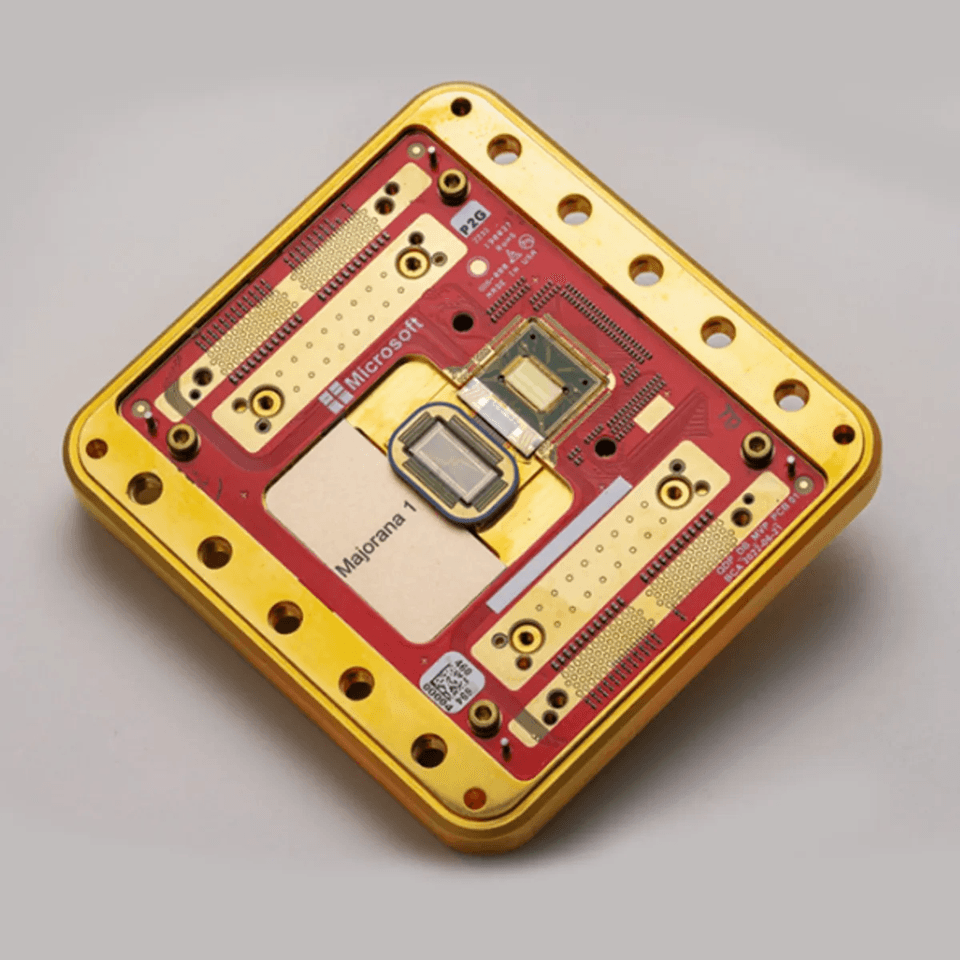
But investors need to stay grounded. Majorana 1 is an 8-qubit proof of concept. It is a research breakthrough, not a commercial product. In quantum's history, the distance between milestone and monetization has triggered disappointment more than once.
Google Willow
Google announced the Willow 105-qubit chip in December 2024. Two achievements stand out: qubit error rates that decrease as qubit count increases — solving a 30-year-old error correction problem — and the completion in five minutes of a computation that would take the fastest classical supercomputer 10 septillion (10²⁵) years. Experts recognized this as a genuine engineering milestone.
Still: the problem Willow solved was a synthe
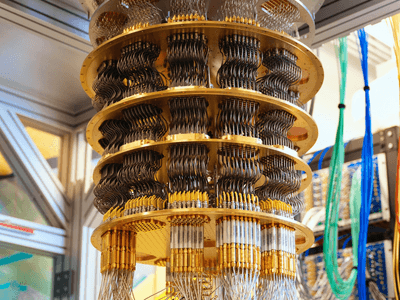
tic benchmark specifically designed to prove classical computers are slow. Replicating the same advantage on real-world problems requires much larger, error-tolerant systems that do not yet exist.
The critical distinction here is: Milestone → Monetization → Market Pricing. These three do not move in lockstep. Willow is a milestone. It is not yet monetization. Market pricing frequently leaps over both.
Company Analysis: Is Progress Reflected in Share Prices?
IonQ (IONQ) — Leader, But Expensive
IonQ commands the strongest commercial traction of any pure-play quantum company. Full-year 2025 revenue reached $130 million — a 202% YoY increase — making it the first company in the sector to exceed $100 million in GAAP revenue. Its 2026 guidance calls for $225-245 million. Trapped-ion architecture delivers industry-leading gate fidelity, and real commercial contracts back the numbers: a $54.5 million U.S. Air Force contract, and access partnerships with Amazon and Microsoft cloud platforms.
But the valuation overhangs the fundamentals. At approximately $12-18 billion in market cap against $130 million in revenue, the implied P/S multiple sits at 90-138x. Even if IonQ hits its 2026 target, the multiple only drops to ~65-70x — still three to five times what even premium SaaS companies command. The 2026 adjusted EBITDA loss guidance of $310-330 million means profitability remains a distant destination. IonQ is the least speculative of the pure-plays; "least speculative" and "fairly priced" are not synonyms.
D-Wave (QBTS) — Niche but Real
D-Wave occupies a distinct category. Its quantum annealing architecture is not general-purpose quantum computing — it is a specialized approach built for specific optimization problems. Q1 2025 revenue reached $15 million, up 509% from Q1 2024. A significant portion of that gain came from a single quantum system sale — the most important vulnerability in the D-Wave story: revenue concentration. GE Vernova, Nikon, and NTT DOCOMO have joined the customer portfolio. Genuine commercial use cases exist in logistics optimization. A $2-3 billion market cap and ~40-50x P/S is more measured than IonQ's — but profitability remains out of reach.
Rigetti (RGTI) — The Survival Question
Rigetti's superconducting architecture puts it in direct competition with IBM and Google — a difficult position for any startup, regardless of its capabilities. Selection for DARPA's Quantum Benchmarking Initiative provides strategic validation; but the balance sheet risk is critical. A small revenue base, sustained R&D burn, and pressure from well-capitalized incumbents combine to make survival risk a real variable. At a $1-2 billion market cap and a P/S ratio above 50x, Rigetti crystallizes the tension between asymmetric upside and existential downside.
QUBT (Quantum Computing Inc.) — Near-Zero Revenue, Multi-Billion Dollar Market Cap
QUBT is the starkest illustration of speculative excess. Full-year 2025 revenue: $0.26 million. Market cap: approximately $4 billion. That implies a P/S multiple in excess of 15,000x — a ratio that almost no commercially viable business in history has been able to justify. The company holds $349 million in cash, which matters for survival. Its nanophotonic "entropy computing" approach is an interesting research thesis. But no financial foundation supports this valuation.
Quantinuum — The Private Market's Solid Middle Player
Quantinuum is not publicly traded, but it belongs in any serious investor's reference frame. Backed by Honeywell, it uses trapped-ion architecture — same approach as IonQ, different go-to-market. A $600 million investment round closed in 2025 at a ~$10 billion valuation. A broad enterprise customer network, serious technical credentials, and IPO potential make it the most credible pure-play competitor to IonQ. When it does go public, the pricing will deserve careful scrutiny.
Company | Ticker | Architecture | 2025 Revenue | Market Cap | P/S | Profitability |
|---|---|---|---|---|---|---|
IonQ | IONQ | Trapped Ion | $130M | ~$17B | ~130x | Negative |
D-Wave | QBTS | Annealing | ~$60M | ~$2-3B | ~40-50x | Negative |
Rigetti | RGTI | Superconducting | <$20M | ~$1-2B | >50x | Negative |
QUBT | QUBT | Photonic | $0.26M | ~$4B | 15,000x+ | Negative |
Quantinuum | — | Trapped Ion | N/A | ~$10B (private) | — | Private |
Big Tech vs. Pure-Play: Who Has the Better Odds?
IBM: The Roadmap Benchmark
IBM holds the most detailed and credibly executed quantum roadmap in the sector. The Nighthawk chip reached 120 qubits; the roadmap targets Starling (~10,000 qubits, error-corrected) by 2029 and Blue Jay (~100,000 qubits) by 2033. IBM Quantum Network counts more than 200 enterprise customers — a genuine commercial ecosystem. IBM collects both research partnerships and QaaS (Quantum-as-a-Service) revenue through this network, giving it the strongest delivery track record of any player in the field.
Google: Research Leadership
Google Quantum AI's Willow breakthrough extended the company's lead in error correction science. The Sycamore and now Willow precedents confirm Google's ability to push technical frontiers. Its commercial aggressiveness in QaaS, however, lags IBM's. Google's quantum position reinforces its research leadership; how much and when that converts into commercial revenue remains unclear.
Microsoft: Big Claim, Big Risk
Microsoft's Majorana strategy is a different kind of bet: rather than optimizing existing architectures, it is attempting to reset the game with a fundamentally different approach. If the "years, not decades" claim proves out, Microsoft's topological qubit patents could position it for winner-take-most dynamics. But this claim has slipped before. Azure Quantum's QaaS business provides a commercial floor during this period of uncertainty.
Amazon: Distribution Power
Amazon Braket offers access to IonQ and Rigetti hardware and Amazon is quietly running its own internal quantum research. Its core quantum advantage is distribution: cloud infrastructure and an established enterprise customer base. Whether Amazon develops its own hardware remains an open question; it has already secured a strong platform position regardless.
Net investor assessment: Big Tech's probability of capturing the long-run majority of quantum value is high — but that is not an instruction to sell all pure-plays today. The correct framework maintains three separate questions: Who wins the technology race (still uncertain)? Who controls platform distribution (Big Tech advantage)? Who has the financial endurance to survive long development cycles (unambiguously Big Tech)? The pure-play role in this scenario collapses to one of two outcomes: acquired, or dominant in a niche.
Support Ecosystem: Where Alpha Might Actually Live
History's clearest lesson from technology gold rushes is that the most consistent profits often came not from the miners but from those selling picks and shovels. In quantum, that logic applies precisely.
FormFactor (FORM): Produces critical cryogenic test equipment for quantum systems. Net profitable — an extraordinary rarity in the quantum ecosystem. FormFactor grows if quantum scales, but it also collects revenue from classical semiconductor testing regardless. This is asymmetric positioning: upside with quantum, a floor without it.
PsiQuantum: Has raised $2 billion in funding and is working with GlobalFoundries on silicon photonic fabrication. Not publicly traded, but the thesis is compelling: adapt existing chip manufacturing infrastructure to quantum production. If successful, this approach resolves the scaling problem — and PsiQuantum captures much of that value.
Classiq: Operates in the quantum software layer. A $110 million investment round closed in 2025. Its hardware-agnostic quantum algorithm development platform means it creates value independently of which hardware architecture ultimately wins — a structurally cleaner position than hardware bets.
NVIDIA: Running collaborations with supercomputer centers for quantum-classical hybrid HPC workloads. NVIDIA's position is distinctive: already critical in AI, and positioned to remain critical as quantum-classical hybrid computing matures. Not a direct quantum bet, but an ecosystem participant that grows with quantum without needing it to arrive on any specific schedule.
The critical distinction for portfolio construction: companies that can generate revenue even if quantum takes longer than expected versus companies that only win if quantum arrives on schedule. FormFactor and NVIDIA sit in the first category. Most pure-plays sit firmly in the second.
Is Quantum Making Money Today?
Short answer: yes, but narrowly.
Real commercial customers are arriving. JPMorgan Chase developed quantum algorithms that reduced options pricing processing time by 90%. Goldman Sachs is researching a potential 1,000x speedup in derivatives pricing. Nearly 80% of the 50 largest banks have begun engaging with quantum technology. In March 2025, IonQ and Ansys ran a medical device simulation on a 36-qubit computer that outperformed classical HPC by 12% — one of the first documented instances of real-world quantum advantage.
Current commercial territories include QaaS, specific optimization problems, financial pilots, military and government contracts, and medical simulation. These are real dollars, but the base is small and fragile — a single large contract or system sale can move quarterly numbers dramatically.
Post-Quantum Cryptography: Today's Real Bridge Trade
Post-quantum cryptography (PQC) warrants its own narrative within this landscape. The logic: quantum computers are not breaking RSA today. But the "harvest now, decrypt later" strategy is real and active. Adversarial state actors and cybercriminals are already storing encrypted data today, intending to decrypt it once quantum machines are powerful enough. This threat compels institutions to build defenses now.
NIST published its first post-quantum cryptography standards in 2024. Organizations are expected to complete system updates by 2035 — high-risk systems far sooner. This transition is a real spending line item today, independent of when quantum hardware matures. PQC software and consulting firms collect revenue from this transition whether or not a useful quantum computer arrives in five years or fifteen.
In many contexts, today's cleanest bridge trade is not hardware — it is PQC and the access layer. These players generate revenue before the revolution, not only after it.
Which Sectors Can Quantum Actually Transform?
Finance
Portfolio optimization, derivatives pricing, and risk analytics represent quantum's earliest commercial value creation opportunity. JPMorgan and Goldman Sachs's active pilots support this thesis. McKinsey projects the financial sector could capture $622 billion in quantum-driven value by 2035. First meaningful commercial revenue likely arrives in the 2027-2030 window. Why adoption will be slow: legacy systems are difficult to displace, regulatory requirements are complex, and classical models are also improving rapidly.
Healthcare and Drug Discovery
Molecular simulation, drug candidate screening, and protein folding dynamics represent one of quantum's most profound potential application areas. Insilico Medicine's hybrid QC pipeline for the KRAS protein stands as the most serious early case study. But the clinical approval timeline for drug discovery is long; the path from quantum computational advantage to commercial revenue points toward 2028-2032.
Cryptography and Cybersecurity
RSA and elliptic curve cryptography become vulnerable once a cryptographically relevant quantum computer exists. Banking systems, government communications, internet infrastructure, and blockchain would all be at risk. This threat is not yet present; estimates point to the late 2030s or 2040s at the earliest. PQC's importance derives precisely from this gap: build the defense before the threat materializes.
Logistics and Optimization
D-Wave is already selling commercial quantum annealing solutions for logistics optimization today. Route optimization and scheduling represent the earliest real commercial revenue in the sector — 2025-2028. Why adoption may be slow: classical optimization tools are already quite powerful; the problem scales at which quantum meaningfully outperforms them are not yet routinely encountered.
Materials Science
New material discovery and battery chemistry may be among quantum's largest long-run impact areas. IBM's VQE (Variational Quantum Eigensolver) molecular simulation work points toward a 2030-2035 timeline. Both quantum readiness and the physical validation of computational results require time.
AI and Machine Learning
Expectations here deserve calibration. Quantum's contribution to model optimization and feature selection is a post-2030 story according to QED-C. Current LLM workloads are not a space where quantum can compete — this is addressed more directly in the next section.
Quantum and AI: Rivals or Synergistic?
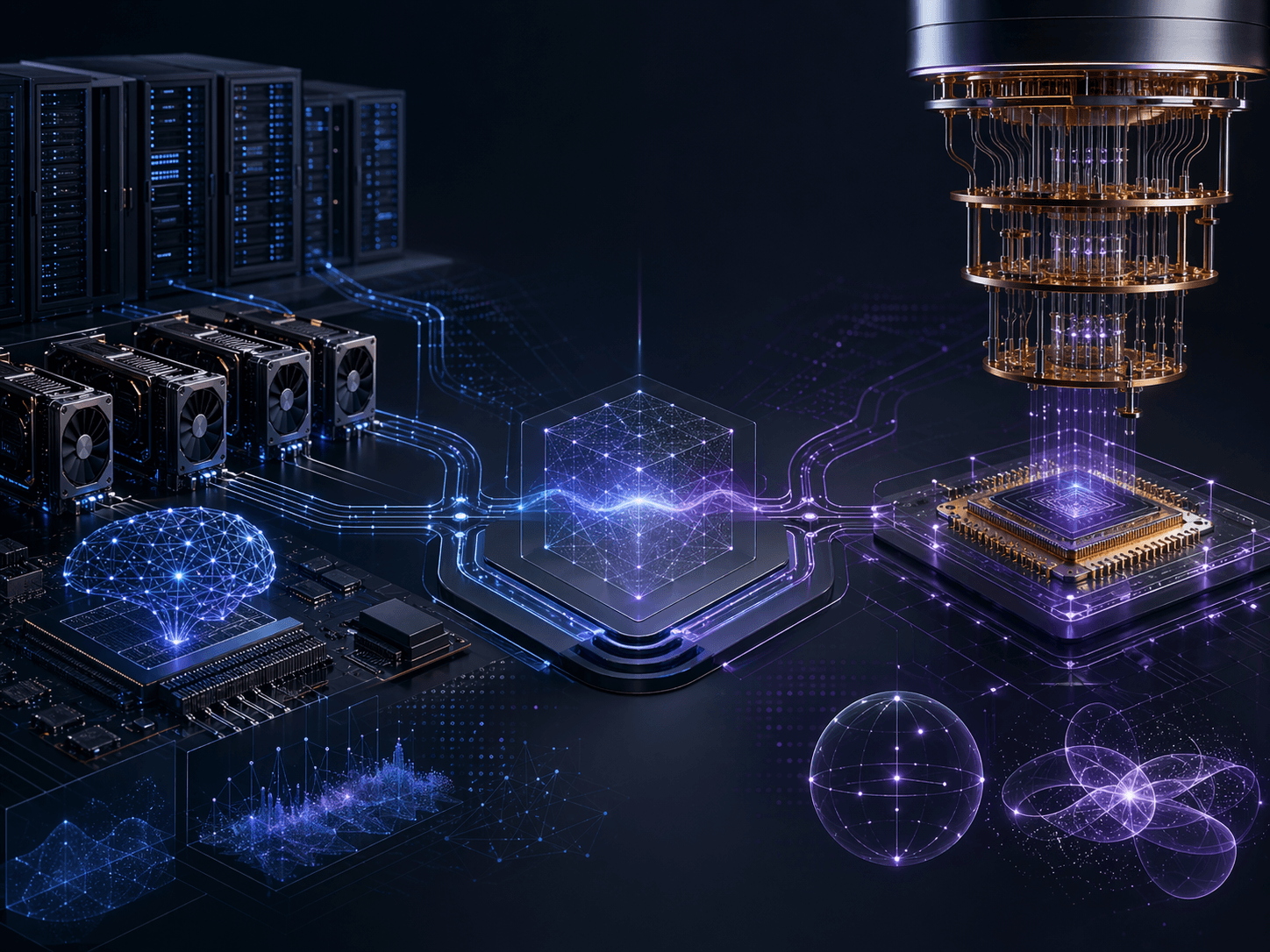
This question deserves a clear answer rather than a diplomatic hedge, because two incorrect narratives are simultaneously circulating: "quantum will kill AI" and "AI will make quantum irrelevant." Both are wrong.
Current AI workloads belong to the GPU. LLMs, image processing, recommendation engines — all require large-scale data-parallel processing that GPU clusters are purpose-built to handle. Quantum computers are not faster than GPUs at these tasks; they are slower and far more expensive. In that sense, they are not competitors today.
But two directions of forward-looking synergy are real. AI to quantum: artificial intelligence can accelerate quantum circuit design, error correction algorithm development, and qubit optimization. This is a meaningful accelerant to quantum's development timeline. Quantum to AI: quantum computers can perform chemistry and physics calculations that no classical system can replicate, generating new-quality training data and molecular insights for AI models. This is a long-run value creation path in drug discovery and materials science.
The hybrid approach is critical context. Quantum-classical hybrid algorithms in drug discovery, materials simulation, and circuit optimization combine the strengths of both paradigms. NVIDIA's collaboration with supercomputer centers on quantum-classical hybrid HPC workflows is a concrete step in this direction. IDTechEx projects that quantum and AI will ultimately be complementary rather than competitive.
The timeline matters. Quantum and AI operate as separate paradigms today. Hybrid approaches become meaningful in the 5-10 year window. Deep synergy characterizes the 10+ year horizon. Investment theses that ignore this sequencing are incomplete.
Timeline: When Does Real Impact Arrive?
0–5 Years (2026–2031): The NISQ Era
The sector is currently in the Noisy Intermediate-Scale Quantum (NISQ) period. Quantum computers are beginning to outperform classical systems on narrow, specific problems. IonQ and its peers are delivering the first real commercial use cases. The PQC transition has begun — standards are published, institutions are initiating update processes. IBM is targeting the Starling system (~10,000 qubits, error-corrected) by 2029.
Revenue-generating quantum themes in this window: QaaS access, PQC software and services, financial sector optimization pilots, military and government contracts. Not yet generating meaningful revenue: general-purpose quantum computing, fault-tolerant systems.
5–10 Years (2031–2036): Broad Quantum Advantage
BCG designates this as the "broad quantum advantage" period. IBM targets Blue Jay (~100,000 qubits) by 2033. Genuine commercial quantum applications are expected to become widespread in finance and pharmaceuticals. McKinsey projects the financial sector could realize $622 billion in quantum value by 2035. The major quantum winners consolidate during this window; losing companies will have either closed or been acquired. But Amazon's quantum chief Oskar Painter's caution deserves respect: a genuinely useful quantum computer may still be 15-30 years away.
10+ Years (2036 and Beyond): Full-Scale Fault-Tolerant Era
Million-qubit systems produce revolutionary results in drug discovery, materials, and cryptography. RSA encryption becomes a genuine vulnerability. The quantum hardware and software sector grows into a $90-170 billion independent industry. BCG assigns "post-2040" to full-scale fault-tolerant systems.
The most critical investor insight here: technology timelines and share price timelines are not the same thing. Shares can price a decade's worth of expectations today — and frequently do. That ten-year trajectory is uncertain, sector consolidation is incomplete, and market expectations are revised every quarter. This structural uncertainty is what makes quantum shares high-beta, momentum-driven instruments.
Risks
Technical Risks
Decoherence: Qubits can maintain quantum states for only extraordinarily brief intervals — from microseconds to milliseconds. This generates noise that amplifies errors during computation. Willow made meaningful progress on this problem, but replicating that success in industrial-scale systems remains unproven.
Scaling: Today's leading systems use fewer than 200 qubits. Commercial utility is estimated to require one million or more. Closing a 1,000x gap is a formidable engineering challenge, not a question of extrapolating existing progress.
Error Correction Cost: Obtaining a single logical qubit requires thousands of physical qubits. Google's Willow improved this ratio, but at practical scale it remains inefficient.
Market and Competitive Risks
Survival Risk: An analyst tracking the sector notes that 84 companies are attempting to develop QPUs, with the majority unprofitable and unlikely to survive the decade. Winner-takes-most dynamics pose a serious threat to smaller pure-plays.
Competitive Pressure from Classical: Classical computers and AI are also advancing rapidly, continuously moving the goalposts for quantum advantage. IBM challenged Google's 2019 supremacy claim almost immediately — this dynamic could recur.
Valuation Risk: IonQ at ~130x P/S, D-Wave at ~50x. If the growth narrative stumbles for any reason, 50-80% drawdowns are plausible. High momentum cuts both ways.
Investor Timing Risk: Quantum hype creates the most insidious risk: being right about the technology and wrong about the timing. A company that delivers a genuine breakthrough in 2035 may still generate poor investment returns for shareholders who paid peak speculative multiples in 2026. Being eventually right and being right on schedule are very different things.
Narrative Assessment
Will Quantum Actually Create a Revolution?
BCG's and McKinsey's economic value projections — $450-850 billion and $198 billion respectively — are methodologically substantiated, not speculative. If the timeline holds — a substantial "if" — quantum constitutes a genuine economic revolution. But the gap between "real revolution" and "timely revolution" is precisely what today's shareholders are paying to bridge.
Is Quantum Close or Still Far?
First evidence in narrow domains has arrived: Willow, IonQ+Ansys medical simulation. General-purpose utility remains 5-10 years out. This "middle distance" rejects both "quantum is ready today" and "quantum will never arrive."
Is Quantum Hype?
Partly — but with an important nuance. Share valuations are decoupled from fundamentals. That is real. But the technology is also real, and the milestones are real. Calling it "hype" requires ignoring IonQ's $130 million in revenue, Willow's error correction breakthrough, and Majorana 1's physics achievement. "Hype" is the wrong word. "Early pricing" or "speculative premium" are more precise.
Big Tech or Pure-Play — Who Wins?
Big Tech's resource advantage is unchallengeable. Probably 5-10 of the 84 QPU companies survive; the rest get acquired or close. But IonQ, with genuine commercial traction, represents the class of pure-plays that could win through either acquisition or niche dominance. The outcome set is binary — not a spectrum.
Can Quantum Be Bigger Than AI?
Over the long run, in specific sectors — yes, possibly. Quantum's potential for existential transformation in drug discovery, materials science, and cryptography is real. But AI is affecting a broad cross-section of the economy today; quantum's impact will be deeper in specific sectors but arrives decades later. Near-term market size comparison favors AI; long-run potential remains genuinely contested.
Quantum Shares: Investment or Speculation?
Predominantly speculation, with a narrow investment component. The correct framework by time horizon: in the near term (0-2 years), favor quantum-adjacent themes over hardware shares — PQC cybersecurity, cloud QaaS, support ecosystem. In the medium term (2-5 years), a small position in high-conviction companies — IonQ, Quantinuum on IPO. In the long term (5-10 years), quantum exposure through Big Tech positions or ETF vehicles.
Final Synthesis
Did Recent Developments Change the Thesis?
Yes — they expanded the upside ceiling without pulling the commercial timeline forward. Google Willow's error correction breakthrough, Microsoft Majorana 1's physics achievement, and IonQ's $130 million in commercial revenue collectively make "quantum will never arrive" indefensible. Confidence in long-run economic potential should increase. But the "quantum is decades out" timeline has not changed. Milestones prove that commercial scale is achievable; they do not compress the time required to reach it. That distinction is everything.
What Is the Market Pricing Correctly Today? What Is It Overpricing?
Correctly priced: IonQ's commercial leadership — the only pure-play with a genuine revenue lever. Big Tech's quantum infrastructure — IBM, Google, and Microsoft's quantum ecosystems are underweighted components of already large valuations. The urgency of PQC transition — this threat is real and generating revenue today.
Overpriced: QUBT's 15,000x+ P/S is indefensible under almost any plausible scenario. IonQ's ~130x P/S falls to ~65-70x if 2026 guidance is met — still carrying substantial speculative premium. Across the pure-play universe, pricing reflects a technological maturity that has not yet arrived.
Where Is the Most Asymmetric Opportunity for Investors?
Three layers offer distinct risk-return profiles.
First layer (lowest risk, earliest payoff): PQC and cybersecurity. NIST standards are published, the 2035 transition mandate is defined, institutional spending has begun. This area grows with quantum's threat — not with quantum's readiness. Revenue flows regardless of hardware development speed. This is the cleanest structural long in the quantum universe.
Second layer (moderate risk, medium horizon): The support ecosystem — companies like FormFactor that are already profitable and sell across sectors; hardware-agnostic software platforms like Classiq. These players grow with quantum maturation but are not existentially dependent on it arriving on schedule.
Third layer (high risk, asymmetric upside): A small, long-duration position in the one or two pure-plays with demonstrated commercial traction — IonQ, and Quantinuum upon IPO. The bet is on survival and niche dominance. High volatility, real downside, and genuine upside if the thesis holds.
Quantum computing is not a fabricated story. The technology is real. The engineering milestones are real. The long-run economic potential is concrete and large — BCG's $850 billion projection and McKinsey's $198 billion total quantum market estimate are defensible numbers, not fiction. But a meaningful portion of today's share prices reflect that long-run reality against the wrong time horizon. The speculative premium is real; the maturation timeline is long; and the cleanest near-term bridge trade is most likely not direct hardware exposure, but PQC, QaaS access, and the support ecosystem. Avoiding the quantum revolution entirely is a mistake — but paying peak speculative multiples for hardware exposure in 2026 is a different kind of mistake. Positioning in the right layer, at the right size, with the right time horizon: that is where the asymmetry lives.


