
The artificial intelligence race is not, from the inside, merely a model race. Yes, parameter counts keep climbing, benchmark scores get refreshed, transformer architectures are refined. But this competition has quietly migrated to another domain: data movement, network infrastructure, energy consumption — and ultimately, physics. The true constraint in running 100,000 GPUs together is no longer compute capacity. It is how fast, cheaply, and reliably you can move data between those GPUs. The answer to that question — or its absence — is redirecting billions of dollars of capital.
Photonics enters precisely at this point. This technology, which uses light as the carrier of information, is converging with photonic integrated circuits and silicon photonics to become the only credible path beyond the physical limits that copper cable reached in 2025. Lumentum (LITE) gained 1,507% over 12 months. Coherent (COHR) rose 458%. In March 2026, Nvidia committed $2 billion to Lumentum and $2 billion to Coherent. Marvell acquired Celestial AI for $3.25 billion. The Silicon Photonics market, valued at $2.62 billion in 2025, is projected to reach $34.34 billion by 2035 — a compound annual growth rate of 29.6%.
But stop here. Because a technology thesis being strong does not mean stocks built on that thesis are good investments. Lumentum is currently trading at 250–300x P/E. The core question for any investor is this: Is photonics an inevitable transformation, or has the market already pulled tomorrow's value into today's prices? That tension will hold throughout every section below.
What Is Photonics and Why Does It Matter Now?
Stepping back to clarify the technology is essential — because understanding photonics as merely "optical cable" completely mislocates where value sits in the chain.
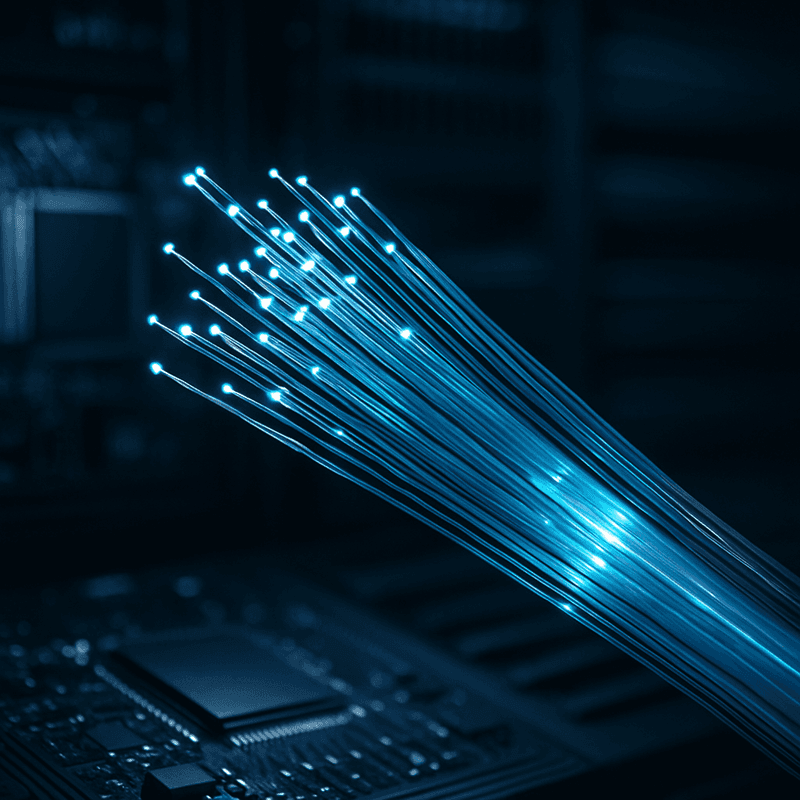
Photonics is the engineering discipline concerned with the generation, transmission, management, and detection of photons — particles of light. Just as electronics is built on electron flow, photonics is built on photon flow. The physical behavior of these two carriers diverges radically. Electrons traveling through a conductor experience resistive loss, generate heat, and are susceptible to electromagnetic noise. Photons travel through optical fiber at near light-speed, with near-zero loss and complete immunity to EMI. The practical consequences are large: bandwidth above 1.6 Tb/s, range measured in hundreds of kilometers, and 40–70% lower power consumption relative to pluggable modules.
Silicon Photonics solves the manufacturing side of this equation. It integrates optical components — waveguides, modulators, photodetectors, and laser sources — onto standard CMOS silicon processing platforms. The critical advantage: the same foundry infrastructure used at TSMC and GlobalFoundries becomes available. The constraint: silicon cannot generate light natively, so Indium Phosphide (InP) compound semiconductors are required as laser sources. That dependency will resurface as one of the most important risk factors in this analysis.
PIC (Photonic Integrated Circuit) is the optical equivalent of an electronic IC: modulator, waveguide, photodetector, and laser source combined on a single chip. But the defining architectural advance is CPO (Co-Packaged Optics). CPO places PIC, EIC (Electronic IC), and switch ASIC inside the same package — a heterogeneous integration approach. In conventional systems, transceiver modules connect to the switch at roughly one cable-length distance. In CPO, that distance approaches zero: optical and electronic circuits sit side by side within the same package. The result: lower signal amplification requirements, reduced latency, and substantially lower energy consumption. Nvidia's Spectrum-X and Quantum-X switch families are the first major production systems making this CPO architectural leap.
The fundamental question: Why is this now a physical necessity rather than an option? Physics provides the answer. At 224 Gbps per lane, copper cable range falls below one meter. A system requiring terabit-scale bandwidth cannot use copper — not just difficult, but physically impossible within the laws of physics. WDM (Wavelength Division Multiplexing) technology allows dozens of simultaneous channels at different wavelengths over a single optical fiber, reaching terabit capacity without multiplying cable count. Copper cannot offer this flexibility.

Where Is the Real Bottleneck in AI Infrastructure?
GPU performance is making impressive generational jumps. Nvidia's Blackwell architecture offers 4x more compute than the previous generation. But I/O — the chip's ability to communicate with the outside world — grows by only 1.5x. That asymmetry is producing a quiet crisis: compute capacity grows but the data flow required to feed that capacity doesn't keep pace. In MLPerf benchmarks, GPU utilization rates in large clusters consistently remain below 50% — meaning more than half of theoretical compute capacity is wasted. Why? The GPUs are waiting for data.
The distinction between scale-up and scale-out is critical here.
Scale-up means expanding within a single system: placing more GPUs in the same rack, connecting them with high-bandwidth links like NVLink. NVLink5 provides approximately 1.8 TB/s bidirectional bandwidth. Copper remains valid at 1–2 meter distances in this context. However, energy density and thermal management impose their own limits on scale-up. CPO enters this layer too, but its primary use case is scale-out.
Scale-out means connecting servers together: distances of hundreds to thousands of meters, multiple racks, multiple buildings. In systems housing 100,000 GPUs like xAI's Colossus cluster, servers are physically tens of meters apart. At these distances copper is entirely out of the picture; optical fiber and active optical cable (AOC) are already the standard. The 400G → 800G → 1.6T transition is rolling out from 2025 through 2027, and each generational step produces a new wave of optical component demand.
Network requirements transform as cluster scale increases. In the 1,000–10,000 GPU range, 400G InfiniBand or Ethernet is manageable; CPO is optional. From 10,000–50,000 GPUs, 800G–1.6T bandwidth and sub-1.5 microsecond latency become mandatory; CPO switching is unavoidable. At 50,000–200,000+ GPUs, all connections must be optical; CPO and WDM together become the standard. Beyond 2028, at 200,000+ GPU clusters, 3.2T is the target — rack-to-rack at light speed is no longer a roadmap item but a hard requirement.
The training vs. inference distinction adds important nuance here. In training — particularly at large-scale 100,000 GPU clusters — all-reduce and pipeline sync operations require 200–400 Gbps per-node fabric bandwidth. Once cluster size exceeds 4,000 GPUs, maintaining network latency below 1.5 microseconds becomes critical. In inference, the picture is different: long-context models (256,000+ token context) must continuously feed KV caches, while diffusion and vision models require multi-GB latent data flows. This layer is entirely bandwidth-bound — you are not waiting for compute, you are waiting for data. Both use cases require photonics, but for different reasons and at different priority levels.
One statistic is worth holding onto: data movement in AI clusters consumes 30% of total cluster energy. That ratio generates waste heat, increases cooling load, and raises the cost of every unit of compute. The problem is increasingly not in computation power — it is in where data is and how it gets there.
Exactly What Problems Does Photonics Solve?
Understanding how photonics simultaneously addresses four distinct problems makes clear why it has attracted such intense interest.
Bandwidth: Moving beyond current 224 Gbps/lane copper systems, WDM-equipped optical fiber carries terabit-scale data across a single channel. Credo's Bluebird DSP already delivers 1.6T on a single chip. IMEC's long-term target is 10 Tb/s per square millimeter of bandwidth density.
Latency: CPO minimizes the cable distance at the optical-electrical interface and reduces the need for signal amplification. According to APNIC's CPO deep-dive analysis, this reduces latency by approximately 40%.
Power consumption: Google's optical network transition experience shows 40% energy savings. CPO-based systems enable 40–70% lower power consumption relative to traditional pluggable modules. In a 100,000-GPU cluster consuming 150 MW, the economic value of that reduction alone is enormous.
Heat: Optical signal transmission generates no Joule heating; photons travel resistance-free. This meaningfully reduces data center cooling load. Cooling is already one of the largest operational costs in AI data centers — improvements here translate directly to operational profitability.
Why copper is "dead in the wrong places": Copper is not dead everywhere, and saying so is overreach. In rack-scale deployments up to 10 meters, copper remains competitive and cost-effective. Until CPO enters scale-up at volume — which points to post-2027 — copper will persist. But in scale-out, across racks and buildings, copper's physical limits have already been exceeded. The accurate formulation: copper is dead in the bandwidth-critical, distance-constrained, multi-rack AI topology — and that is precisely where AI clusters are growing.
At this point, why photonics moves from "nice to have" to "must have" becomes clear. Nvidia's Blackwell/Rubin roadmap requires terabit-scale GPU-to-GPU bandwidth. Carrying that traffic on copper is physically impossible within the laws of physics. This is not a technology choice — it is an infrastructure constraint.
Stack Analysis — Where Does Value Accumulate?
The photonics value chain consists of five distinct layers, each with different economic dynamics. The investor's critical question: where does value capture occur, when, and at what margin?
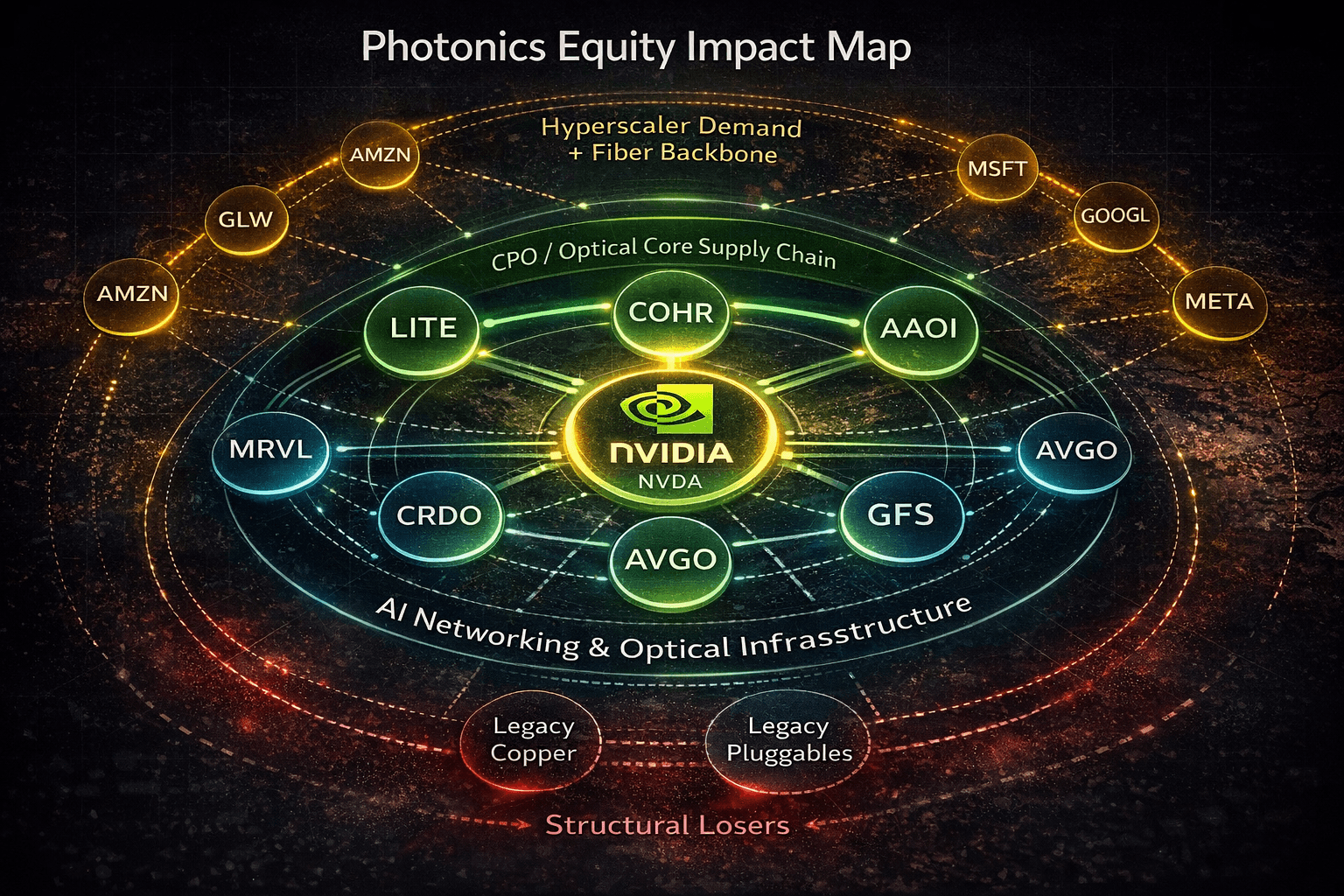
Platform Architects — Nvidia (NVDA) and Broadcom (AVGO): This layer is the ecosystem coordinator. Nvidia is driving CPO integration; Broadcom, with Tomahawk 6 and CPO-based switch ASICs, remains the dominant player in AI cluster switching. The economic logic is straightforward: whoever defines the system defines the supply chain. Nvidia's $4 billion investment in Lumentum and Coherent must be read through this lens — this is not a financial investment but a strategic supply chain lock: multi-year purchase commitments and capacity access rights extending to 2030. Long-term, the highest economic rent will accumulate in this layer, but that accumulation requires the layers below to first lose their independence.
Optical Components — Lumentum (LITE), Coherent (COHR), Applied Optoelectronics (AAOI): This is the layer with the strongest pricing power right now. The physical heart of CPO lives here: EML lasers, transceiver modules, optical chiplets. And the critical input material for these components — InP (Indium Phosphide) — is acutely supply-constrained. The demand-supply gap is approximately 70%; China placed InP on its export control list in February 2025. Nvidia's $4 billion commitment is largely motivated by this: just as it secured CoWoS (advanced packaging) capacity early in 2022–23, it is now locking in InP laser capacity before the constraint deepens. Near-term value accumulation in this layer is strong; however, valuations may already be pricing that accumulation aggressively.
Connectivity ICs — Marvell (MRVL), Credo (CRDO), Broadcom (AVGO): Optical DSP and retimer ICs form the electronic brain layer of the optical transition. Every phase of the shift from pluggable modules to CPO makes this layer more critical, because the logic that converts optical signals to electrical and back resides here. Marvell's December 2025 acquisition of Celestial AI for $3.25 billion (plus up to $5.5 billion in milestone payments) is precisely a bet on this layer: the Photonic Fabric technology aims to push scale-up optical I/O to terabit per second scale. Credo's Bluebird DSP delivers 1.6T capacity operating below 20 watts — given how important energy efficiency has become, this is a meaningful competitive advantage. This layer becomes critical in the medium term.
Foundries — TSMC (TSM), GlobalFoundries (GFS): TSMC's COUPE (Compact Universal Photonic Engine) platform combines EIC and PIC chips in the same package using copper-to-copper bonding. TSMC filed 50 US patents in silicon photonics in 2024 — nearly double Intel's 26. GlobalFoundries doubled its silicon photonics revenue in 2025, crossing $200 million, with a target of $1 billion run rate by 2028. These foundries hold both production capacity and know-how advantages in a strategically critical position.
Materials and Infrastructure — Corning (GLW), AXT Inc. (AXTI), Sumitomo (SMTOY): The least discussed layer, but potentially the one with the highest scarcity premium in certain sub-segments. Corning signed a $6 billion long-term optical fiber agreement with Meta in January 2026; Q1 2026 guidance came in above expectations; the stock gained 84% in 2025. AXT's Indium Phosphide wafer business has become strategically elevated by InP supply constraints. AXT must obtain Chinese government approval for every international shipment — an operational risk for both AXT and its customers
Company-by-Company Impact Map
Having traced the value chain layer by layer, each company must be examined individually. This section is not a flat list — for each name, the mechanism, time horizon, and thesis break point are considered together.
Lumentum (LITE): Nvidia's primary supplier of EML lasers and CPO modules. The $2 billion Nvidia investment extended the order book to 2028. J.P. Morgan raised its price target from $565 to $950; Bank of America targets $775. The stock returned 1,507% over 12 months, up 123% YTD in 2026. When does the thesis break? CPO mass production delays, InP supply constraints limiting Lumentum's own output, or the Nvidia agreement's scope falling short of expectations.
Coherent (COHR): Positioned across lasers, optical networking, and 800G/1.6T transceivers. Received $2 billion from Nvidia; five new CPO product families are in development for Nvidia systems. EPS growth projected at 55.9%. Returned 458% over 12 months, up 67% YTD. Momentum held despite a Bain Capital block sale. Risk: Bain Capital's remaining position exiting early, valuation compression, CPO timing delay.
Applied Optoelectronics (AAOI): Positioned in 800G and 1.6T transceivers with InP vertical integration — both chip and module production under one roof. This vertical structure provides both cost advantages and supply chain flexibility. Up 282% YTD in 2026. But note: AAOI fell 13.26% in a single session during the March 2026 tariff scare. Exposure to Taiwan and Chinese supply chains is notable here.
Corning (GLW): The "pipe" layer of optical fiber infrastructure. The $6 billion Meta agreement validated market confidence. Gained 84% in 2025; Q1 2026 guidance came in above consensus. Risk: Corning's story is directly tied to data center fiber density; if hyperscaler capex slows, demand softens relatively quickly.
Marvell (MRVL): The Celestial AI acquisition was a large bet on scale-up optical I/O. Positioned as a strategic supplier to Amazon and other hyperscalers. Near-term integration costs and tariff pressure weigh on the stock; but 2027–2030 is when Celestial AI's value capture is expected to materialize. Thesis break: Celestial AI technology missing expected scale or timing.
Credo (CRDO): Positioned in active electrical cable (AEC), retimers, and 1.6T optical DSP (Bluebird). Microsoft and Amazon are primary customers. Bluebird's sub-20W operation creates competitive differentiation. Revenue growth is strong. Risk: large customer concentration — a single customer decision can materially move the revenue model.
Broadcom (AVGO): Present in both switching and optical layers through Tomahawk 6 switch ASIC and CPO integration. Third-generation CPO solution TH6-Davidsson reinforces its dominant position in hyperscaler custom chip production. An OpenAI multi-billion dollar deal further consolidated this. Broad portfolio diversifies risk; not a "pure play photonics" name but value-add is high.
Ciena (CIEN): Benefits from long-haul AI network traffic growth with its WL6e 1.6T coherent optical solution. Launched AI networking products at OFC 2026. AI data center growth structurally increases long-haul WDM demand. Medium-term positive; near-term pressure may come from telco slowness in long-haul networks.
Arista (ANET): Benefits from AI cluster network layer growth via its strong data center switching position. Announced AI networking products at OFC 2026. However, Arista is not a direct photonics player; this is more of an "AI networking infrastructure" play. Its photonics exposure is indirect.
GlobalFoundries (GFS): Generating value in silicon photonics foundry services. SiPho revenue crossed $200 million in 2025, doubling year-over-year. 2028 target: $1 billion run rate. Competition with TSMC COUPE continues; but GFS's focus differs — broader market segments and mixed-signal SiPho. Thesis break: TSMC scaling SiPho capacity too quickly and squeezing GFS on margins.
Nvidia (NVDA): Both winner and dependent on this trend — simultaneously. The GPU business doesn't need detail here; but the Spectrum-X and Quantum-X switch families carry Nvidia's "full-stack AI factory" vision into the optical layer via CPO architecture. The $4 billion Lumentum + Coherent commitment mirrors the logic of locking TSMC's CoWoS capacity early in 2022–23: securing control over raw materials and production capacity. Thesis break: Nvidia's own CPO systems reaching market ahead of competitors while leveraging InP scarcity advantageously.
Hyperscalers — Amazon, Google, Meta, Microsoft: This group benefits from photonics differently. Building more efficient AI infrastructure — lower energy cost, higher GPU utilization rates, larger viable cluster sizes — improves the economics of their AI products. Meta's $6 billion fiber deal with Corning and Microsoft's development of its own MOSAIC optical link project are concrete expressions of this logic. For hyperscaler stocks, however, photonics is a secondary factor; the primary valuation driver is AI revenue growth.
Risk-exposed areas: Copper cable manufacturers in data center DC segments are systematically losing ground to optical fiber in scale-out, and that loss will deepen through the 2030s. Legacy pluggable module manufacturers at the low-price end face a shrinking market as CPO grows — the transition won't complete until 2030, but the direction is unambiguous.
Has the Photonics Trade Started?
The numbers speak directly: Lumentum up 1,507% over 12 months, Coherent up 458%, Applied Optoelectronics up 282% YTD, Corning up 84% in 2025. These returns left the S&P 500 behind by hundreds of basis points. The Silicon Photonics market stood at $2.62 billion in 2025; the AI-driven datacom optical component market crossed $16 billion the same year; 800G transceiver shipments grew 100% year-over-year.
The trade has started. The issue is how far it has already traveled.
On the day Nvidia announced its $4 billion photonics investment — March 2, 2026 — Lumentum jumped 12% and Coherent 15%. Markets read this correctly as a strategic supply chain lock rather than a financial investment: multi-year purchase commitments and capacity access rights extending to 2030. Bank of America set $290 for Coherent and $775 for Lumentum. J.P. Morgan lifted its Lumentum target from $565 to $950. But these analysts are assigning price targets to stocks trading at 250–300x P/E — at these levels, any small growth disappointment can produce severe value destruction.
The sector-wide selloff on March 30, 2026 made this fragility concrete. When news emerged that the Trump administration faced a deadline to prepare semiconductor tariff negotiations by April 14, the entire photonics sector sold off hard: AAOI fell 13.26%, COHR 9.79%, LITE 6.82% in a single session. The asymmetry is telling: these stocks price in good news gradually and price in bad news instantaneously. This is the characteristic behavior of richly valued narrative stocks. Companies with Taiwan and China supply chain dependencies took disproportionate damage; those with US-based manufacturing expansion plans (Lumentum's new fab, Coherent's US capacity growth) get partial insulation.
The technology is real. The valuation is debatable. That distinction must be maintained with discipline.
The Direct Link to AI
The mechanism connecting photonics demand to AI growth is direct and structural.
On the training side: as large language models scale in parameter count, the number of GPUs required for training scales exponentially. Larger clusters require stronger network infrastructure. InfiniBand NDR (400G) is this year's standard; XDR (800G), targeting 2026, is in development; 1.6T fabric is the 2027–2028 goal. Each generational transition produces a demand wave for new optical components.
On the inference side: models like GPT-4o operate with 256,000-token context lengths, requiring constant high-bandwidth KV cache feeding. Vision and diffusion models require multi-GB data flows. Inference servers are increasingly running optical fabrics — this segment differs from training but is no less important.
The relationship between hyperscaler capex and optical component demand can be quantified: roughly 8–12% of hyperscaler spending goes to network infrastructure, optical components included. For 2026: Amazon is planning $200 billion in capex, Alphabet $175–185 billion, Meta $115–135 billion, Microsoft $110–120 billion. The total for these four approaches $630 billion. A 10% allocation to network infrastructure alone implies $63 billion; a meaningful share of that flows into optical components. Epoch AI estimates that hyperscaler capex has grown 4x since the GPT-4 launch.
Is This Really a Supercycle?
The evidence supporting the supercycle thesis is substantial. The datacom optical component market grew more than 60% in 2025. GlobalFoundries' silicon photonics revenue doubled. Lumentum's order book extended to 2028 — a backlog that far exceeds normal semiconductor cycle lengths. Corning signed a $6 billion long-term fiber agreement with Meta. Nvidia made multi-year purchase commitments extending to 2030. 100 million pluggable module shipments are expected in 2026. All of this points to a structural growth period rather than a cyclical bounce.
But a dissenting voice must be raised here.
At the end of 2022 and into 2023, major hyperscalers cut capex. The growth deceleration across AWS, Google Cloud, and Azure directly hit optical component companies; optical stocks suffered meaningful losses in that period. The supercycle narrative always carries the risk of cyclical overshoot. Economic slowdown, AI revenue growth below expectations, or a geopolitical shock could alter hyperscaler capex plans. LightCounting is direct: a slowdown signal from a single large customer immediately propagates through the entire optical demand chain.
The difference between "supercycle" and "cyclical overshoot" is this: in a supercycle, every pullback finds a structural floor and demand resumes from there. In cyclical overshoot, after the excess is corrected, a new normal is established and prior peak levels are not revisited. The physical arguments we have for photonics support the supercycle thesis — but the pricing structure may already have accounted for it.
Counter-Narratives and Risks
A single-directional bullish reading of photonics stocks requires ignoring the following.
Technology maturation risk: CPO mass production still points to 2027–2028. A more critical issue: when an optical chip in a CPO module exhibits loss, it can only be detected post-bonding — meaning the entire module must be scrapped. This yield challenge both increases production cost and extends ramp timelines. Reliability concerns remain unresolved; hyperscalers will require proof of reliability before deploying CPO in critical infrastructure.
InP supply risk: The most concrete and most urgent risk component. China placed Indium Phosphide on its export control list in February 2025. Indium costs rose 32% from January to March 2026. The demand-supply gap stands at approximately 70%; global InP wafer production is concentrated in two or three companies including AXT and Sumitomo. AXT currently requires Chinese government approval for every international shipment — an operational risk for both AXT and its customers. This is exactly what motivates Nvidia's $4 billion commitment: a capacity locking strategy to pre-neutralize competitive pressure from supply scarcity.
Valuation and hype risk: Lumentum and Coherent are trading at 250–300x P/E. Capital Economics notes the AI sector is displaying "dotcom-like characteristics." Deutsche Bank's survey found 57% of respondents consider the AI bubble the biggest risk of 2026. These valuation levels leave no tolerance for growth disappointment; a six-month slip in CPO timeline alone could produce significant price pressure.
Tariff and geopolitical risk: The March 30, 2026 scenario is repeatable and could be more severe. Manufacturing dependencies in Taiwan, China, and Japan are fragile under US-China technology decoupling pressure. If the US imposes additional tariffs on Chinese-sourced InP, material costs and supply chains transform dramatically on both sides.
Adoption slowdown risk: Hyperscaler capex plans are externally communicated figures; actual spending can surprise. Major cloud companies materially revised their guidance in 2022–23. A macroeconomic contraction or AI revenues failing to meet expectations could replay this scenario.
Alternative technology risk: Research continues on reducing silicon photonics' dependence on InP lasers. Radio-based short-range connection solutions could create niche competition. MIT's December 2024 integrated photonic processor demonstration could affect compute architecture more fundamentally over the long term.
The aggregate of these risks establishes this: technology may be necessary, but not every stock is a well-priced expression of that necessity.
Narrative Analysis
This section tests six major narratives circulating in the market against data and structured reasoning.
"Is networking really the post-GPU bottleneck?" — Partially true, but with nuance. GPU-internal HBM3E bandwidth remains the primary single-chip constraint. But at 4,000+ GPU clusters, east-west network traffic becomes the second largest bottleneck. Compute scales 4x per generation; I/O scales 1.5x. That asymmetry will convert networking to the primary constraint by 2026–2027. The network is not the bottleneck today — it will be very soon.
"Can AI scaling physically occur without photonics?" — Beyond a certain scale: no. Copper falls below one meter at 224 Gbps per lane. Nvidia's Rubin architecture will require terabit-scale GPU-to-GPU bandwidth. Carrying that traffic on copper is physically impossible under known physics. This is not a technology preference — it is a physics constraint.
"Where does value accumulate: lasers, connectivity, or system architects?" — The answer changes with the time horizon. Near term (2025–27): Lasers — InP scarcity creates pricing power and supply reserves are valuable. Medium term (2027–30): Connectivity ICs — the optical DSP layer becomes the connective brain at every scale, and margins will concentrate here. Long term (2030+): Platform architects — Nvidia and Broadcom, defining the ecosystem, will capture the highest margins through ecosystem control.
"Is Nvidia a winner or a dependent in this trend?" — Both simultaneously, but in a managed way. Without Nvidia's GPUs, photonics would not be seeing demand at this pace — winner. But Nvidia's next-generation switch and networking products depend on InP lasers — dependent. The $4 billion investment is not about eliminating that dependency; it is about managing it. The CoWoS analogy is perfect here: Nvidia secured CoWoS capacity early in 2022 and gained a production advantage over competitors; the same game is being played now with InP laser capacity.
"When does photonics reach mass scale adoption?" — A clear roadmap is emerging. In 2025: 800G pluggable went mainstream; Nvidia's first CPO switches deployed. 2026–27: CPO volume deployment begins; 1.6T becomes standard. 2028–29: Scale-up optical proliferates; first 3.2T deployments appear. Post-2030: Per SemiEngineering consensus, all high-bandwidth AI data center connections become optical.
"Is this a 5–10 year mega-trend or a short-term trade?" — Both, in different time frames. In 2025–26: the trade is active, returns are striking, valuations are rich. In 2027–28: stocks will diverge based on CPO transition cadence; this period will produce high volatility. Post-2030: the structural mega-trend will be definitively established. For investors: being in these stocks while being unable to tolerate near-term volatility is an incorrect position — even if the technology thesis is correctly understood.
Final Synthesis
Three questions demand direct answers.
How technically strong is the photonics thesis? Exceptionally strong. The physics are uncontested: copper drops below one meter at 224 Gbps per lane. AI clusters require terabit-scale bandwidth. There is no alternative to optics. Microsoft Research's MOSAIC project, SemiEngineering's five-year consensus, and technical publications from Nvidia and Cisco all point the same direction. There is no uncertainty about technological necessity; uncertainty lies in timing and valuation.
What is the market pricing correctly today, and what is it overpricing? The market is correctly pricing the existence of structural demand — LITE's and COHR's 12-month performances are the proof. Corning's Meta deal, GFS's SiPho growth, and Credo's momentum are also correctly priced narratives. But the market is likely overpricing the timeline for CPO mass production, the speed of InP supply resolution, and the valuation tolerance band. Stocks trading at 250–300x P/E are completely exposed to any form of delay or disappointment.
Where is the most asymmetric opportunity for investors? Near-term, the connectivity IC layer (Credo, Marvell) — whose valuations have not yet risen as far as laser company valuations — is notable; optical DSP demand is as direct as laser demand but not yet priced as such. Medium-term, foundry players expanding US-based manufacturing capacity (GFS) and with InP supply chain control are interesting. Long-term, ecosystem control will inevitably flow to platform architects (Nvidia, Broadcom); but much of that value is already partially priced in.
A final return to the core tension is necessary. Photonics is not hype — it is real. The laws of physics impose this conclusion. Nvidia's $4 billion commitment, Marvell's $3.25 billion Celestial AI move, and Corning's $6 billion Meta contract make it concrete in numbers. But pricing has meaningfully pulled tomorrow's value into today. Lumentum's 1,507% 12-month return is not sufficient reason to conflate the reality of the technology with the correctness of the investment thesis — on the contrary, it is a strong warning signal to keep those two things rigorously separate. The stocks that comprise this sector are trading on a different valuation cycle than the technology cycle itself. How the gap between those two cycles closes — through gradual growth realization or a volatile correction — will determine the real test of the photonics investment thesis.


